Showing posts with label Merida. Show all posts

Sunday, July 23, 2017

Brompton M6R: Pentaclip Design and Saddle Change

The Brompton comes with its special saddle clamp, which is designed to shift the saddle position forward. This is to keep the folded package small, by tucking as much of the saddle as possible within the frame dimensions. Also, when the saddle is pushed all the way forward, it places it in the correct position for efficient pedaling. This is different from full sized bikes where there is usually a rear offset on the saddle clamp.

As much as I tried to like the Brompton stock saddle, I could not get comfortable on it. The saddle has a concave shape that makes it hard for me to find a good position on the saddle and maintain that position. Therefore, I decided to change the saddle to one that is more comfortable for me.

Stock Brompton saddle

Since I have spare saddles lying around, I looked to see if there is a suitable saddle. The stock saddle from the Merida Scultura 5000 is actually quite comfortable, and I changed it out only because it was heavy. Also, the colour matches the Lagoon Blue Brompton quite well!

Blue saddle from the Merida matches the Brompton quite closely! Not 100%, but close enough to look matching.

First, I have to remove the stock Brompton saddle from the saddle clamp.

The saddle clamp on the Brompton is called Pentaclip, and it is rather unique that I have not seen other brands use this design before. As shown below, it is made up of so many parts that it can be rather confusing to put everything back properly.

One side of the clamp disassembled. Made up of multiple copper washers and steel washers. Too many parts I feel...

The advantage of this Pentaclip is that it offers infinite angle adjustment, without any discrete steps of most other saddle clamps. I just wonder if they could have designed it so that it does not have so many separate parts...

Upon removing the Brompton saddle, I found a M5 threaded hole that can be useful for mounting a rear light. There are also two loops at the side for saddle bag straps.

Merida saddle installed! Flat top profile is what I prefer over the concave profile of the Brompton saddle.

Blue colour looks quite matching. Pushed all the way to the front for correct positioning and also compact folding.

From this picture, you can see why a saddle that is pushed all the way forward will make the whole folded package more compact.

This is a free upgrade since I am just using a spare part that I have lying around. Makes the ride more comfortable and also looks better in terms of colour matching. Many more upgrades to come!

Wednesday, June 21, 2017

Java Freccia Carbon Mini Velo: Part 7 - Dura-Ace 9000 Groupset

The Java Freccia carbon mini velo is almost completed! All that is left to do is to fine tune the adjustments and it is ready to go.

Java Freccia carbon mini velo, built up with Dura-Ace 9000 components

Looks great!

During my test ride, I found that the riding geometry is really low and aggressive, due to the low handlebar height. In fact, after comparison, the handlebar height is even lower than the Merida Scultura 5000 road bike! It is too low for comfort, which is why I decided to flip the stem to make it more comfortable.

Handlebar height on the Java mini velo is even lower than the Merida road bike

Controltech 80mm stem was originally installed with a downward tilt

After flipping the stem to be upward tilting, the geometry is better and almost the same as the Merida road bike

Another view of the full bike with the geometry properly set up

Full bike weight is only 6.7 kg inclusive of pedals!

Full specifications of the bike. I did not use any boutique super lightweight components, all can be found easily. Theoretical weight is equal to actual measured weight. Only 6.3 kg without pedals!

Completed bike spotted in the wild

Using the Ridea brake pad extenders with Ridea brake pads

Same for the rear wheel. Braking power is better than expected.

Java Freccia carbon mini velo project completed!

Yet another bike building project has been completed, and I am very pleased with the results. This mini velo is very lightweight at only 6.3 kg without pedals. Also, it rides really well, despite the short chain stays. Braking power using the Ridea brake pads is actually quite good, and I don't miss the SwissStop brake pads. Shifting performance with the Dura-Ace groupset is of course top class, while the Wheelsport Smart 1.0 451 wheels roll really well.

Despite my initial worries, there has been no creaking sounds from the press fit bottom bracket, while the integrated seatpost clamp has not given me any problems with slippage. Other than the insufficient reach from the road brake calipers and the slightly tricky internal cable routing, there has not been any real issues with the installation.

I have tested it while riding with some road bikes, and this mini velo actually feels just as fast as my Merida road bike! The weight difference is felt most during climbing, where this bike just keeps moving instead of dragging you back like on some heavier bikes. Carrying the bike up the stairs or anywhere is a breeze due to the low weight. It is currently my favourite bike to ride as I have rediscovered the joy and fun of riding a mini velo!

 Riding the Java Freccia mini velo by the sea

Thursday, May 25, 2017

Java Freccia Carbon Mini Velo: Part 3 - Frame Geometry Comparison

As with any frame, the geometry is important as it affects how the bike rides and also the handling. Since I have the Java Freccia bare frame, it is a good idea to compare it with the other bikes to see the differences in geometry. The weight of the frameset components had already been checked previously.

Java Freccia carbon mini velo frameset

Overlaying the new Java frame onto the Wheelsport mini velo for comparison

I tried to line up both the front and rear axles, but the bottom bracket does not line up. The geometry seems to be quite different...

Different top tube design, although the horizontal top tube length seems to be similar

Bottom bracket for the Java frame seems to be higher up

Front axle lined up nicely, acting as a datum for comparison

Rear axle of Java frame does not match up nicely, suggesting a shorter chain stay length

Seat tube angle and location seems to be similar

Head tube of the Java frame is much higher, which should translate into more stiffness at the front end since the exposed length of the steerer tube is shorter.

Steerer tube of the Java fork ends about 40mm below that of the Wheelsport fork, which means a more aggressive riding geometry.

That concludes the frame comparison with the Wheelsport mini velo. With a shorter steerer tube, it will mean a lower handlebar height for the Java Freccia mini velo and thus a more aggressive riding posture.

Next, I also compared the frame with the Merida Scultura 5000 road bike.

Just to double check: The Wheelsport handlebar is quite a bit higher than the Merida handlebar. The Java handlebar height should thus end up pretty close to that of the Merida road bike.

Overlaying the Java Freccia frame onto the Merida Scultura 5000 road bike, using the bottom bracket area as the datum.

Top tube height is obviously lower on the mini velo frame

Steerer tube height is about the same as that of the Merida road bike. This means that the handlebar height of the Java should be close to that of the Merida.

After doing more research, I finally found some details of the Java Freccia frame dimensions. What stood out for me was the chain stay length, which is short at only 380mm! This is quite a bit shorter than the 405mm on the Merida and the 420mm on the Wheelsport.

Frame dimensions of the Java Freccia frame

The major findings from this frame comparison is the difference in head tube length with the Wheelsport frame, and also the short chain stay length. A short chain stay length usually means a more agile but also less stable ride. Nevertheless, all these numbers should only be used as a reference, as the ride quality and characteristics ultimately depends on riding the actual bike. It may or may not have a big effect on the ride at all.

Wednesday, May 3, 2017

Avanti Inc 3: Installation of 60mm FSA Stem

After completing the modification of the Avanti Inc 3 to have a narrower Q factor, it seemed that the geometry had been dialed in already. However, even after using a road crankset with road drop bars, something still did not feel right.

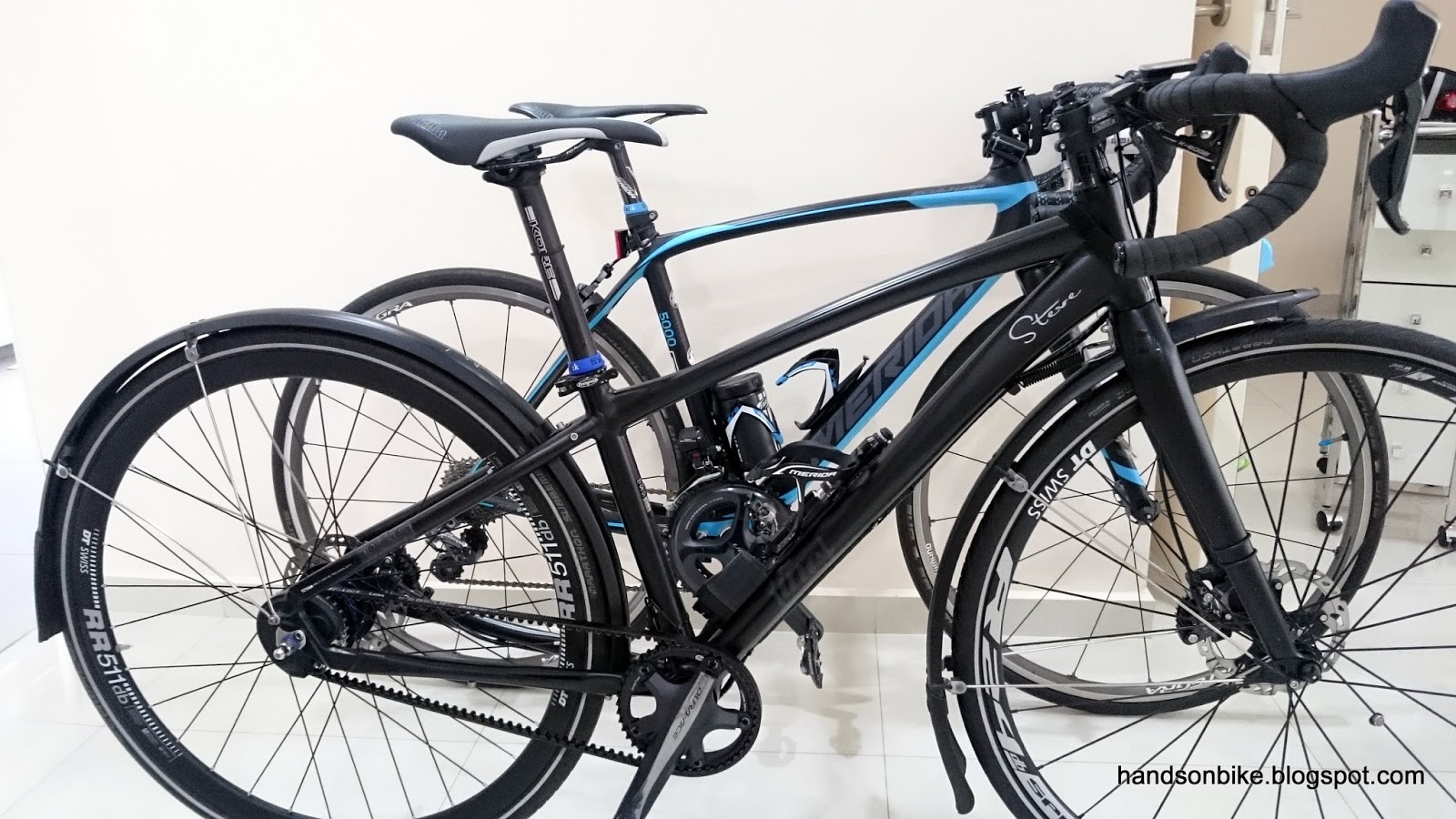
I found that while riding, the reach on the Avanti Inc 3 seemed longer than the Merida Scultura 5000 road bike. When holding the shifters, I felt that I had to reach further than what I am comfortable with. This is not my intention as the road bike should have the most aggressive posture out of all my bikes, since it is the fastest bike that I have.

During the previous modification to change to Alfine 11 Di2 with a drop bar setup, I used a shorter 80mm stem to compensate for the longer top tube of the Avanti Inc 3 frame. To double check my previous measurements, I measured from the saddle (area where the sit bones contact the saddle) to the centre of the handlebar.

Distance on Merida road bike is about 665mm.

Distance on Avanti Inc 3 is about 668mm.

The distance from saddle to handlebar is almost the same. Both the bikes are using a compact drop bar from FSA, which means a 80mm reach on the drop bar itself. Therefore, the different reach is not from these areas. Finally, I realised that the bracket on the shifters might be different in length.

Ultegra Di2 6770 road shifters, gripping distance is about 100mm from centre of handlebar.

ST-RS785 shifters, with a gripping distance of about 120mm from centre of handlebar.

Finally, I realised that the bracket length on the shifters are different in length, which means a different reach distance. On the Avanti Inc 3, the road hydraulic disc brake shifters ST-RS785 has a bracket that is about 20mm longer, which is probably to fit in all the hydraulic components.

This extra 20mm of reach is the difference that I feel when riding the bikes. As I ride all my bikes often, I am able to feel any subtle geometry differences.

It is easy to fix this, as I can just change to a shorter stem. There is no worry of a shorter stem making the steering less stable, as the longer shifter bracket makes up for it. As long as the overall distance from the steerer tube to the gripping area on the shifters are the same, it should feel the same.

Simple FSA stem with a 60mm reach

+/- 6 degrees of tilt, depending on which way you fix the stem

Weighs 115 grams for this 60mm length. If it was a more expensive stem, it will weigh less, probably 100 grams.

Comparing the difference in stem length. 60mm in front, 80mm behind. See how much difference it makes to the handlebar position.

New FSA 60mm stem installed! Short stem indeed.

Now the handlebar reach and height is the same as on the Merida road bike!

With this modification, both bikes will ride more similarly as the geometry is now almost the same.

The Avanti Inc 3 can now be classified as an all-weather commuting road bike

Some rearrangement of the accessories is required, due to the shorter stem. Looks rather cluttered, think it needs more work.

View of the full bike. Handlebar area looks a bit cramped due to the short 60mm stem, but it rides really nicely.

With this change of stem length, the geometry has been nicely adjusted and feels perfect. After testing the bike on a half round island ride, passing through Mandai road, I was pleased to find that the gear range is perfect. The highest gear was just sufficient for continued pedaling even when rolling down the Mandai slopes at close to 50km/h. The lowest gear has not been used yet, but it will definitely come in useful if I need to go up steeper slopes such as in NTU or Mount Faber.