Showing posts with label Wolftooth. Show all posts

Saturday, October 22, 2022

Fnhon DB12: Dura-Ace R9100 Crankarms and PRO Stealth Saddle

A few months ago, before I converted the Focus Paralane from a 1x11 speed to 2x11 speed road bike, I had the Dura-Ace R9100 crankset available and not in use on any of my bikes. This is the original R9100 crankset that I had on the Canyon Endurace, since year 2017.

Therefore, I decided to put this Dura-Ace crankset on the Fnhon DB12, because it is black and matches the frame well. Prior to this, an Ultegra 6800 crankset was in use.

Dura-Ace R9100 crankset with the Wolf Tooth 44T chain ring for AXS 12 speed chain.

Looking good with my signature 4 colour chain ring bolts!

Saturday, March 26, 2022

Wolf Tooth vs ZTTO Portable Chain Link Tool

I recently came across this ZTTO Portable Chain Link tool, which looks almost the same as the original Wolf Tooth Pack Pliers. Check out this link for the original article that describes this tool in detail.

As the ZTTO chain link tool is only 1/5 the cost of the original Wolf Tooth version, I decided to get one for my other bikes, and compare it with the original version.

At first glance, they look the same!

The aluminium centre bolt is available in many colours.

Here is the first difference. The Wolf Tooth version has a bolt and nut to tighten the two arms together, while the ZTTO version has a threaded hole on one arm, for the aluminium bolt to thread into.

Tip profile for opening or closing quick links look similar.

At the other end, the tire lever shape and Y-shaped slot for Presta valve cores are the same design.

The internal slots and magnet for storing extra quick links are the same as well, with the capacity to store 2 pairs of quick links.

View from the back, looks the same.

Side profiles look the same as well.

In summary, the ZTTO chain link tool only differs in the middle area, where the fastening method is different. Otherwise, functionally and appearance wise they are the same. Of course, we can see that the ZTTO version is a blatant copy of the Wolf Tooth version. However, at 1/5 the cost, the ZTTO version is a much more affordable version.

Thursday, January 13, 2022

Fnhon DB12: Wolf Tooth Chain Ring for AXS 12 Speed Chain

For this new 1x12 speed drivetrain on the Fnhon folding bike, a new chain ring is required, because of the new Flattop chain used. As shown in detail in the chain comparison post, the Flattop chain has larger rollers, which do not fit onto existing chain rings.

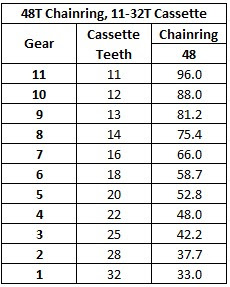
Since I am getting a new chain ring, this is a good chance to adjust the gear ratios that I want. Previously I was using the 48T Wolf Tooth chain ring together with a 11-32T cassette. The gear ratio was a bit too high for my usage, but I did not change the chain ring then, as it was not critical. The lowest gear of 33 gear inches is not quite low enough for steeper slopes.

Previous gear ratios on the 11 speed drivetrain, with 48T chain ring and 11-32T cassette.

I would have preferred to shift the gear range down a bit, as I rarely use the highest gear of 96 gear inches. In fact, even on my Focus Paralane road bike, with a similar top gear of 98 gear inches, this top gear is hardly used except when going downslope.

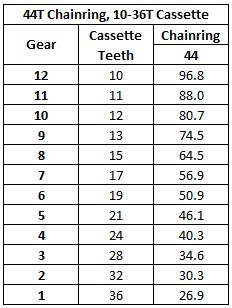
This time, I decided to get a new 44T chain ring, to go with the new Force 10-36T cassette.

44T chain ring with 10-36T cassette, on 451 wheels.

Actually I could have used an even smaller chain ring, as the highest gear of front 44T and rear 10T is 96 gear inches, almost the same as the previous front 48T and rear 11T gearing.

What is wonderful about this new 10-36T 12 speed cassette is that the gear range is much wider (360%) vs the 11-32T 11 speed cassette (290%). As such, I can afford to keep the highest gear the same, but gain 2 more lower gears as seen above.

New 44T Wolf Tooth chain ring!

Drop Stop B teeth profile is compatible with Flattop chains. This chain ring can be installed on Shimano 4 arm road cranksets, with 110 mm BCD.

44T chain ring on the left is noticeably smaller than the 48T chain ring on the right.

The Drop Stop B teeth profile replaces the older Drop Stop profile.

The new chain rings come with an additional cutout, to match with newer Shimano crank arms. Older chain rings don't have this cutout, so I needed to cut it manually.

Previously it was patent pending, now the patent has been granted.

44T chain ring is 81 grams.

Old 48T chain ring is 103 grams.

For a front single drivetrain, it is important to set the gear range properly, so that all the gears can realistically be used. During climbing, the low gears should be low enough. During sprinting or descending, the high gears should be high enough. There will be some compromises compared to a front double drivetrain, but generally a front single gives sufficient gear range for folding bikes.

One of the most common mistake people make when selecting their chain ring size, is to have a chain ring that is too big for their usage. Many use 52T, 54T, or even up to 60T. On a 451 wheel, these correspond to quite high gear ratios that are rarely used. However, they still use large chain rings, as they mistakenly believe that a large chain ring allow them to go faster without additional effort, without considering that you need strong legs to push high gears.

At the same time, these people struggle up slopes, as the large chain ring means that the low gear is not easy enough. Therefore, the chain ring size selection is very important, to ensure that you can maximize the gear usage across the whole cassette.

When I use my folding bikes, I mainly ride casually for leisure, so I don't need high gears for sprinting. On downslopes, if I run out of gears, I just let the bike roll freely. What is important is that I always have a sufficiently low gear for climbing, and this is done by choosing chain rings that are not too big.

Therefore, the 44T chain ring that I chose is carefully selected after calculations, to make sure that the top gear is not so high that I can't use it. More lower gears are always better for climbing!

Sunday, January 9, 2022

Shimano 11 Speed vs SRAM AXS 12 Speed: Chain and Chain Ring

For the modification of the Fnhon folding bike from 11 speed to 12 speed, I will be using the SRAM AXS drivetrain. One quirk of that drivetrain is the unique AXS Flattop 12 speed chain, which is not compatible to any other drivetrain.

Although SRAM does have its own 12 speed MTB drivetrain, it uses a different chain from the road/gravel 12 speed drivetrain. From what I understand, the Flattop chain has larger chain rollers, which means that it will not fit onto any of the existing chain rings or cassettes, which are matched to smaller rollers. In fact, roller size have not changed for a long time, even though the chains are getting narrower as we go to more speeds. For chains with 11 speed and below, they are mostly cross-compatible across manufacturers, even though performance may differ slightly.

Therefore, I had to get a new chain ring for this 12 speed conversion, even though I already have a few narrow wide chain rings available. I first used a Wolf Tooth narrow wide chain ring 5 years ago, and my most recent one was the cheaper Stone narrow wide chain ring.

I find both brands make good narrow wide chain rings, and both of them do make new narrow wide chain rings that are specifically stated to be compatible to the SRAM Flattop 12 speed chain. However, there was not a lot of good information on the Stone 12 speed chain ring, which was why I decided to get the Wolf Tooth 12 speed chain ring instead. Also, the Wolf Tooth version is apparently backward compatible to older chains as well.

In this post, I will do a comparison of the chain rings and chains, between 11 speed and 12 speed versions. Note that measurements will be off by a little bit, as the proper measurement tool to use would be a micrometer instead of a vernier caliper that I have.

Old 48T Drop Stop chain ring, vs the new 44T Drop Stop B chain ring.

Even with a side by side comparison, I couldn't really tell a difference in the teeth profile just by looking at it.

The new profile (in front) apparently has a deeper valley and a sharper tooth to match the 12 speed Flattop chain, which has larger rollers and a narrower inner width.

The narrow teeth on the new chain ring (right) has a sharper point than the older version.

Old tooth profile is around 4.64 mm from front to back.

New tooth profile is about 0.1 mm smaller. However, this measurement may not be accurate as there is no clear measurement datum on the tooth profile.

Thickness of older narrow tooth profile, 1.95 mm.

Thickness of new narrow tooth profile is noticeably thinner, at 1.7 mm. This is to match the new 12 speed chain with a narrower inner width.

Thickness of old profile wide tooth is 3.64 mm.

Thickness of new profile wide tooth is 3.34 mm. This also means lower tooth durability.

For the chain rings, all I can compare are the thicknesses of the narrow and wide tooth profiles. Comparing the old to new profile, the new profile has a 0.25 mm thinner narrow tooth profile, and a 0.3 mm thinner wide tooth profile. As it is thinner, it is compatible to older chains that are wider. However, it also means less chain stability as the chain has more space to move laterally on the chain ring teeth.

Next, let's compare the chains. The difference in chain dimensions is why a new chain ring was required.

SRAM Force AXS Flattop 12 speed chain, vs the Shimano Dura-Ace 11 speed chain. Comparison will be based on dimensions only, not other factors.

Putting the 11 speed chain on the old Wolf Tooth chain ring gives just a little bit of free play. Good for chain retention.

Putting the 11 speed chain on the new chain ring, with narrower teeth means there will be more free play. It is compatible, but chain retention ability might drop a bit.

In this case, the new chain ring is compatible to both older 9/10/11 speed and also the new 12 speed Flattop chain, as claimed by Wolf Tooth. It is NOT compatible to Shimano 12 speed chain.

However, the reverse is not true, as you can see below. The older chain ring is NOT compatible to the new 12 speed Flattop chain.

New 12 speed Flattop chain on the old chain ring. As the chain rollers are larger, they are not able to rest properly on the chain ring teeth. Completely incompatible.

12 speed Flattop chain on the new chain ring, fits perfectly as it should. This is why a new chain ring is needed for the Flattop chain.

Flattop chain rests nicely on the new chain ring. The chain link plates look really thin here!

Diameter of Shimano 11 speed chain roller is 7.65 mm, which is the same as almost every other chain.

Diameter of SRAM 12 speed Flattop chain roller is larger at 7.9 mm. This is why it does not fit properly onto existing chain rings or cassettes.

External width of Shimano 11 speed chain is 5.62 mm. This is the width that gets narrower with more speeds.

External width of SRAM 12 speed Flattop chain is even narrower, at just 5.05 mm!

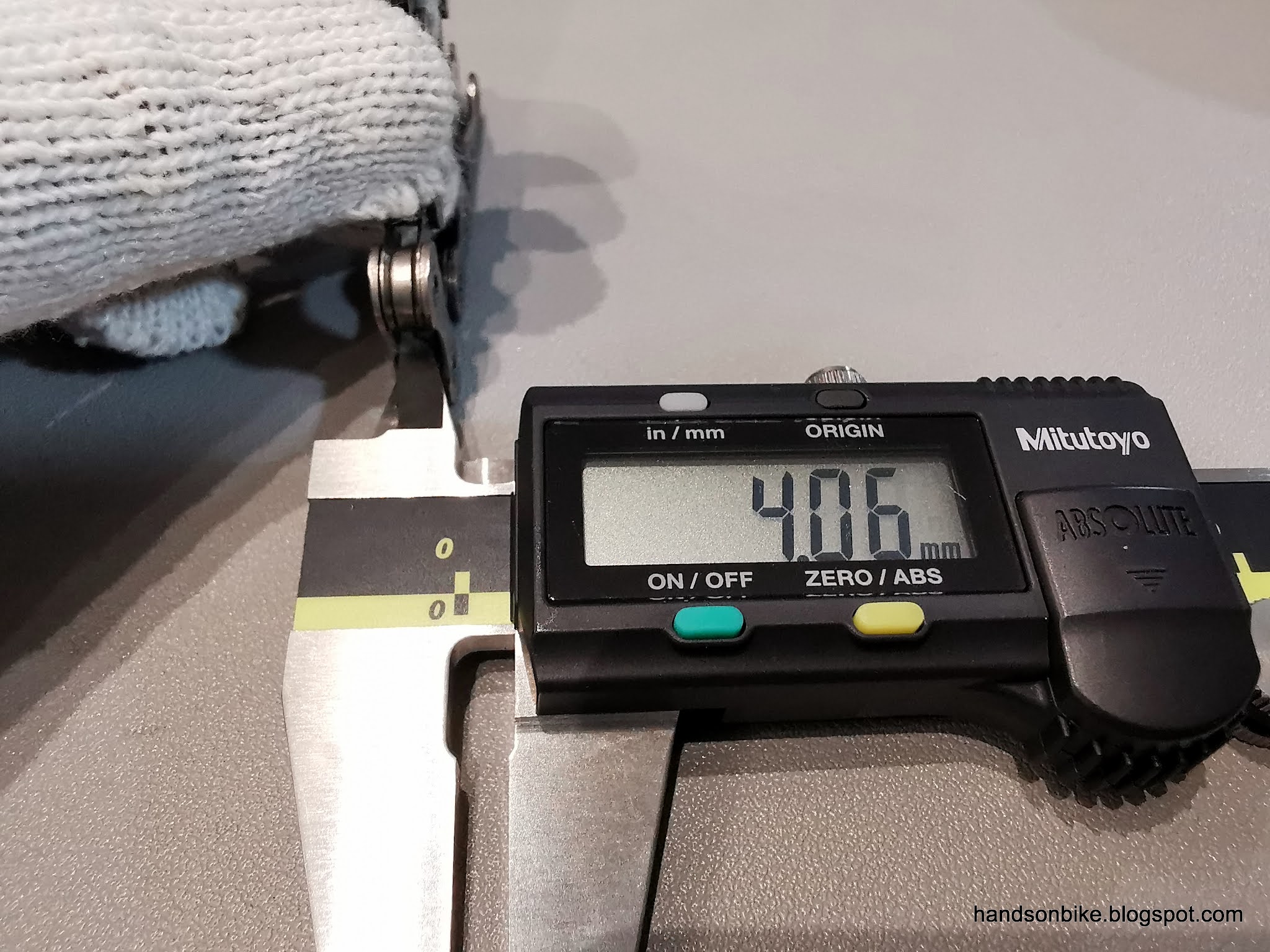
Internal width of Shimano 11 speed chain, between outer plates is 4.06 mm.

Internal width of SRAM 12 speed Flattop chain, between outer plates is 3.68 mm, almost 0.4 mm narrower. This does not really fit onto the old profile wide tooth which is 3.64 mm as shown earlier.

Internal width of Shimano 11 speed chain, between inner plates is 2.32 mm. This is the same across most multi-speed chains, from 9 to 11 speed.

Internal width of SRAM 12 speed Flattop chain is slightly narrower between inner plates, at 2.21 mm.

Thickness of Shimano 11 speed chain outer plate is 0.78 mm. The plate thickness decreases as the chain goes to more speeds.

Thickness of SRAM 12 speed Flattop chain outer plate is even thinner at 0.65 mm.

Thickness of Shimano 11 speed chain inner plate is 0.73 mm.

Thickness of SRAM 12 speed Flattop chain inner plate is really thin, at just 0.58 mm!

Comparison table

With a comparison table, all the chain dimensions can be seen clearly. Once again, note that these dimensions are based on my own measurements, in which there will be a small error. Also, there are manufacturing tolerances, so this is by no means a standard dimension.

Key Points:
1) Just a small 3.3% larger chain roller makes it completely incompatible to older chain rings, as the difference accumulates quickly across the chain links.
2) 12 speed Flattop inner chain width is reduced slightly, which necessitates narrower chain ring teeth as well.
3) Chain link plate thickness of the 12 speed Flattop chain is really thin, which is why they needed more material on the plates for strength, giving it the distinctive Flattop shape.
Side Note: The Campagnolo Ekar 13 speed chain is even narrower at 4.9 mm!

I think this is a pretty good comparison showing how different this new AXS 12 speed Flattop chain is, compared to other chains. There will be serious compatibility issues if you try to use this new chain on older chain rings or cassettes.

Now that the Shimano 12 speed road groupsets are available, there is an opportunity to mix and match components. However, the Shimano 12 speed chain (common use for road and MTB) is also unique, as it has longer inner plates with a large chamfer, which introduces other compatibility issues. I might have a chance to do some 12 speed cross-compatibility checking in the future, when I get my hands on some new 12 speed components.

Friday, September 17, 2021

Cervelo Aspero: Front Single Road and Gravel Drivetrain

From the first set up of the Cervelo Aspero, where I first used a 2x11 speed drivetrain for road and gravel riding, I have now changed to a dedicated 1x11 speed gravel drivetrain.

The Aspero is now a dedicated gravel bike, which is why I have changed some of the components to make it more suitable for gravel riding, instead of striking a balance previously between road and gravel usage.

Other than the drivetrain, I have also changed to the GRX Di2 shifters, which has ergonomics that are very well suited for gravel riding. The default wheelset is also the excellent Hunt 650B carbon wheelset, with WTB Venture 47 tires.

That said, if I want to, I can still swap it to a road wheelset, if I ever want to ride fast on the road with this Cervelo Aspero. This is because the Ascent Bikes Zenith Elite wheelset is using the Sunrace RX1 11-36T cassette, which is relatively similar in size to the SLX CS-M7000 11-42T cassette on the Hunt wheelset. Previously I have swapped between the 11-30T cassette and the 11-36T cassette, without adjusting the rear derailleur at all, so I think swapping between the 11-36T and 11-42T cassette is possible.

Default gravel wheelset on the left (Hunt 650B + Venture 47 tires + 11-42T cassette) and the road wheelset on the right (Zenith Elite + GP5000 tires + 11-36T cassette).

From the picture above, you can see that the external wheel diameters are similar. This post shows the size difference in detail. The Zenith Elite carbon wheelset is currently being used on the Focus Paralane, as my all-weather commuting road bike.

Road wheelset with 11-36T cassette installed on the Cervelo Aspero.

Distance between the largest 36T sprocket and the guide pulley is a little further, since the rear derailleur is set for a 42T large sprocket. However, shifting is still OK.

Looks good as a road bike too!

With a carbon road wheelset, this Aspero can be converted into a pretty fast bike as well. It is only limited by the small 38T chain ring, which is good for gravel riding but rather small for road riding.

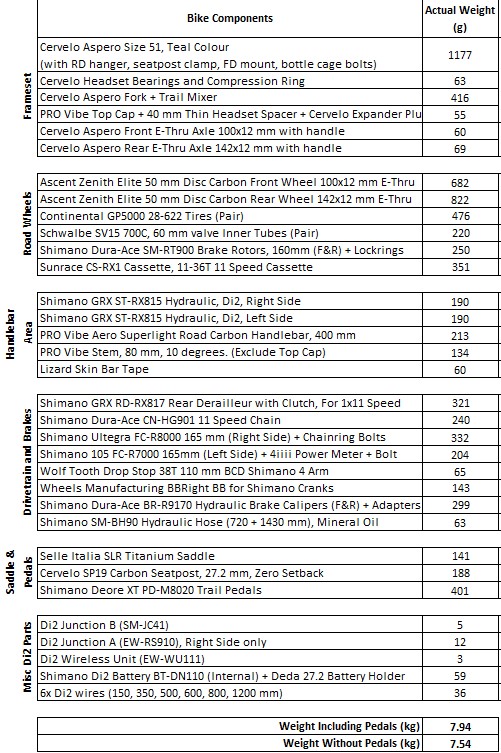
Full specifications of the Cervelo Aspero in road setup. Weighs about 7.5 kg without pedals.

As for the gravel setup, it will definitely be heavier, due to the heavier wheelset and larger cassette.

Installed the XTR RT-MT900 rotors onto the Hunt wheelset.


Full gravel setup

I think this setup is perfect for gravel riding!

The gravel setup weighs about 8.1 kg without pedals, with the additional 600 grams of weight coming from the wheelset.

Although it is possible for this Aspero to be set up as a road bike as shown above, it is not so likely that I will use it for road riding. I would just take the Focus Paralane instead, as it has more road specific components, such as a slightly larger chain ring and road shifters.

In any case, this Aspero is so versatile that it can be setup as a full road bike or full gravel bike, or anything in between.