Showing posts with label Aleoca. Show all posts

Saturday, December 10, 2011

Part 8: Cheap Bikes vs Premium Bikes: What is the Difference?

This is the final instalment of the bike comparison series! In the previous parts, we have already discussed and compared the other major components on the bicycle. The detailed analysis and comparisons can be found at the links below.

Cheap Bikes vs Premium Bikes: What is the Difference?

Today, we shall compare the rest of the components on the bike. Besides the major ones like the braking system or the drivetrain, we will take a closer look at the folding joints and some other miscellaneous stuff on the bike, which may seem insignificant but are actually rather important.

Folding Joints
For a folding bike that folds into half like the Aleoca Ready2Ride or the Dahon MuP8, there are a few main joints/mechanisms on the bike that enables folding.

1) Frame Joint
2) Handlepost Joint

By folding the frame into half and then folding down the handlepost, it will make the folded package rather compact. The seatpost is also lowered to be the third leg that stabilises the folded bike.

The main frame joint is very important here, as it is crucial to keeping the bike in one piece, and needs to be strong enough to prevent frame flex. Taking into account the rider's weight, and maybe some luggage, the frame joint needs to be large in order to hold the front and rear part of the frame together tightly.

Aleoca R2R Frame Joint: Quick Release Skewer
Dahon MuP8 Frame Joint: Dahon proprietary V-Clamp

Type of quick release skewer clamp found on the Aleoca R2R frame.

Frame clamp on Dahon MuP8. See how tall and big the metal clamp is!

The frame clamp when opened. Ingenious construction with precision machined components to ensure that the two halves fit together snugly.

From the pictures, it can be clearly seen that the huge frame joint of the Dahon MuP8 is much stronger than the frame joint on the Aleoca R2R. It is hard to explain the physics of the frame joint here in words, but to put it simply, the Aleoca R2R's quick release frame joint is definitely not ideal for taking on the heavy loads acting on the joint. This results in a flexible frame that will twist from side to side as you pedal hard.

On the other hand, the large metal clamp on the Dahon MuP8 has a much larger clamping area, and is also taller, which makes the two halves of the frame fit very tightly to each other, and helps to maintain the stiffness of the frame.

In my opinion, this frame joint is one of the main reasons why the MuP8's frame is much better than the Aleoca R2R's frame. Poor components can be upgraded, but you cannot change the frame, else you might as well change a new bike. The excellent frame joint is one of the reasons why the MuP8 is worth much more than the Aleoca R2R.

Aleoca R2R Handlepost Joint: Traditional folding handlepost joint
Dahon MuP8 Handlepost Joint: Radius Handlepost with V-Clamp

Handlepost joint on the Aleoca R2R. Also found on many other folding bikes, even the new Tern bikes. There is a hidden vertical metal rod that pushes the top half of the handlepost onto the bottom half.

Radius handlepost with V-clamp lever seen at the bottom.
Big stainless steel clamp that clamps the top and bottom half of the handlepost together. Similar construction to the frame clamp of the MuP8.

I used to think that the traditional handlepost clamp is inferior to the new V-clamp handlepost hinge used by Dahon, which is why Dahon has been phasing out the traditional handlepost clamp found on the older Dahon Eco 2/3 bikes. However, after Tern bikes began using this construction on their handleposts, I realised that the traditional handlepost clamp can also be very strong! This can be seen in the excellent handleposts made by Tern for their bicycles.

In any case, Tern has already improved greatly on the design of the traditional handlepost clamp. However, the older one found on the Aleoca R2R is not good enough to ensure sufficient stiffness in the handlepost. The main culprit here is the hinge on the handlepost. The hinge that links the two parts of the handlepost must be well engineered to tight tolerances, to prevent any play. This hinge cannot be adjusted, so once it wears out and develops play, there is no way to tighten up the handlepost properly.

Whereas on the Dahon V-clamp handlepost, the whole mechanism is much more robust when compared to the one on the Aleoca R2R. There is minimal play when the handlepost hinge is properly adjusted and tightened. This handlepost hinge can also be considered part of the frame, as it is proprietary to Dahon and cannot be swapped out for a handlepost from other folding bikes. A lot of people have the misconception that folding bikes always come with flexible handleposts. However, a stiff and strong handlepost is possible, just that it will cost more to develop and produce. Which is why the Dahon MuP8 is a premium bike, because it comes with frame technologies that are specially developed for folding bikes.

Miscellaneous Stuff
There are other components on the bike which do not fall into any specific category. Here, I have listed out some components/accessories which I feel are really useful and worth mentioning.

Dahon MuP8 Seatpost: Biologic Postpump Seatpost

Biologic Postpump Seatpost. Use the saddle as the handle for pumping!

This is an ingenious pump that hides inside your seatpost. It does not take up any space on the bike, such as a frame mounted pump, and yet is powerful enough to be used like a standard floor pump. People are always amazed when you draw out your seatpost, and flip out the pump to use! One drawback is that there is no pressure gauge on the pump, but then again how many portable pumps come with a pressure gauge? Best of all, it only weighs 100+ grams more than the stock seatpost without a pump. Definitely a value-adding accessory that comes with the Dahon MuP8.

When folded, the magnet on one half of the frame will stick to the metal plate on the other half, keeping the folded bike together neatly. There is no need to take out a velcro strap to tie the folded bike together. With the magnets, the bike folds quickly and can also be unfolded quickly. You won't know how useful it is until you have used it!

Magnetix system that holds the two halves together

Magnet on springs on one side (to absorb the impact when the two sides come together) and a steel plate on the other side.

There are also other factors that affect the quality of the frame, such as the dimensional precision of the parts the make up the frame, the welding quality, or the quality control that determines if the frame passes the strength test. However, there is insufficient information available to compare these things, so they will not be discussed.

What we do know is that for Dahon bikes, the dealer/bike shop that is selling the bikes need to go through the checklist as shown below, before the bike can be delivered to the customer.

Dealer Pre-Delivery Checklist
For every Dahon bike that the dealer sells, they have to go through this checklist before the bike can be handed over to the customer. This is necessary because when the bikes are delivered around the world, it is almost unavoidable that there will be some rough handling of the boxes containing the bikes. By tuning the bikes and checking them for damage, it ensures that the customer gets a bike that can be ridden out of the shop in good condition, which is especially important for a folding bike that has many more joints and parts than a normal full sized bike.

At MyBikeShop, or any authorised Dahon dealer, whenever a new batch of Dahon bikes arrive, the numerous boxes of bikes are always taken out one by one, and each bike will be taken out and inspected. Basic tuning such as the gear shifting will be done at this time. The bike is then placed back into the box, fully tuned and ready for delivery!

When the customer buys a bike, the bike is then brought out of the box again, unwrapped, and then checked again to ensure that the bike has been tuned properly. The mechanic will run the bike through the checklist either during the initial check, or when the bike has been unwrapped for delivery.

If you buy a Dahon bike from overseas, it is unlikely that these checks will be made. There is no warranty, and therefore no obligation for the bike shop to do this, as you will not fly back to the country if anything goes wrong with the bike. The onus is wholly on the customer to make sure that the bike is properly tuned and adjusted. I have seen instances whereby new Dahon bikes have been brought back to Singapore from overseas, but have been plagued with several problems. These problems include loose pedals, warped bashguards, poorly adjusted hinges and clamps, that may pose serious problems if not remedied quickly. Unless you know your bike well, and have the ability to service your bike completely, it is not advisable to bring in bikes from overseas, bypassing the quality checks that are done by the bike shop.

This checklist can actually be found in the Dahon manual that comes with every new bike. Has anyone actually read that manual? In any case, I have included the checklist here for your reference.

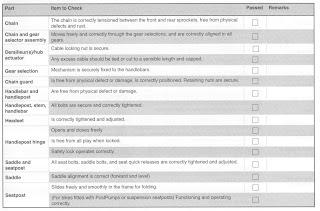
      
Dealer Pre-Delivery Checklist for Dahon bikes

This checklist is not restricted to Dahon folding bikes! In fact, most of the items on the list are applicable to other bikes. You may want to print out the checklist and use it to inspect or service your bikes.

Final Summary
And here we are at the final part of the bike comparison article! I have made every effort to ensure that the facts are correct, and that the comparison is as fair as possible.

To answer the question: Cheap Bikes vs Premium Bikes, What is the Difference? The main components that come to mind when I compare the Aleoca R2R to the Dahon MuP8 would be the wheelset, the frame, the handlepost, and the folding joints. These are the major components that account for most of the difference in price between those two bikes. The detailed facts have been laid out for your comparison, whether the MuP8 is worth the price or not, it is up to you to decide!

Monday, December 5, 2011

Part 7: Cheap Bikes vs Premium Bikes: What is the Difference?

Before I continue with the article, I would like to thank all my readers, some of whom have given me valuable feedback and compliments. Without all your continued support and encouragement, I would not have found the inspiration and drive to write all these articles on my blog. Thank you!

The Drivetrain! It is the heart of the bicycle, without which the bicycle is just a Flintstone-style vehicle. The drivetrain is the system that transmits the power from the rider to the bicycle, powering you forward. A good drivetrain will be very efficient, using almost 100% of the rider's input to drive the bicycle forward. It is not possible to be 100% efficient, because energy losses are unavoidable. However, we can try to minimise the energy loss with good engineering. Let us first take a look at what the drivetrain of the modern bicycle consists of.


Components that make up the drivetrain:
1) Bottom Bracket (BB)
2) Cranks
3) Chainring
4) Chain
5) Cassette sprockets

Useful accessories that help to keep the drivetrain running properly:
1) Chainguard
2) Bashguard

Now for the comparison! I don't have complete information on the Aleoca R2R's drivetrain, so I will give it my best shot at guessing the parts, and give it the benefit of the doubt. Hope it does not affect the credibility of the comparison too much!

Bottom Bracket (BB)
The bottom bracket, also commonly known as the BB, is the core of the drivetrain. For the square taper BB used for both the Aleoca R2R and the Dahon MuP8, the BB has bearings at either end of the BB, together with the square taper axle.

The square taper BB has been around for a long time, and is still very commonly used nowadays. It is also cheap, and nowadays people don't service square taper BB's. When it wears out, it is much easier to just change out the BB.

The BB screws into the bottom bracket shell on the frame of the bike. Point to take note is the direction of the screw thread used. To loosen the BB from the frame, the BB cups have to be turned in the pedalling direction. This helps to prevent the BB cups from tightening further during pedalling, which will make it impossible to remove in the future. The BB cups will have a left-hand thread on the right side, and right-hand thread on the left side. Confusing?

Aleoca R2R Bottom Bracket: Square Taper (Cup & cone bearings with ball retainer)
Dahon MuP8 Bottom Bracket: Square Taper (Cartridge type, sealed bearings)

Cartridge-type BB on top, Loose bearing type at the bottom. Note the difference in the number of parts!

The excellent picture above shows the difference between a cartridge-type BB and a loose bearing BB. The cartridge-type is non-serviceable, you just replace the whole unit when it is broken.

Both the BB's are square taper BB. When mounted on the bike you cannot really tell the difference. The difference is in the construction. The Aleoca R2R uses an older type of square taper BB, with loose bearings (kept together with a ball bearing retainer) that can be serviced. This is the same stock BB used on the Dahon Vitesse D7. The disadvantage is that it is not as well sealed against dirt and water as the sealed bearing type. Since BBs are rarely serviced nowadays, there is hardly any advantage to be able to service the bearings. Just change the BB!

The Dahon MuP8's square taper BB is the newer type, with sealed bearings that come from the factory almost fully assembled. You just need to screw in the cartridge from the right side, and then insert the left side BB cup. Cartridge type refers to the construction, where the BB comes as a cartridge that you can just change out as a single unit. This type of BB is better sealed against the elements, thus it should be more durable.

Comparing these 2 BB's, there is frankly not much difference here. Cost savings are made here since it cannot be seen by the user anyway. Performance wise there isn't much that can go wrong here, even cheap BB's will perform decently.

Cranks
The cranks link the pedal to the chainring, which in turn pulls the chain and drive the rear wheel. To be efficient, the cranks have to be very stiff to endure the high forces that the rider exerts on the drivetrain. The ultimate crank would be super stiff and ultra lightweight. Carbon cranks come close, but at a high price! Nowadays, cranks are mostly made out of aluminium, because it is relatively lightweight and strong.

Aleoca R2R Cranks: Cold-forged aluminium, crank+chainring
Dahon MuP8 Cranks: Kinetix Supra Crank, forged aluminium

Cranks that come attached with chainring. Similar to the type found on Aleoca R2R.

Kinetix Supra crank. Note the 5-bolt chainring mounting and the beautiful surface finish!

Aluminium cranks are always cold-forged for strength, which is especially important for cranks. It would be very "exciting" and dangerous if your crank were to snap while pedalling hard!

The main difference here is the way in which the chainring attaches to the right-side crank. For the Aleoca R2R crank, the chainring is permanently press-fitted onto the crank with a splined interface. Good system, just that you cannot change out your chainring if it wears out or if you want a chainring with different number of teeth.

The Kinetix Supra crank uses the 5-bolt mounting with 130mm bolt circle diameter (BCD). This is a pretty standard mounting for most road bike cranksets nowadays, which means that you are free to change your chainring as you please. What stands out here is the polished surface finish of the Kinetix Supra crank! Really beautiful finish that greatly elevates the aesthetic value of the cranks.

Chainring
The chainring drives the chain, and by varying the number of teeth on the chainring, you can alter your gear ratio. Some strong riders like to change their chainring from the standard 52T chainring to a larger 56T or even 60T chainring to compensate for the smaller wheel size of the 20" bikes. Since there is no front shifting for these two bikes, there is no need to get highly engineered chainrings (with ramps and pins and profiled gear teeth for optimum front shifting) used for bikes with double or triple chainrings.


Aleoca R2R Chainring: Steel chainring
Dahon MuP8 Chainring: Aluminium 6061 chainring

Typical aluminium chainring with 130 BCD mounting.

Main difference here is the material! A steel chainring is very durable, but it is heavy and may be prone to rust after some time. Aluminium chainrings are the norm nowadays, being light and strong. A chainring can always be replaced if it wears out, which is possible only if the standard 5-bolt mounting, such as those found on the Kinetix Supra crank is used.

With the 5-bolt mounting, the mounting points of the chainring onto the crank is much closer to the edge of the chainring. This reduces the likelihood that the chainring will be bent during transportation or usage, as the chainring is better supported by the crank spider. This contrasts with the one-piece crank+chainring set found on the Aleoca R2R, where warping of the chainring is much more common.

Chain
Not much to compare here, pretty standard chains used for the bikes! A nicer chain would usually be nickel or chrome plated for better appearance and corrosion resistance. The most important aspect is not the surface finish of the chain, but how you take care of the chain. As long as you remember to clean and lubricate the chain regularly, even the dull looking cheap chains will run nice and smooth.

Typical bike chain. Dull surface finish.

Dura-Ace 10 speed chain with durable zinc-alloy silver finish for corrosion resistance.

In the previous post of the bike comparision article, which is Part 6: Gear Shifting System, I mentioned that the recommended chain for an 8 speed system should be an 8 speed chain. (6,7,8 speed chains are the same). However, you can also use a 9 speed chain on an 8 speed system with not much of a problem. Being narrower, the 9 speed chain should run quieter, as it is less likely to rub on adjacent sprockets, especially when cross-chaining. The compromise here is the gear shifting, where it might be hesitant to downshift (change to lower gear), as the chain is narrower and will not climb as well onto the larger sprockets. But it is usually not a big issue. Just don't use an 8 speed chain on a 9 speed drivetrain, as the wider 8 speed chain will be too wide to fit properly on the narrower 9 speed sprockets!

Cassette Sprockets
In the previous part, the cassette sprockets were discussed when the gear shifting systems were compared. The sprockets are also part of the drivetrain, as the sprockets drive the freehub, which then turn the rear wheel. This will not be discussed further as it has already been compared in Part 6: Gear Shifting System.

Chainguard and Bashguard
Other little parts that complement the drivetrain would be the chainguard and the bashguard. The chainguard and bashguard are commonly mis-labelled, with the bashguard also being called the chainguard.

Strictly speaking, the chainguard is the little black tab that wraps around the seat tube, which helps to prevent the chain from falling inward off the chainring. The bashguard is the large disc that encircles the chainring, preventing the chain from falling to the outside of the chainring. With these, the chain will stay on the chainring, and not fall off when shifting too quickly or riding over bumpy terrain.

Aleoca R2R: 2-piece plastic bashguard
Dahon MuP8: Chainguard and alloy bashguard

2-Piece plastic bashguard. Sandwiches the chainring to prevent chaindrop.

Black chainguard and edge of bashguard shown. Together, they prevent chaindrop.

The very stylish bashguard that was on my Boardwalk! It has since been removed as I have added a front derailleur (FD), and the FD will prevent chaindrop.

An alloy bashguard would be more durable and resistant to damage compared to plastic bashguards. But performance wise, there is no difference here. It does not contribute to drivetrain efficiency, although it may improve the appearance!

Comparing the drivetrains, the significant differences are the cranks and also the chainring. Other than that, the other components are quite similar. I would have expected the Dahon MuP8 to have a better BB, such as a Shimano Octalink BB (stiffer and more efficient). However, this would mean upgrading the crankset too, which I guess is not possible if they need to keep the production costs down.

One good thing is that the Dahon MuP8 frame is a good frame, thus it is worth upgrading the drivetrain to a Shimano Hollowtech II drivetrain. The Hollowtech II drivetrain is much stiffer and also lighter at the same time, making the drivetrain more efficient as less energy is lost to the flexing of the BB axle and also the cranks.

You can read the other parts of the article at the links below!

Cheap Bikes vs Premium Bikes: What is the Difference?
Part 1: Frame & Fork
Part 2: Frame & Fork (continued)
Part 3: Contact Points and Steering System
Part 4: Wheels and Tires
Part 5: Braking System
Part 6: Gear Shifting System

In the next and last part of this article, other less well-defined aspects of the bikes will be discussed and compared. Examples would be the folding joints that are used on the bike, and the Pre-Delivery Inspection (PDI) conducted by the bike shop before selling the bike to the consumer.

Check out Part 8 here!
Part 8: Folding Joints and Miscellaneous Stuff

fortgesetzt werden!

Sunday, November 27, 2011

Part 6: Cheap Bikes vs Premium Bikes: What is the Difference?

A useful feature of modern bicycles: The gear systems on the bike! With multiple gears, it allows you to make use of mechanical leverage to pedal efficiently on all sorts of terrain.

However, what use is so many gears if you cannot switch between them easily? And here is where the gear shifting system comes into play. The modern gear shifting system is engineered so that you can select your preferred gear quickly, easily and accurately. In fact, the gear shifting system is one of the most highly engineered and complicated system that can be found on a bicycle. So how many gears are enough?

The answer depends on your type of usage for the bike! For the Aleoca R2R and the Dahon MuP8, they are equipped with a single chainring up front, and multiple gears in the rear. This is the most common gearing system found on folding bikes. Front gearing systems are not so common on folding bikes, because there is less need for it, unlike mountain bikes that need many gears for very varied terrain, or road bikes that seek speed with high gear ratios. What constitutes a gear shifting system?

For a rear gear shifting system, there are 3 main components:
1) Rear Shifter
2) Rear Derailleur
3) Cassette

A rear derailleur. The one shown here is a gold version of the Ultegra 6700 RD.

A rear shifter. This is a SRAM X9 mountain bike shifter.

A cassette. This is a 7 speed cassette, stock from the Dahon Boardwalk D7.

A good gear shifting system will require all these components to be compatible with each other, in order to give a crisp and accurate shifting performance. Beginners usually get confused with all these different compatibilities, and the more questions they ask, the more confused they get! I shall try to explain the details in simpler terms, with minimum jargon for maximum understanding. After that, we will compare the gear systems between the Aleoca R2R and the Dahon MuP8, and see if the gear shifting system is worth the significant price difference. Let's start with the cassettes.

Understanding Cassettes
The cassette refers to the bunch of gear sprockets found on the rear hub of your bicycle. The more sprockets there are, the more speeds you have! However, you will realise that even though the width of the rear hub does not change, how can they fit less or more sprockets in the same amount of space?

There are 2 ways to fit a cassette onto the rear hub. The previous post on wheels and tires explains the differences between a freewheel and a freehub. 

For a 6, 7 or 8 speed cassette, the spacing between sprockets is quite similar, but not exactly the same. The thickness of the sprockets can also differ between different models or different brands, and across different speeds. Even so, the wide dimension tolerances means that they can use the same chain without big issues. One way to think of it is to imagine one sprocket + spacer as one layer. 6 speeds mean 6 layers, and 8 speeds will mean 8 layers. 8 layers will be thicker/wider, and thus the cassette width for an 8 speed cassette is more than 7 speeds, which in turn is more than that of 6 speeds.


 Side view of a cassette. There are 7 sprockets here, notice the spacers between the sprockets.

Now, if you have a 6 speed cassette, most likely it fits onto the bicycle rear hub with a thread-on freewheel system. As for 7 or 8 speeds, it can come in freewheel or freehub type, but the more common type is freehub. 

A 7 speed freehub can only fit a 7 speed cassette, an 8 speed cassette will not fit. Remember, an 8 speed cassette is wider than a 7 speed cassette, and thus will not fit on a 7 speed freehub.

Confused so far? More to come!

Now, let us look at 8, 9 and 10 speed cassettes. As the number of gear sprockets increase from 8 to 9 to 10, it is not feasible to keep adding more "layers" and making the cassette even wider. Instead, the layers are made thinner, so that you can fit more layers into the same amount of space!

Therefore, you will find that a 9 speed cassette actually has the same overall width as an 8 speed cassette. Both will fit on the 8 speed freehub with no problem. The difference here is that each spacer and sprocket on the 9 speed cassette is slightly thinner than the 8 speed version, and the total difference allows 1 additional gear sprocket to be added within the same cassette width. In some cases, the sprocket thickness may be different, and the overall stack height is compensated with different spacer thicknesses. Confusing, I know.

Same story for the 10 speed cassette. Even thinner sprockets and spacers are used, which mean that 8, 9 and 10 speed cassettes have very similar cassette widths, and they all fit on the same freehub. Note that a 10 speed road cassette will require an additional 1mm spacer to fit on the 8/9/10 speed freehub body.

An 8/9/10 speed compatible freehub. A 7 speed freehub would be slightly shorter.

Because of these different sprocket and spacer widths, the recommended chain for 8, 9 or 10 speeds are all different. These will be explained in the later part of this article, when the drivetrains are analysed.

Cassettes

Aleoca R2R Cassette: 6 speed thread-on freewheel
Dahon MuP8 Cassette: Shimano Hyperglide 8 speed, 11-32T

6 speed Thread-on Freewheel cassette.

8 Speed Shimano Hyperglide cassette 11-32T. Credits: www.sjscycles.com

The 6 speed cassette has 2 less gears than the 8 speed cassette found on the MuP8. This means that most likely the gear range for the Aleoca R2R is less than the MuP8. Also, with less gears to span the gear range, this will make the jumps between gears quite large, which  makes it difficult to find a comfortable gear to pedal in. You will likely find the selected gear to be too low or too high to pedal at a comfortable cadence.

A Shimano Hyperglide cassette will have specially profiled sprocket teeth and wall profiles to help the chain transit between gear sprockets smoothly and quickly. Also, the nickel plated surface will be tough and hardwearing for longer durability. A good cassette's value lies in its smooth gear changes and durability, and it is worth paying more to get a high performance cassette.

Gear Shifter
A good gear shifter is very important in ensuring quick and accurate shifts. When you twist a grip shift, it pulls a fixed amount of gear cable, which actuates the rear derailleur to move the chain. This precise amount which the cable is pulled is carefully controlled, in order to shift gears accurately. This is why we can have an indexed shifting system, where each click moves the chain accurately to the next gear.

The shifter determines how many speeds the bicycle can have. You cannot use a 9 speed shifter on an 8 speed cassette, because the cable pull ratio is different! Also, the cable pull ratio for most Shimano components is different from SRAM components, thus it is not recommended to mix and match gear shifting components from different brands.

Aleoca R2R Shifter: Saiguan 6 speed gripshift
Dahon MuP8 Shifter: SRAM Twist shifter, 8 speed

Saiguan brand 6 speed gripshift

SRAM Twist shifter. The one on the MuP8 is similar to this but is 8 speeds.

A well designed gripshift will require less effort to twist and change gear, and will also retain its accuracy over time. If you compare the shifting performance of the Aleoca R2R to the MuP8, you will find the MuP8's gear shifting to be much quicker and crispier, without the annoying sound of the chain rubbing against adjacent sprockets. A good grip shift does not cost much, but is crucial if a good shifting performance is desired.

Rear Derailleur
The rear derailleur basically derails the chain from the current sprocket, and attempts to put it accurately on the next sprocket. For folding bikes, the rear derailleur deserves special mention because of its vulnerability to damage, compared to large wheeled bikes. This occurs during transportation in the folded mode, where the rear derailleur may stick out and hit other objects. Also, the rear derailleur should not hang down too low, as it will be vulnerable to damage if it is too near the ground.

Theoretically, the number of speeds that a rear derailleur can achieve is not fixed. The movement of the rear derailleur is not indexed, it just moves according to how much cable is pulled by the shifter. Which is why we can find 8 speed rear derailleurs being used for 9 speed systems or the other way round with no issues. You can use a 10 speed rated Ultegra RD with an 8 speed cassette and shifter. The compatibility issue is usually with the width of the cage, where wider 8 speed chains may not fit nicely through a narrow 10-speed-rated cage.

Aleoca R2R Rear Derailleur: Saiguan brand rear derailleur
Dahon MuP8 Rear Derailleur: Dahon Neos 2.0 Rear Derailleur

Saiguan Rear Derailleur. Very traditional design and appearance.

Dahon Neos 2.0 rear derailleur. Quite unique because it is mounted in front of the rear axle.

See how well it tucks away under the axle, so that it does not stick out to the side.

As you can see from the link above, the Dahon Neos RD is really ideal for small-wheeled folding bikes. It helps to tuck away the RD, preventing it from damage. Not only that, I personally find that it performs excellently, with crisp and accurate gear shifting.

A good RD will have a rigid construction, so that it does not bend or become misaligned when under spring tension or cable tension. It will also need to pivot smoothly when it is actuated. This enables it to track the sprockets accurately, which helps improve and quicken gear shifting. 

Summary
After comparing the gear shifting systems for the Aleoca R2R and the Dahon MuP8, I must honestly state that although the MuP8's gear shifting system is better, the cost price is not that great a jump over the Aleoca's shifting system. The components used are mostly entry level, with no branded stuff, thus the shifting system is where I feel the increased cost is not fully justified.

Nevertheless, the performance of the shifting system on the MuP8 is definitely better than that on the Aleoca R2R, and it may be worth the investment if you like smooth gear shifts that are fast and accurate.

Read the previous parts of this article here!
本文章的下一集即将登场。。。

Part 7: Drivetrain

Wednesday, November 23, 2011

Part 5: Cheap Bikes vs Premium Bikes: What is the Difference?

The better your brakes, the faster you can go!

Brakes on a bicycle are often overlooked, and are unlikely to be the first components that are upgraded. Usually, the first components that are upgraded would be those that can make you go faster, such as lighter wheels, slicker tires, stiffer cranks etc. However, brakes are also very important, as a good set of brakes are necessary to allow you to cycle fast, with the confidence that you can stop when you need to!

The folding bikes that we are looking at are the Aleoca Ready2Ride (R2R) and the Dahon MuP8. Both look similar, but have a big difference in their price tags. And why is that so? Start reading from the first part to find out!

Cheap Bikes vs Premium Bikes: What is the Difference?
Part 1: Frame and Fork
Part 2: Frame and Fork (Continued)
Part 3: Contact Points and Steering System
Part 4: Wheels and Tires

Today, we shall compare the braking system used for these two folding bikes. Both the bikes use V brakes, which are very common on bicycles nowadays. And no wonder: V brakes are cheap, effective, lightweight and relatively easy to adjust. For folding bikes, V brakes are sufficient most of the time, unless you are going for a road bike setup with caliper brakes, or plan to go off-road with disc brakes.

The brake system can be generally sub-divided into 4 main parts:
1) Brake Levers
2) Brake Cable Housings
3) Brake Calipers
4) Brake Pads

Brake Levers
Whenever you brake, your fingers come into contact with the brake levers. It is the component that you will come into contact with most frequently, after the grips, pedals and saddle. A good brake lever will feel solid and flex-free, with no mushy feeling when the brakes are applied.


Aleoca R2R Brake Levers: Generic brake levers with plastic bracket
Dahon MuP8 Brake Levers: Avid FR-5 Brake Levers

Avid FR-5 Brake Levers used on Dahon MuP8
 
Brake lever used on Aleoca R2R

This is where a great deal of cost savings were made, when the brake levers for the Aleoca R2R was selected. The plastic used for the brake lever bracket feels cheap and is flexy when braking hard. Also, a plastic bracket will be more likely to get damaged than an aluminium bracket.

The Avid FR-5 used on the MuP8 is a much better brake lever. In fact, Avid makes one of the better brake levers out there, with their Avid V-brakes being a very popular choice for upgrades due to its affordable price and surprisingly good quality. The Avid FR-5 brake levers feel really solid and reassuring, with smooth pivots and very little flex. There is seriously no need to upgrade your brake levers if you already have Avid brake levers on your bike.


Brake Cable Housings
This is the most underrated component on the bicycle! It does not contribute to speed, you cannot shave weight by upgrading it, and you hardly notice it unless it is gone. Which is why many bicycle OEMs save costs by using cheap housings. After all, the customer cannot tell the difference just by looking at the housing!

However, the housing actually plays an important role in ensuring friction-free braking. A good housing will have a well lubricated plastic liner inside the coiled housing, that minimizes friction between the brake cable and the brake housing. If you have ever pulled on a brake lever, and it feels smooth and predictable, that is largely because a good brake housing was used.


Aleoca R2R Brake Cable Housings: Generic brake cable housing
Dahon MuP8 Brake Cable Housings: Jagwire housing with Dupont L3 Lubricant

Jagwire L3 Brake Housing

Jagwire is the biggest cable housing manufacturer in the world, and you can find Jagwire housings on many good quality bikes. Many aftermarket brake cable housings are Jagwire housings too, with Alligator, Nokon, Goodridge and Clarks being some of the other well known brands.

If your brakes still does not feel smooth after you have upgraded your brake levers and calipers, changing your brake housings may just do the job! You will be surprised how much difference a good brake cable housing can make to your braking feel and performance.


Brake Calipers
I have come across many V brake calipers, and they mostly look the same. However, the difference between them lies in the parts that you cannot really see. Examples are the springs that are used, the bushings in the pivots, the bolts that are used, the brake noodle linking the brake housing to the brake caliper etc.

Aleoca R2R Brake Calipers: Generic steel brake calipers
Dahon MuP8 Brake Calipers: Kinetix Speedstop V-Brakes (Stainless steel hardware)

Generic V Brakes

Kinetix Speedstop V Brakes

I did not know they still made brake calipers in steel until I was doing research for this article. Not sure why steel is still used, because aluminium brake calipers are so much lighter and can do the job just as well. Maybe it is because steel calipers are cheaper to manufacture than aluminium ones.

Anyway, besides the weight penalty of using steel brake calipers, a good pair of brake calipers is usually only obvious after a period of use. The first thing you notice is that a good set of brake calipers will not rust. The bolts and the brake noodle will be made of stainless steel, which is more expensive than plain steel but has the important advantage of being rust-free.

Another thing you will notice is that a good set of brake calipers will improve the smoothness of your braking, as the better bushings in the pivots will reduce friction. It will also be easier to adjust the spring tension on either side of the brake calipers without repeated back and fro adjustments.

There are also other small details that you can use to differentiate between a high quality and entry level brake caliper, but it is too lengthy and difficult to show these clearly in a blog post. Perhaps it will be easier to point them out on the actual brake caliper itself!


Brake Pads
This is one component where there isn't much to compare. Neither of the bikes use good quality brake pads, which is surprising for a premium bike such as the Dahon MuP8. I would have expected the brake pads on the MuP8 to be at least a cartridge brake pad, so that the brake pads can be swapped out easily. However, it comes as an entire block, which means that if you want to change the brake pads, you have to change the entire brake pad assembly.

Block Brake Pads

Cartridge Brake Pads. Brake pads can be swapped out by sliding the pads out of the aluminium pad holders.

The stock brake pads are not really good, and most of them tend to squeal terribly, especially after a ride in the rain. What is worse is that during braking, metal bits from the rim will embed themselves in the brake pad, and wear away your rims. This can be seen by grooves cut into the rim by the brake pads, and if it gets really bad, you can hear scraping sounds when you brake.

As a solution, I recommend the Kool Stop brake pads. They are rather pricey, but what you get is good braking performance and squeal-free operation. Most importantly, they will save you from having you change your worn-out expensive rims!

Kool Stop brake pads.

After comparing the brake systems, it should be clear that the different quality of brake components used is one of the reasons why the Dahon MuP8 costs more than the Aleoca R2R. With a better brake system, the braking performance is smoother and lighter, more reassuring and reliable, and the components will not rust over time. If you are a rider who cycles often, you will definitely appreciate the difference.

In the next part, we will examine an utterly confusing but hugely interesting part of the modern bicycle: The Gear Shifting System.

Part 6: Gear Shifting System

d'être poursuivi!

Friday, November 18, 2011

Part 4: Cheap Bikes vs Premium Bikes: What is the Difference?

As stated in the Bicycle Maintenance book: "Wheels and tires, without which there would be no bicycle."

That is so true, as the word bi-cycle essentially means on two wheels. During normal usage of a bicycle, the only part of the bicycle that touches the ground would be the tires. Also, the wheels and tires are some of the many parts of the bicycle that rotates, and they are the components that have the biggest impact on rolling resistance.

Before we move on to the wheel and tire comparisons, you may want to start with previous parts of this article.

Cheap Bikes vs Premium Bikes: What is the Difference?
Part 1: Frame and Fork
Part 2: Frame and Fork (continued)
Part 3: Contact Points and Steering System

Let us move on to the comparisons, between an Aleoca Ready2Ride and a Dahon MuP8!

Wheels
The wheels can be considered the core of the bicycle. It is the component that has the biggest impact on the ride quality and speed. With a good pair of wheels, you will be able to go fast and cruise longer with less effort. However, it is also one of the priciest single component on a bicycle. For a decent pair of 20" wheels, it can easily cost a few hundred dollars.

For me, the wheels can be split into 2 major parts, the hubs and the rims. We shall assume that both the bikes use similar stainless steel spokes.

Aleoca R2R Front Hub: Cup & Cone Bearings
Dahon MuP8 Front Hub: Kinetix Neutron Cartridge Bearings

Cartridge bearings in Dahon MuP8 hubs

Cup & cone bearings found in Aleoca R2R hubs

Cup & cone bearings are simple to service and maintain, but their sealing is usually poorer than cartridge style bearings. Cup & cone bearings can also be very smooth-running, but the bearings used must be of high quality (very smooth and round) and the cones must be well machined to very tight tolerances. Shimano is one of the few bicycle wheel manufacturers that still use traditional cup & cone bearings for strength, and are able to maintain the smooth running of the wheel hubs.

A bad cup & cone bearing hub is easy to detect. When spinning, there is noticeable drag and it will feel lumpy or notchy when you spin the wheels. Sometimes it is only because the hub is not adjusted properly, but many times, especially on lower end wheels, this is due to the poor quality of bearings and cones used.

On the other hand, cartridge bearings are difficult to service, as they require special tools to remove and install the cartridge bearings. The good news is that they are usually better sealed and require very little maintenance. If it wears out, it is possible to just swap in a new set of cartridge bearings. One disadvantage of cartridge bearings is that they are not built to withstand side loads, unlike cup & cone bearings.

In this case, the Kinetix Neutron hub of the MuP8 is far far better than the hub used on the Aleoca R2R. The Kinetix Comp wheelset used on the MuP8 is one of the most value-for-money 20" wheelsets available, especially with the extremely smooth running front hub.

Aleoca R2R Rear Hub: Cup & Cone Bearings and thread-on freewheel
Dahon MuP8 Rear Hub: Cup & Cone Bearings with 8/9/10 speed compatible cassette freehub

Credits: Sheldonbrown.com

Both the rear hubs use cup & cone bearings. However, the similarity ends here. As seen above, the method and construction that is used to attach sprockets to the rear hub is vastly different. The Aleoca R2R is a 6 speed bike which uses a thread-on freewheel on its rear hub. Freewheel hubs are much cheaper than freehubs and the number of sprockets possible are very limited. Most freewheels available on the market are 6 or 7 speeds, with very rare 8 speed freewheels.

For the cassette freehub used on the Dahon MuP8, it has splines that enable the use of a cassette. The freehub spacing used for 8, 9 or 10 speed cassettes are similar, thus the potential for upgrade is there! Also, because of the construction, the bearings in the freehub system can be spaced further apart on the axle, improving the rigidity of the rear wheel.

Because of its better performance and upgradeability, the freehub found on the rear wheel of the MuP8 is a much better system than the R2R's freewheel system. Just to reiterate, the wheels are the core of the bicycle, and it is worth paying more to get a better wheelset that rolls well and lasts long.

Rims
The rims are a critical part of the wheel. For a wheel to roll properly, the rims have to be trued, such that they are as round as possible and are not twisted in anyway. By adjusting the spoke tension, different parts of the rim will be pulled to a different extent towards the hub, and the ultimate aim is to make the rim stiff and round. If V brakes are used, it is very important to have nicely trued wheels in order to have brakes that perform predictably and consistently.


Aleoca R2R Rims: Single walled rims
Dahon MuP8: Kinetix Comp Double walled rims

Single Walled Rim


Double Walled Rim

Rims can be classified into two main types, single-walled and double-walled. A single walled rim is easy to manufacture, but the downside is that it is not as strong as a double walled rim. A double walled rim will be stronger and more durable, and less likely to be damaged. Also, the double walled rim will be able to withstand higher tire pressures. That is also a reason why cheaper bicycles come with single walled rims, fatter tires, and lower tire pressures, whereas better bicycles meant for greater speed come with stronger double walled rims that can take high pressure slim tires.

Kinetix Comp rims are decent mid-range rims that are relatively lightweight and strong. It is worth paying more for a decent set of wheels in the first place, as these wheels are going to be used a lot, and can be very pricey if you decide to change out your wheels later on.

Tires
The bicycle tires will greatly influence the comfort and speed of the ride, much more so than the frame or other components. A good fast tire will be lightweight supple and absorb little energy when it rolls, preventing efficiency losses due to tire deformation. On the other hand, a tire meant for durability will be heavier, tougher, and probably thicker due to multiple layers of puncture resistant material.

For an immediate improvement in speed, the easiest and most effective way would be to change out the tires, and get slim road tires that roll fast. Changing the tires from a stock Kenda 1.75" tires to the fast Schwalbe Durano 1.1" tires will give you a significant speed improvement that can be easily felt.

Aleoca R2R Tires: Kenda 1.5" or 1.75" tires
Dahon MuP8 Tires: Schwalbe Marathon Racer/Marathon Plus tires

Kenda Kwest Tire, 20x1.75"

Schwalbe Marathon Racer, 20x1.5"

Schwalbe is well known as an aftermarket tire brand, that produces excellent tires that are lightweight, with low rolling resistance and good puncture protection. Most Schwalbe tires come with layers of Kevlar underneath the tread of the tire that helps to prevent sharp objects from poking through the tire. It is very effective at stopping small sharp objects such as gravel or thorns from puncturing your inner tube.

These Marathon Racers also come with a reflective sidewall that can increase your side visibility, plus it looks cool too! However, Schwalbe tires do not come cheap, as a single Marathon Racer tire can cost $40.

Based on the price of Schwalbe tires, it is no wonder why a Dahon MuP8 costs much more than an Aleoca R2R. The tires already take up a significant portion of the price difference.

After comparing the wheels and tires, it is obvious that the Dahon MuP8 uses much better wheelset components than the Aleoca R2R, which is why it costs significantly more. It can be troublesome and expensive to upgrade wheels and tires later on, which is why it is advisable to get a decent wheelset in the first place. If you don't plan to upgrade, the cheaper wheelsets may be good enough for leisurely rides, but if you forsee yourself upgrading the bike, it is much better to get a 8/9/10 speed compatible wheelset.


Part 5: Brake System


que continuar!

Saturday, November 12, 2011

Part 3: Cheap Bikes vs Premium Bikes: What is the Difference?

In this Part 3 of the article, let us take a look at some of the most underrated components on the bicycle. These would be the contact points on the bicycle, which the rider will constantly be in contact with. The 3 main contact points would be the saddle, the grips and the pedals.

Part 2: Frame & Fork (continued)

A lot of the time, new cyclists will complain of butt aches or sore wrists, but do you know that these can be alleviated if the proper components are used? A sore butt can be due to a number of reasons, but usually it is due to a bad saddle or a badly adjusted saddle. Sore wrists or numb hands are also relatively common, but these can be partially relieved with a well designed grip.

Let us now compare the difference in saddle, grips and pedals between the Aleoca Ready2Ride (R2R) and the Dahon MuP8!

Saddle
A good saddle will go a long way in keeping your butt pain-free and happy! With no butt pain bothering you, you will be able to enjoy riding the bike and go for longer rides.

Aleoca R2R Saddle: Generic plastic saddle
Dahon MuP8 Saddle: Biologic Aria Saddle

The R2R has a generic plastic saddle, similar to those found on many cheap bikes. These saddles are infernally uncomfortable, as they are hard and badly shaped. Even for short trips, they are very uncomfortable. As for the Biologic Aria Saddle, it is one of the better saddles available.


Biologic Aria Saddle, comes stock with many premium Dahon bikes.
 Plastic saddle
 
To me, it blends comfort with speed very well. It has enough cushion to prevent butt aches even when you are not wearing padded cycling shorts, but not too much cushion that you sink into it. The shape is also pretty good if you like cycling fast, since it does not restrict your leg movements unlike bigger, more cushy saddles. In addition to that, the groove down the middle will prevent numbness.

I have been using it for over 3000km, and I only recently changed it when it literally wore out (the thin mesh in the middle was starting to tear). It weighs in at a decent 380g, not very lightweight, but it is definitely way more comfortable than any cheap plastic saddle.

Throw away your cheap and nasty saddle, and pay more for a good saddle! Your butt will thank you for this.

Grips
To me, having a good pair of grips is very important, as it helps prevent hand numbness on longer rides. After using ergonomically designed grips, that are aptly named Ergon Grips, I will never go back to using those cylindrical shaped grips for anything other than short rides around the neighbourhood.


Aleoca R2R Grips: Generic rubber grips
Dahon MuP8 Grips: Biologic Arx Grips with Integrated T-Tool

Generic rubber grips
 Biologic Arx Grips. As a bonus, it comes with an Allen key stored within the grip!
I find that gripping traditional cylindrical grips bends my wrist at an awkward angle, leading to wrist pain after extended riding. With the ergonomically shaped Ergon-style grips, there is a large area of soft rubber on the grip to support the palm. This spreads the weight out more evenly across the whole hand, which makes it less likely to get hand numbness. This link sums up the ergonomics very well.

The Biologic grip is fixed onto the handlebar by a clamp that tightens with an Allen key, which makes it very easy to remove the grips, such as when you are upgrading/changing your shifters or brake levers. For a rubber grip, it can be very tough if the proper techniques are not used.

Pedals
For a folding bike, folding pedals are usually provided as it allows the folded bike to be more compact in size without the pedals sticking out the side. These are usually not changed out, unless the rider wants to use a higher end folding pedal or go with non-folding pedals.


Aleoca R2R Pedals: Generic plastic folding pedal. Not sure if it folds.
Dahon MuP8 Pedals: Suntour Alloy folding pedals

Suntour Alloy folding pedals

Not much to compare between the pedals, except that the Suntour pedals have a rubber surface that improves grip during wet conditions.

From comparing the contact points, it is obvious that the stock MuP8 comes with good quality grips and saddle, giving you comfort and performance. Of course, you can upgrade to these components on your own on the Aleoca R2R, but it will cost you money. It is not worth it when the Biologic saddle and grips already cost more than half the price of the Aleoca R2R!

-------------------------------------------------------------------------------------
Steering System

The most common comment that I have heard, from people trying folding bikes for the first time:
"Why is the steering so twitchy, and why does the handlepost flex so much?"

Natually, this comment comes about because people compare full-sized bikes to folding bikes. Yes, folding bikes may have a more sensitive steering, but I would say it is agile instead of twitchy. Folding bikes, or small wheeled bikes in general, are very manoeuvrable (I needed a dictionary to spell that word!) in packed traffic or around crowded places. The turning radius is usually smaller than large wheeled bikes. This is largely due to the geometry of the bike frame/fork, and to a small extent, the smaller wheels. Once you are used to the more sensitive steering, you will likely find it to be useful for city commuting or leisure riding in crowded areas.

As for the flexing of the handlepost, it is largely due to the much longer handlepost when compared to conventional full sized bikes. In fact, a full sized bike hardly has a handlepost, just a steerer tube sticking out, some spacers and a stem. A telescopic handlepost is at least 30cm tall, and can go over 60cm when fully extended! That is a lot of leverage on the base of the handlepost.

The handlepost for the Aleoca R2R and the Dahon MuP8 is a combination of 2 parts, the lower part that connects to the headset and the upper part which connects to the handlebar. The additional joint in the middle allows you to change the height of your handlebar to suit your needs.

Handlepost
Folding bikes usually have telescopic handleposts, so that you can adjust the height for folding and also to suit the rider's preferences. This makes it easier to change from a leisurely upright position or a sporty low handlebar height.

Aleoca R2R Handlepost: Height adjustable handlepost
Dahon MuP8 Handlepost: Radius V Telescopic Handlepost

Type of adjustable height handleposts found on most folding bikes. The handlebar is welded to the handlepost. Note the rubber shim in the telescopic joint.


Radius V Telescopic Handlepost. Note the clamp on top which allows you to adjust your handlebar angle for folding, also also the handlepost joint in the middle to adjust the height. The telescopic joint does not have a rubber shim inside, the contact is between the 2 aluminium surfaces.

Dahon uses their patented Fusion Technology for their handleposts, which makes them much stiffer and stronger than other folding bikes' handleposts. If you compare the "flexiness" of the handlepost between the Aleoca R2R to the Dahon MuP8, you will find that the handlepost on the R2R flexes alarmingly, much more that the MuP8's handlepost. This is due to a few factors as listed below.

Some factors that affect handlepost stiffness:

1) Telescopic joint in the middle of the handlepost
2) Stiffness and quality of headset
3) Clamp design at base of handlepost that allows the handlepost to be folded down (will be discussed in later parts of this article)

A majority of the flex that is felt in the handlepost is from the telescopic joint in the middle. Therefore, to minimise flex, the connection between the upper part and the lower part should be tight to prevent play.

On the telescopic joint on the Aleoca R2R, there is a rubber shim between the 2 sections of the handlepost. This is supposed to help increase friction and ensure a good fit between the 2 sections. However, because the shim is made of rubber, it will compress and deform when subjected to forces. Because of this, instead of making the upper and lower sections fit tightly together when clamped, the rubber shim actually deforms and allow flex to develop.

In the Radius V telescopic handlepost used on the Dahon MuP8, the contact is between 2 sandblasted aluminium surfaces. These rough surfaces will grip each other tightly when clamped together, and because it is a metal-to-metal contact, there will be very little play and thus little flex in the handlepost.

It is actually cheaper to add a rubber shim in the telescopic joint, than to control the sizes of two metal tubes, making sure that the upper section fits nicely into the lower section. Sandblasting and anodizing are also costly processes that are used on Dahon's Radius V telescopic handlepost.

Headset
Aleoca R2R Headset: External cup headset
Dahon MuP8 Headset: Fusion+ Headset (Semi-integrated)

Type of external cup headset found on the Aleoca R2R folding bike.

Dahon's proprietary Fusion+ Headset. Semi-integrated headset cups.

The main difference here is the design of the headset. For the Aleoca R2R, the narrower headtube diameter and the external cup headset makes the headset less stiff than the one on the MuP8. The headtube on most Dahon bikes are flared at the top and bottom to increase the diameter and add stiffness. The semi-integrated headset design, where the headset cups are partially sunk into the headtube also helps in improving stiffness by lowering the overall stack height of the headset.

After all these comparisons, it should be quite clear why the Dahon MuP8 rides much better, this is largely due to a stiffer handlepost that improves bike handling and gives the rider the confidence to ride hard and fast. A good handlepost costs more not only because of higher raw material cost or the costly manufacturing processes, but also because of the R&D work put in to design the product.

With this, I will end this Part 3 of "Cheap Bikes vs Premium Bikes: What is the Difference?" In Part 4, we will look at some of the key components of a bicycle: The wheels and tires.

Part 4: Wheels and Tires

討論を継続する!