Showing posts with label FSA. Show all posts

Saturday, June 11, 2022

Bestrider Pump Pro 16: Stem Upgrade + Exploration

This is probably the last upgrade post for this Bestrider Pump Pro 16 that I will be writing in a while. Starting from the stock bike, the drivetrain was upgraded from single speed to a 3 speed internal hub system. The tires were changed to slick type for lower rolling resistance, while the saddle and seat post were also changed to allow saddle position adjustment.

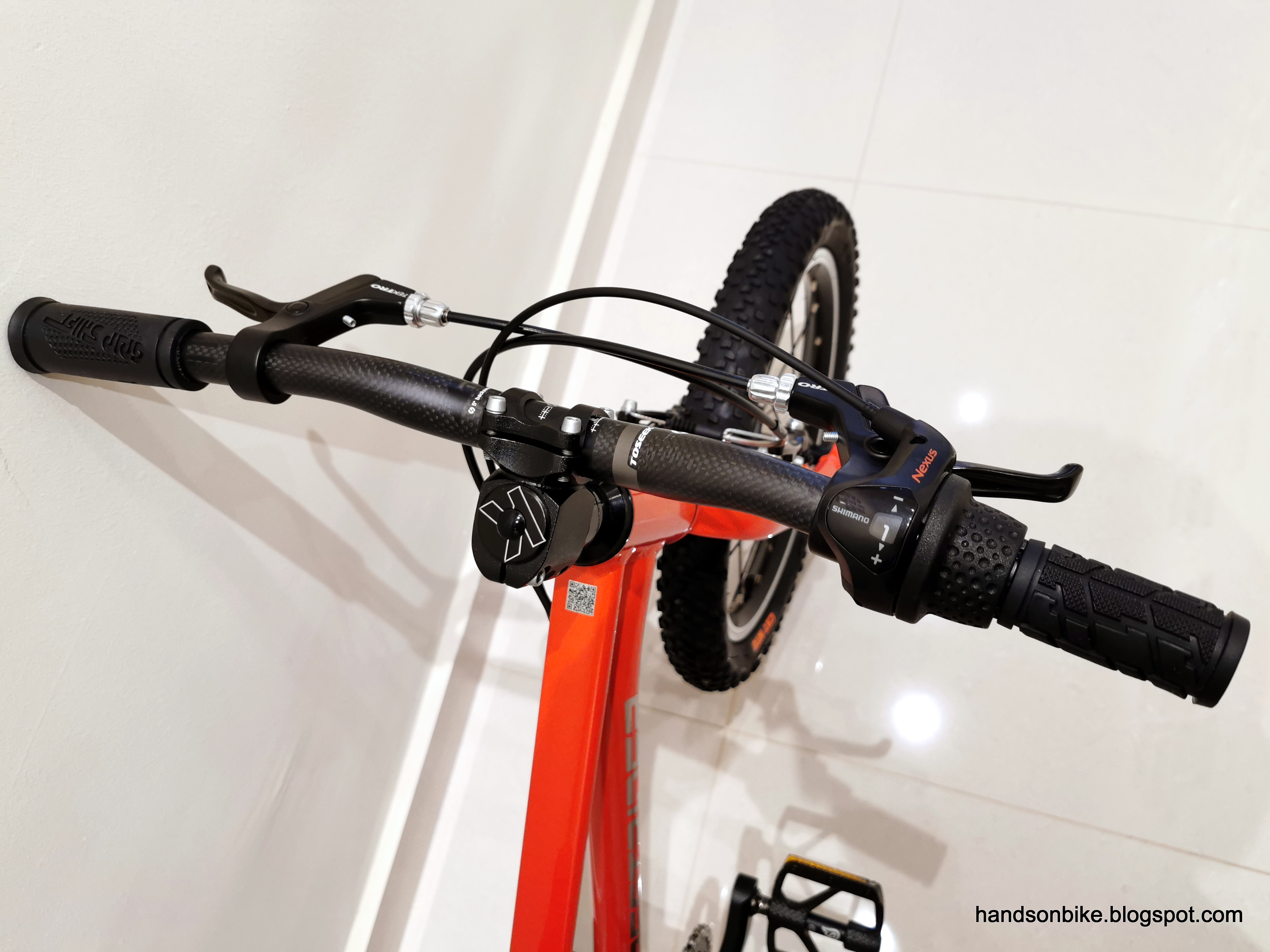
Now, I will be changing the stem, to improve the handling of this bike. I placed a GoPro on the stem cap of the bike, to record some riding videos from my kid's point of view. It is very interesting, and I found that the handlebar swerves left and right quite a bit even when riding in a straight line.

As I am unable to ride the bike myself to check the geometry, I suspect that this could be due to sensitive steering. It could be due to insufficient trail on the fork or some other geometry problem. Instead of being able to self-center when riding the bike in a straight like, the steering might be too sensitive, requiring constant input and correction to prevent it from steering towards the left or right side. I encountered this issue when I used a handlepost that was too short on the United Trifold.

Stock setup with a super short stem, MTB style.

Wednesday, September 12, 2018

Dahon MuSP: Handlebar Setup for Di2

For the Di2 setup on the Dahon MuSP, it will be mostly an internal routing setup. The stock Dahon MuSP rear brake cable and rear derailleur cable are internally routed through the frame, giving a clean appearance.

Using the same concept, the new rear brake cable and also the rear derailleur Di2 wire will be routed internally through the frame. How about the cable routing at the front of the bike?

The usual set up on a road bike is to have a Di2 Junction A situated under the stem, with the shifter Di2 wires connected to this Junction A. This is the stock condition on the Canyon Endurace.

However, this is not a conventional bike, and so the usual Di2 wire routing is not advisable. On the Dahon MuEX, which is also a folding bike, there is a display screen on the handlebar, so the shifter Di2 wires will be connected to the display.

Also, in keeping with the internal routing concept, I would like to keep the Di2 wiring as neat as possible, which means hiding it internally where possible. With that, I considered something that I have never tried before, which is to run the Di2 wire inside the handlebar!

The concept is to hide Junction A inside the bar end for a clean look, and this is made possible by the new type of Junction A as shown below. Other than that, the wireless unit, EW-WU111 will also be hidden inside the handlebar. Finally, I will use a Garmin display to show the selected gear on the Garmin screen! This setup will maintain the neat appearance and yet allow the selected gear to be displayed.

In order to run the Di2 wires inside the handlebar, there will need to be some holes on the handlebar, so that the Di2 wires can be connected between the shifters and Junction A. I thought of buying a PRO handlebar with pre-drilled holes, but they were quite expensive and did not have the size that I needed in stock.

I came across a Youtube video showing how to drill holes in the handlebar for Di2 wiring. This might sound unsafe, but the area where the small holes will be drilled are not under high stress, and so from my point of view it is safe. Obviously this will void your warranty, so do it at your own risk. Lastly, don't do it on a carbon handlebar, as it is more risky.

Using the Youtube video as a guide, I did my own DIY internal routing on the handlebar!

FSA Vero Compact road handlebar, 40cm wide. Weighs 309 grams which is much heavier than a carbon handlebar that is around 200 grams.

Time to drill the holes at the end of the drop bar! For this 1x11 speed Di2 setup, I actually only need to drill one hole on the right side. However, as I want to control the Garmin with the hidden buttons on top of both the left and right shifters, I decided to also connect up the left shifter. This also gives the option of customizing the function of the shifting buttons, such as using the right shifter button for shifting up, and the left shifter button for shifting down, much like the SRAM eTap system.

Clamping the handlebar before drilling a hole. Start with a small drill bit to fix the hole position first, before changing to a larger 6mm drill size.

Drilled hole after removing the burrs

The edges of the holes are also taped up to help prevent the Di2 wire from being damaged by the edge of the hole.

With a similar hole drilled at the other end, this DIY internal routing handlebar is done! It is actually quite easy once you know the technique and have the right tools. By the way, this is the underside of the drop bar, which is normally under compression load and so it is not a danger to have a small hole drilled there.

As the handlepost is a T-shaped type, a stem is needed to link the handlepost to the handlebar. This is the exact same Controltech stem which I used last time on the Dahon Boardwalk.

Weighs 96 grams for this pair of aluminium stem

This stem converts the 25.4mm diameter of the T-shaped handlepost to the 31.8mm diameter of handlebars, while allowing reach and height adjustment at the same time.

The normal Litepro stem requires a 25.4mm diameter handlebar, which is not so common nowadays. Therefore, using this stem allows most road handlebars to be used, which increases your options greatly.

For internal routing through the handlebar, an internal type Di2 Junction A is required. This is quite new, and it is the first time I am using this type of Junction A. The other types of Junction A are the EW67 (used on Dahon Boardwalk and Merida Scultura) and the 3 port EW90 (used on Merida Scultura and Canyon Endurace).

Internal type of Junction A, EW-RS910.

This Junction A can be installed at the bar end of the drop bar, or inside the frame (if the frame is designed for it).

If used at the bar end, the bar tape will be wrapped on top of it. The mode button and the charging port can also be found on the exposed part. If you have an internal Di2 battery, you will need to charge it using this port.

All the parts that are included with this Junction A set, including those for internal frame mounting which I will not need.

Parts required for left and right side. The left side parts is just to make the bar end look similar to the right side, it is not compulsory. There is even a dummy wire (left side of picture) to wrap under the bar tape, to make the grip feel similar to the right side.

Weight of Junction A plus the other small parts weigh 25 grams.

Before installing the Di2 wires into the handlebar, I will first need to connect up the whole system to make sure it is working properly. That will be done in the next post where the bike assembly will start!
Wednesday, May 3, 2017

Avanti Inc 3: Installation of 60mm FSA Stem

After completing the modification of the Avanti Inc 3 to have a narrower Q factor, it seemed that the geometry had been dialed in already. However, even after using a road crankset with road drop bars, something still did not feel right.

I found that while riding, the reach on the Avanti Inc 3 seemed longer than the Merida Scultura 5000 road bike. When holding the shifters, I felt that I had to reach further than what I am comfortable with. This is not my intention as the road bike should have the most aggressive posture out of all my bikes, since it is the fastest bike that I have.

During the previous modification to change to Alfine 11 Di2 with a drop bar setup, I used a shorter 80mm stem to compensate for the longer top tube of the Avanti Inc 3 frame. To double check my previous measurements, I measured from the saddle (area where the sit bones contact the saddle) to the centre of the handlebar.

Distance on Merida road bike is about 665mm.

Distance on Avanti Inc 3 is about 668mm.

The distance from saddle to handlebar is almost the same. Both the bikes are using a compact drop bar from FSA, which means a 80mm reach on the drop bar itself. Therefore, the different reach is not from these areas. Finally, I realised that the bracket on the shifters might be different in length.

Ultegra Di2 6770 road shifters, gripping distance is about 100mm from centre of handlebar.

ST-RS785 shifters, with a gripping distance of about 120mm from centre of handlebar.

Finally, I realised that the bracket length on the shifters are different in length, which means a different reach distance. On the Avanti Inc 3, the road hydraulic disc brake shifters ST-RS785 has a bracket that is about 20mm longer, which is probably to fit in all the hydraulic components.

This extra 20mm of reach is the difference that I feel when riding the bikes. As I ride all my bikes often, I am able to feel any subtle geometry differences.

It is easy to fix this, as I can just change to a shorter stem. There is no worry of a shorter stem making the steering less stable, as the longer shifter bracket makes up for it. As long as the overall distance from the steerer tube to the gripping area on the shifters are the same, it should feel the same.

Simple FSA stem with a 60mm reach

+/- 6 degrees of tilt, depending on which way you fix the stem

Weighs 115 grams for this 60mm length. If it was a more expensive stem, it will weigh less, probably 100 grams.

Comparing the difference in stem length. 60mm in front, 80mm behind. See how much difference it makes to the handlebar position.

New FSA 60mm stem installed! Short stem indeed.

Now the handlebar reach and height is the same as on the Merida road bike!

With this modification, both bikes will ride more similarly as the geometry is now almost the same.

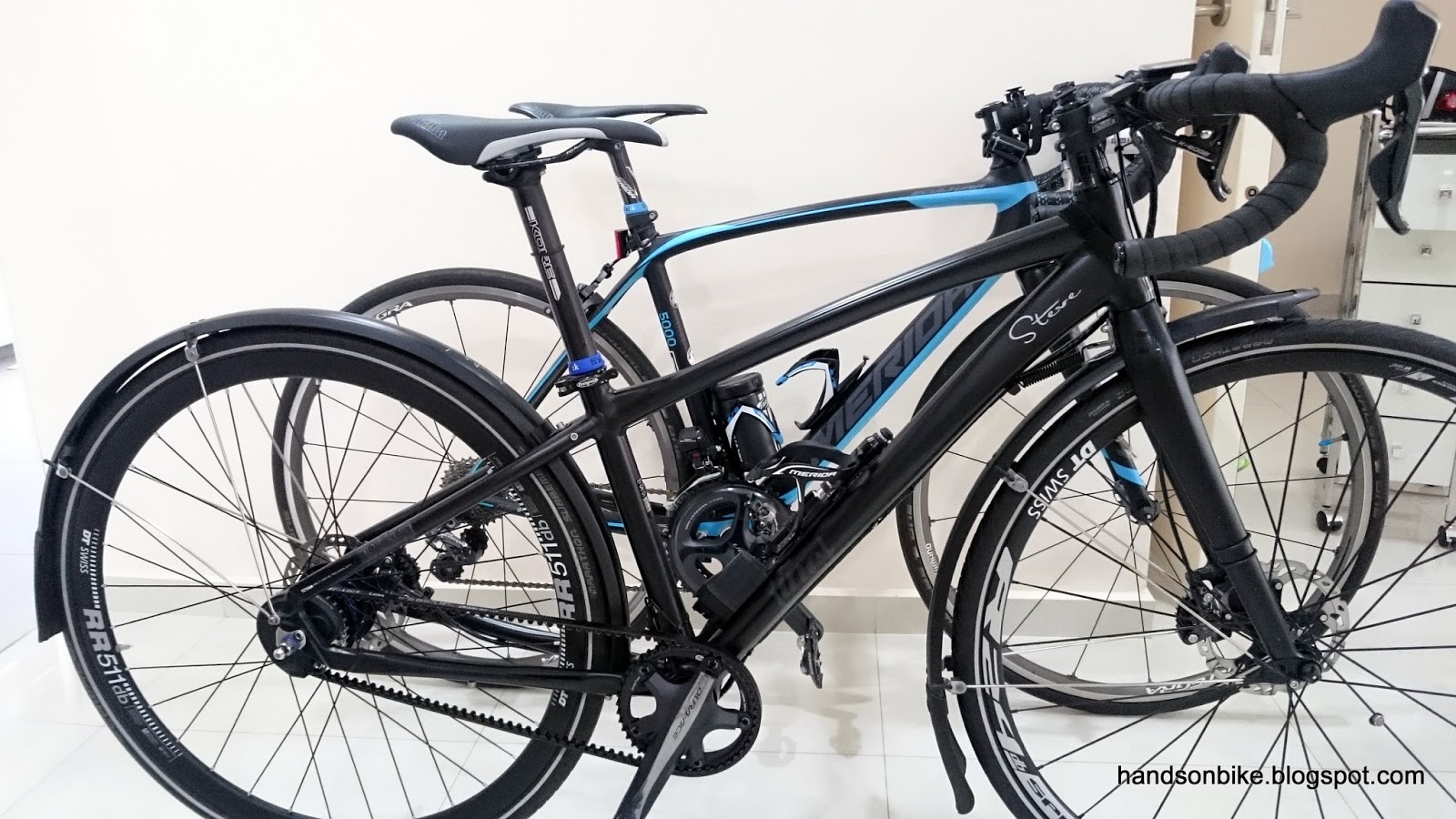
The Avanti Inc 3 can now be classified as an all-weather commuting road bike

Some rearrangement of the accessories is required, due to the shorter stem. Looks rather cluttered, think it needs more work.

View of the full bike. Handlebar area looks a bit cramped due to the short 60mm stem, but it rides really nicely.

With this change of stem length, the geometry has been nicely adjusted and feels perfect. After testing the bike on a half round island ride, passing through Mandai road, I was pleased to find that the gear range is perfect. The highest gear was just sufficient for continued pedaling even when rolling down the Mandai slopes at close to 50km/h. The lowest gear has not been used yet, but it will definitely come in useful if I need to go up steeper slopes such as in NTU or Mount Faber.

Saturday, February 11, 2017

Avanti Inc 3: Alfine 11 Di2 Drop Bar Conversion Part 2

Continuing from Part 1 of this project, which is to convert the Avanti Inc 3 to a drop bar bike with Alfine 11 Di2, here are the rest of the components that are required.

The drivetrain system has been settled, with the new Alfine 11 Di2 hub and rear wheel, new 28T Gates rear sprocket and also the 115T Gates CenterTrack belt.

The other components that are required are the shifters, brakes and motor unit to activate the shifting inside the rear internal hub. As I want to have a drop bar bike with hydraulic disc brakes, the only shifter that is currently compatible with Alfine 11 is the non-series ST-R785 shifter. This is a road Di2 shifter that is integrated with a hydraulic brake lever. For more pictures and details, check out this earlier post where I studied the ST-R785 shifter in more detail.

ST-R785 Di2 road shifter integrated with hydraulic brake lever. Rather heavyweight due to the full aluminium bracket. For comparison, the new Dura-Ace ST-R9170 weighs only 316 grams/pair.

As the entire brake system will be changed, from the current Deore M615 hydraulic brake lever and brake calipers, there is a need to get new brake calipers and set up the whole brake system from scratch. This means installing the brake hose and bleeding the whole brake system.

This BR-RS785 brake caliper is the recommended brake caliper to go with the ST-R785 shifters

Low profile road hydraulic disc brake caliper, using the traditional Post Mount system, not the new Flat Mount standard

No banjo fitting for this brake caliper for a low profile look.

With the brake system components settled, next is the electronic components. As I am converting the bike from mechanical shifting to electronic shifting, I will need to get some electronic components. I have set up a few Di2 bikes previously, so this is quite straightforward for me.
Dahon Boardwalk Ultegra Di2
Dahon MuEX Ultegra/XTR Di2
Wheelsport Fantasy Ultegra Di2
Merida Scultura 5000 Ultegra Di2

New battery mount is required. A long battery mount is used and will be fixed to the bike using the water bottle cage mounts.

MU-S705 Motor Unit, will be fixed to the Alfine 11 Di2 hub to activate the shifting inside the hub. The yellow ring is the seal.

The splines that will engage with the Drive Plate on the hub. This unit has been pre-programmed to work with 11 speed Alfine Di2.

After installing the yellow ring to create a watertight seal around the Drive Plate area

Weighs 140 grams for this Motor Unit. Di2 wire will plug into the hole as shown at the bottom.

Wiring up all the Di2 components to test out, before installing onto the bike. The digital display, SC-S705 is from the Dahon Boardwalk a few years ago.

Wiring diagram for this Alfine 11 Di2 setup. Quite simple as there are fewer components than the road Di2 setup.

Everything worked fine even before any firmware updates. The plan is to share 2 external Di2 batteries across the 3 Di2 bikes that I currently have. The Merida Scultura 5000, Dahon MuEX, and this Avanti Inc 3.

The system is then connected to the Di2 SM-PCE1 box to update the firmware and also customize the settings.

Updating the firmware for all the Di2 components

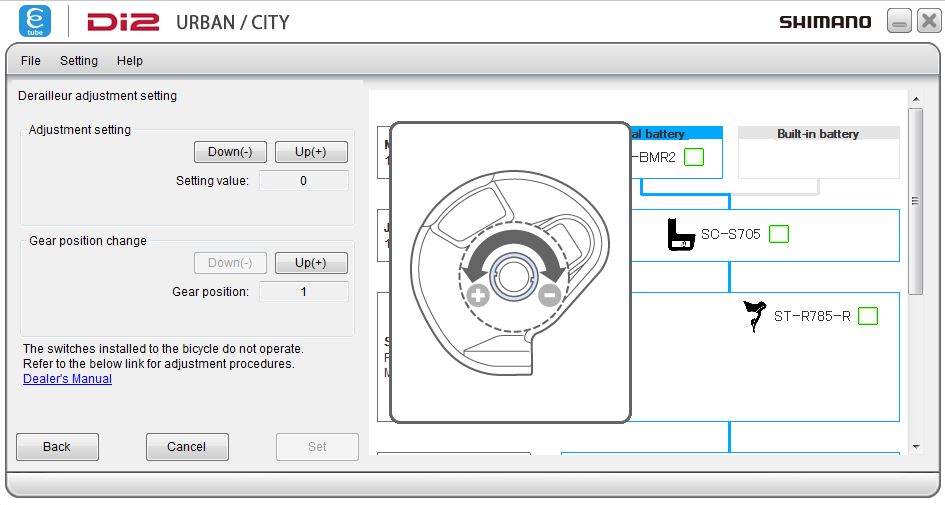
It is possible to re-program the Motor Unit to work with either the 8 speed or 11 speed Alfine Di2 system

There is a fine-tuning function for adjusting the Motor Unit, in case there is some problem with the shifting. Otherwise, the factory setting will be fine.

A new drop bar is required to convert this bike from flat handlebar to drop bar. As weight is not the main concern, while durability and all-weather ability is more important, I opted for an economical FSA aluminium drop bar, in my preferred compact shape.

FSA drop bar (42cm width) that is wider than usual (40cm), in order for better control during wet weather. Same concept as on cyclocross bikes.

Flat top that may be more comfortable for holding

Over 300 grams for this handlebar, which is 50% heavier than the lightweight FSA K-Force carbon drop bar that I am using on the Merida Scultura 5000 and Wheelsport Fantasy Mini Velo.

One downside to using this Avanti Inc 3 frame and modifying it to a road bike style is that the top tube length of the Avanti Inc 3 bike is quite long. In fact, it is about 25mm longer than the Merida Scultura 5000.

Therefore, I decided to compensate for the longer top tube by using a shorter stem.

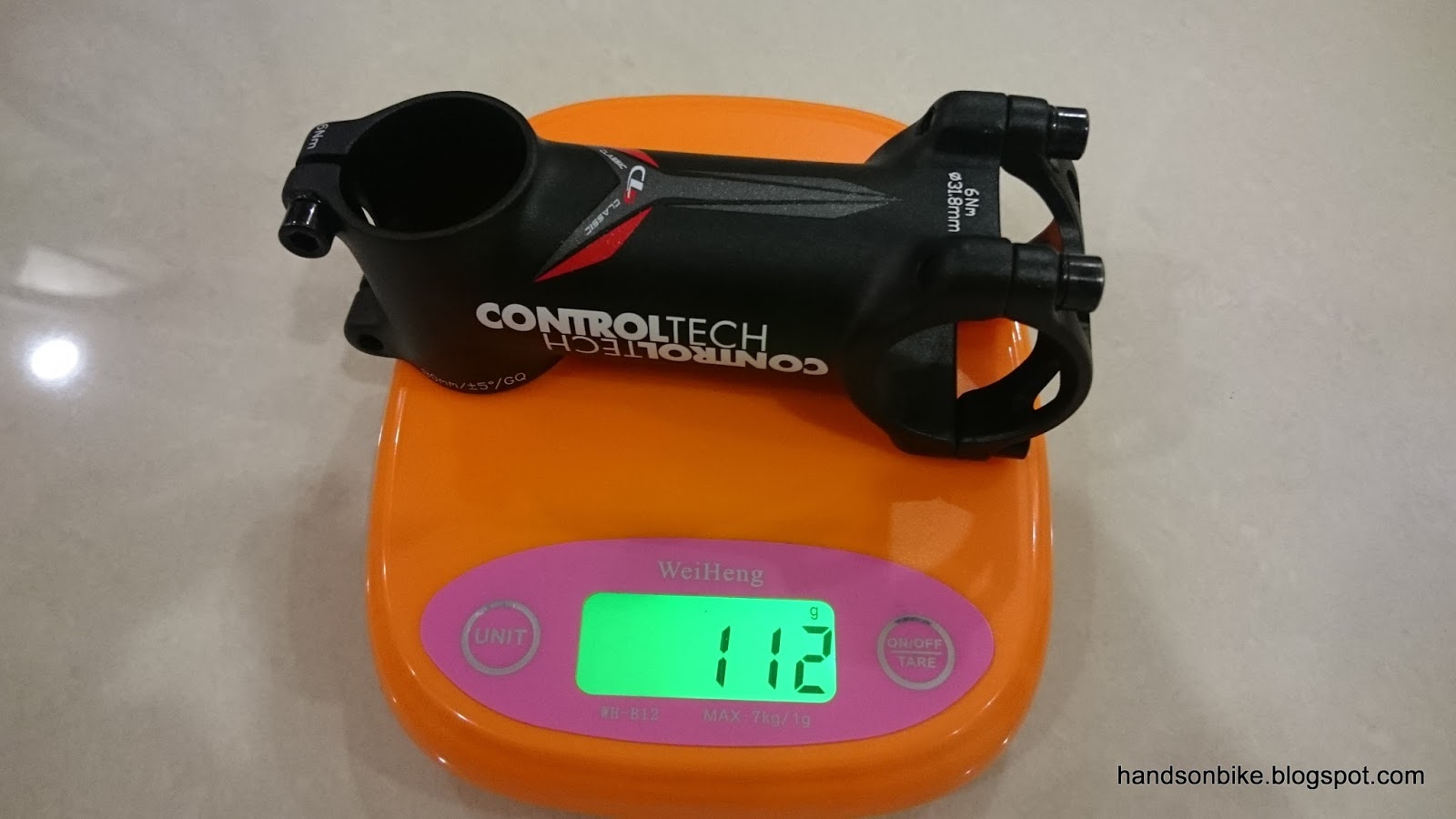
80mm Controltech stem

Looks very similar to the stock stem on the Merida Scultura 5000

Lightweight at only 112 grams

As a preview for Part 3, where the installation of all the new components will take place, here is a wheel weight comparison.

Weight of stock Alfine 11 (mechanical) rear wheel, without sprocket or disc rotor

Weight of new Alfine 11 Di2 rear wheel. Lighter by about 250 grams, mainly from the rim and spokes.

In the third part of this project, all the components will be installed onto the bike. Stay tuned for the updates and the pictures!

Part 3 here

Friday, June 24, 2016

Merida Reacto 4000: Part 2 - Disassembly (continued) and Restoration

This continues from the first part of the Merida Reacto 4000 disassembly, where the stock bike was being dismantled for cleaning. As the bike was quite dusty, it was necessary to remove the components for proper cleaning.

The next component to be removed was the crankset. As this is not the more common Hollowtech II crankset, it took me a while to figure out how to remove the crankset. Luckily it did not require any special tools, or it would not have been possible to remove it.

As a FSA Goassamer crankset, it is considered a mid-high end crankset, much like the Shimano 105 crankset. This FSA crankset does have a larger spindle which is 30mm in diameter, which is bigger and stiffer than the 24mm Hollowtech II type of spindle. Also, it has a BB386 spindle, which means that it is BB30 compatible, with a press fit BB width of 86mm.

Large diameter BB386 spindle looking pretty stiff

Weighs 519 grams on the right side including 52/36T chain rings

251 grams for the left crank arm, including the integrated crank bolt

Total weight of 777 grams including the spring washers. Very similar to the weight of the Shimano 105 5700 crankset.

Overall view of the clean crankset

Press fit bottom bracket in the frame. Nice and clean now!

After removing the crankset from the frame, it was easy to clean up the bottom bracket area. As it is a press fit bottom bracket, it is not worth the trouble to remove the bottom bracket.

Also note the rear caliper brake which is mounted underneath the chain stays, supposedly for better aerodynamics as compared to being mounted on the seat stays. It is also a direct mount brake, which should give better braking force as compared to the usual type that is mounted with the centre bolt. One major disadvantage of being mounted underneath is the difficulty of servicing the brakes. Most of the time, it is necessary to remove the crankset or chain rings to make adjustments to the brake, as the chain rings will block access to the brake.

This bottom mounted rear brake also does not have a quick release adjuster, which makes it more troublesome to remove the rear wheel. More elaboration on this issue can be found later on.

Bike frame is flipped upside down for better cleaning of the rear caliper brakes.

In order to allow the rear wheel to be removed, the rear caliper brake needs to be opened up. However, since there is no quick release adjuster, Merida added an inline cable adjuster to the rear brake cable, near the handlebar area (shown below). However, this is not ideal as it is not as convenient as a quick release lever, and is it not possible to get back the same cable tension setting after removing and installing the wheel.

Original setup, with the inline cable adjust for the rear brake.

A better solution is to use an inline quick release adjuster, such as the Shimano SM-CB90 Brake Cable Adjuster, which has a quick release lever. This should have been used, instead of the stock cable adjuster, since the rear brake does not have a quick release lever. I decided to change the stock adjuster to the SM-CB90 brake cable adjuster for future convenience.

At the same time, since the original brake cable adjust needed to be removed anyway, I changed out the rear section of the brake outer casing to a new section. This involved some internal routing through the frame, and so it took quite a bit of time and effort.

Changed to the SM-CB90 Brake Cable Adjuster, which is the correct part to match the rear brake caliper.

Rear section of the brake cable outer casing, passing through the frame

Direct mount front caliper brakes by Tektro. Cleaned and lubed for smooth operation.

Scuffed right side shifter and name plate, which was probably sustained at the same time as the scratches on the rear derailleur.


Cassette is clean and shiny after a thorough cleaning. As you can see, there is very little wear on the sprockets which means low mileage on this bike.

The shifters were not removed, because they were not really dusty, and also because it was too troublesome to remove the bar tape and the shifters. With that, the disassembly is complete!

Now, since most of the components are already off the bike, I took the chance to clean and wax the bike frame. As a bike frame with a glossy finish, it is great to make the frame nice and shiny again.

It is now time to reinstall all the cleaned up components. Assembly in progress!

Bike is partially assembled, to be continued!

Part 3 to be continued