Showing posts with label DT Swiss. Show all posts

Saturday, August 7, 2021

Cervelo Aspero: 650B and 700C Gravel Wheelset Comparison

Since I now have both a 700C and 650B wheelset for my Cervelo Aspero gravel bike, it is a good chance to do a side-by-side comparison. This will be useful for those who cannot decide between a 700C or 650B gravel wheelset.

As the wheels are different, the weight comparison is merely for reference. The Hunt 650B Adventure Carbon Disc wheelset is one of the best 650B wheels around, and is also very lightweight. On the other hand, the DT Swiss G 1800 wheelset is a basic aluminium gravel wheelset that is rather heavy.

650B wheel on the left, with brown sidewall WTB Venture 47 tires.

Both are using 11-42T 11 speed MTB cassettes.

650B wheel with WTB Venture 47 tires have a diameter of 681 mm.

700C wheel with WTB Byway tires have a diameter of 698 mm.

As you can see, there is a diameter difference of about 17 mm between these two wheelsets. It is expected, and this size difference will mean a different axle-to-ground height, and also BB ground clearance. The ride characteristic will also be slightly different, which is where the Trail Mixer position may be used to adjust the ride feeling.

Axle centre differs by about 8.5 mm, which is about half the diameter difference of 17 mm.

700C wheelset is noticeably larger than the 650B wheelset.

Very different tire treads. Smooth centreline on the 700C Byway, and grippy treads on the 650B Venture 47.

Tire width is different, as a smaller 650B tire can have a wider tire compared to a 700C tire, without frame interference.

Venture 47 measures true to size at 47 mm, on a 24 mm internal rim.

Byway measures 37 mm on a 24 mm internal rim, smaller than the claimed 40 mm width. I'm OK with this width as it is midway between the 27.5 mm GP5000 road tire and the 47 mm Venture 47 tire.

The 700C Byway has a tire width that is 10 mm narrower than the 650B Venture 47, which may or may not be a good thing. I'm hoping that the smooth centreline on the Byway will give me low rolling resistance on tarmac.

The height of the tire sidewall is very different. The black areas are about the same height, but the 650B tire has an additional brown sidewall height which adds a lot to the air volume inside the tire.

DT Swiss G 1800 front wheel with Byway tire and rotor weighs 1600 grams, which is quite heavy. Also partly because I am using inner tubes.

Hunt 650B carbon front wheel with Venture 47 tire and rotor weighs less, at 1448 grams. Although the tire is heavier, the carbon rim and tubeless setup saves quite a bit of weight.

DT Swiss G 1800 rear wheel with rotor and cassette weighs 2224 grams, which is also heavy.

Hunt 650B rear wheel with rotor and cassette weighs less at 2036 grams.

700C wheelset weight is thus 3824 grams, while the 650B wheelset weighs 3484 grams. If I used a high end carbon rim for the 700C wheel, plus tubeless setup, the final weight will be lighter than the 650B wheelset, as the 700C tires are usually lighter.

Main Differences:
1) 700C tire width is 10 mm narrower than the 650B tire.
2) 700C tire diameter is 17 mm larger than the 650B tire.
3) 700C wheelset is 340 grams heavier than the 650B wheelset.
4) 700C tire has a smooth centreline tread, which should make it roll smoother on tarmac.

It is nice to compare the specifications, but the final test is how well it rides on the road. For this 700C gravel wheelset, I need it to ride well on the road, while also being wide and grippy enough to handle some light gravel.

After extensive testing on the road and gravel, I found that this 700C gravel wheelset is rather disappointing. My expectation was smooth rolling on tarmac, due to the smooth centreline in the middle of the Byway tire. However, I could still feel a significant amount of drag, and it feels pretty slow to accelerate or cruise. In fact, my 650B wheelset feels even faster, even though the Venture 47 tire has a more knobbly tire on it. It could be due to the heavier DT Swiss G 1800 wheelset, instead of the Byway tire. Hard to conclude unless I put the Byway tires onto a lightweight set of 700C carbon gravel wheels to compare again.

As for light gravel riding, the Byway tire also does not perform very well. Due to the smooth centreline, it does not have sufficient grip. Compared to the 650B tires, I have to slow down a lot more on loose corners, to avoid sliding during cornering. This makes it a relatively poor gravel tire as well.

I just came across an article reviewing this exact tire, and the conclusion was the same as what I discovered. The rolling resistance was quite high, which is unexpected since there is a smooth centreline that is supposed to reduce rolling resistance.

In all, this Byway 700C tire is neither fast rolling on road, and also not grippy enough for proper gravel riding. I'm sure there are some good 700C gravel tires out there, but this is not the one. Unfortunately this 700C tire does not provide the characteristics that I want, so it is back to the 650B gravel wheelset on my Cervelo Aspero gravel bike.

Wednesday, July 28, 2021

Cervelo Aspero: 700C Gravel Wheelset

As mentioned in the previous post, I want to try out a proper 700C gravel wheelset equipped with a fast rolling tire. This will be meant for light gravel riding, where the largest volume and width is not necessary. It has to roll relatively well on smooth tarmac, and still be comfortable enough on light gravel trails.

To recap, these are the DT Swiss G 1800 wheels with the WTB Byway tires. Claimed tire width is 40 mm, but the actual width is 37 mm. Let's see how it looks on the Cervelo Aspero.
 
Front 700C gravel wheel installed on the Aspero.

Plenty of clearance at the fork crown area, and also at both sides of the tire.

Rear tire also has lots of clearance with the frame.

As usual, the tightest clearance would be at the chain stay areas. Still a comfortable gap here.

MT900 Ice-Tech disc brake rotors, with 11-42T cassette.

Using the same front single drivetrain, but with a 700C gravel wheelset.

Next step is of course to bring the bike out for a test ride. I found that my usual gravel track has been resurfaced with a new layer of gravel. Let's see how these new tires perform on this surface.

Fresh gravel! Unfortunately, the smooth centre tread does not perform well on loose gravel as there is not enough traction.

The gravel here is really loose and deep. Probably only fat bikes can ride through easily.

Picture of the Aspero with 700C gravel wheels out on the gravel.

With the black gravel wheelset and tires, it looks more like a road bike than a gravel bike.

How does it look? Still got to ride it more to see how it performs.

It is still too early to say how good the 700C gravel wheelset is. As the tire is narrower and smoother than the 650B Venture 47 tires, it is suitable for smoother paths.

My objective for using a 700C gravel wheelset is to use a smoother tire for faster riding on the road, on the way to the light gravel trail. Therefore, it will be important to see if the smooth tread along the centreline of the WTB Byway is useful or not. It should feel like something in between a pure road wheelset and the 650B gravel wheelset.

Friday, October 9, 2020

Fabike C3: Rear Dropout Thru Axle Conversion + Ultegra Crankset

I have been riding my Fabike C3 for about 2 years, on the Alfine 11 Di2, belt drive setup. It is a really good all-weather bike, as the combination of internal hub, belt drive, hydraulic disc brakes and full mudguards makes it rain proof and pretty much maintenance free.

However, the downside of this setup is noticeably more drag compared to a normal chain drive bike. Although the geometry is quite close to a proper road bike, with drop bars as well, it just feels slower than my road bike. The internal hub is heavier and a bit draggy, while the belt drive is not as efficient at transmitting power as a metal chain. It is probably a very fast commuting bike, but not as good as a proper road bike.

For my all-weather commuting bike, the most important feature is to be maintenance free. My understanding is that a chain will rust if left uncleaned and unlubricated after riding in the rain. The rear derailleur will also collect lots of dirt from riding in the rain. That was why I believed in using internal hub and belt drive.

However, I recently heard that the KMC EPT chain is virtually rust-proof, with some first-hand accounts to confirm this. If the chain does not rust, it also means maintenance free, except for some lubrication once in a while. If I am using a Di2 rear derailleur, there is no shifting cable to rust or get contaminated, so it should also be maintenance free. As for the cassette, higher end ones are also quite rust resistant, as I have not come across an Ultegra cassette that rusts.

With this new knowledge, I realized that it should be possible to build a chain drive, rain proof, road bike, by changing the internal hub + belt drive to a conventional cassette + chain + rear derailleur. This would make it ride more like a proper road bike, with good power transfer in the drivetrain. Basically what I wanted is a road bike with mudguards and weather resistant components.

The wonderful thing about the Fabike C3 frameset is the versatility. By changing the rear dropouts, the frame can accommodate a normal 12 mm E-thru axle and rear derailleur hanger. The cleverly designed rear dropout can accommodate internal hubs (135 mm OLD), when the non-turn washers are installed. When the non-turn washers are removed (3.5 mm thickness each), the frame OLD becomes 142 mm, which is the standard for road E-thru.

I emailed Fabio of Fabike, whom I bought the Fabike frameset from 2 years ago. He was very nice to send the rear dropout conversion kit over at no cost, although I have to pay for shipping.

Rear dropout on the left. I also requested for the front derailleur mount, in case I want to mount a front derailleur in the future.

The rear dropout is threaded for the E-thru axle to screw into.

The dropout is not fixed to the frame, but merely clamped onto the frame with the E-thru axle.

Prior to receiving the rear dropout, I also measured/estimated the E-thru axle length required. This differs from frame to frame, depending on dropout width and dropout design.

After measurement, I found that the thru axle length needed is about 169 mm. The thread is a standard M12 x 1.5 mm. That said, the Cervelo Aspero has a rear thru axle with a M12 x 1.75 mm thread. DT Swiss makes many E-thru axles and I really like the adjustable lever.

DT Swiss rear thru axle, with a removable and adjustable lever.

The thru axle comes with a nut, but it does not match the frame in this case.

The lever is removable for saving a bit of weight, while the lever angle is also adjustable.

Here is how it looks, with the thru axle screwed into the rear dropout.

Rear thru axle weighs 63 grams

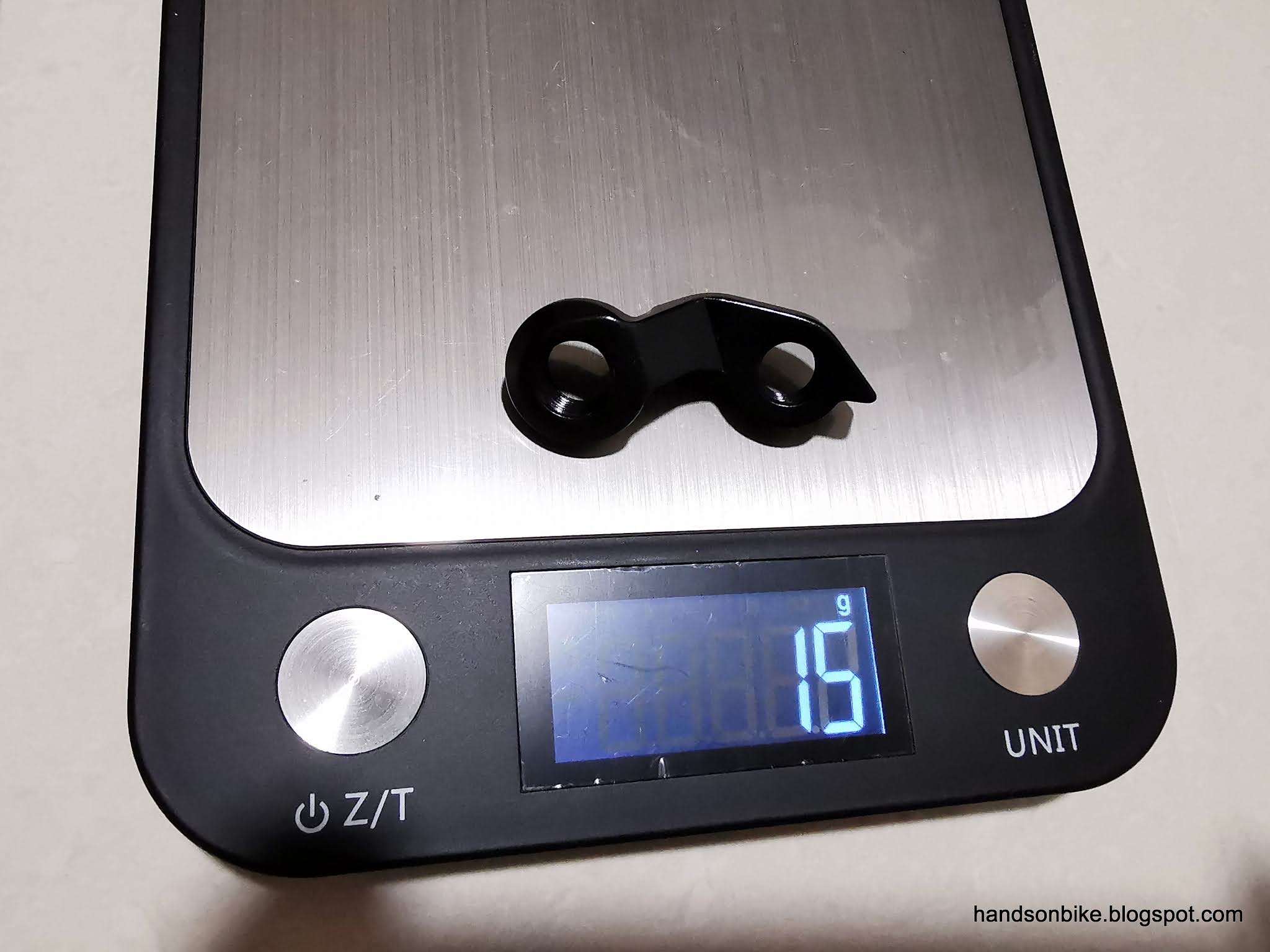
Rear dropout weighs 15 grams.

Previous dropout setup has two non-turn washers and two adapters, which weigh 18 grams in total.

In summary, changing the dropout design saves 3 grams (18 - 15 grams). The versatility of the dropout is really good to have, as I am not aware of any other frame that can convert between thru axle and nutted axle type.

Since I will be changing to chain drive, I will need a new chain ring as well. Previously I was using the Gates front sprocket with a Dura-Ace 7900 5 arm crankset, but I am not able to use this any more. This is because I got this Wolf Tooth narrow wide chain ring from a friend, and it requires a 4 arm Shimano crankset.

I have been using the Wolf Tooth narrow wide chain rings on many of my front single bikes, such as the folding bikes and the mini velos. It is my first choice for a front single chain ring, although it is quite pricey as well.

Based on my usage and experience, a 38T chain ring will give me the biggest sweet spot for gear range. Coupled with a 11 speed 11-32T cassette, the gear ratios are as shown below. Note that I am now using 27 inches as the wheel size for a 700C bike.

Although the ratio may seem low, it is ideal for my commuting, as there are no steep upslopes or downslopes. Most of the time, I will be cruising along at around 28 km/h in gear 8.

Gear range is from 32 to 93 gear inches, with a 38T chain ring and 11-32T cassette on a 700C wheel.

This 38T Wolf Tooth chain ring weighs 65 grams. Pretty lightweight as it is quite small.

4 chain ring bolts weigh just 8 grams.

Chain ring bolt length of 8.5 mm from Litepro is just nice, to attach the Wolf Tooth chain ring to a Shimano road crank arm.

Why not get more colours? Let's make this crankset look more unique.

4 different colours, which are coincidentally the Google colours.

I installed this chainring on the 4 arm Ultegra R8000 crankset, which is the same as what I installed on the Dahon MuSP.

Right side crankarm plus chain ring and bolts weigh just 396 grams.

Left crankarm plus bolt weighs just 194 grams.

The crankset weight is thus just 590 grams, which is a nice low weight. This is the first part of the conversion, where I showed the new dropout and the new 38T chain ring.

Sunday, April 5, 2020

Cervelo Aspero: 700C vs 650B Wheel Size Comparison - Part 1

Before I tried gravel riding, there was no need to consider wheel size or tire width. Basically, a road bike setup means using a 700C x 25 or 28 mm tire. The tire diameter or width is just what it is, there is no concern if the tire ends up a bit wider or narrower than claimed, or even a bit bigger or smaller in diameter.

However, when I first used a gravel setup on the Canyon Endurace, I found that depending on the tire width, the tire diameter will also be affected significantly, especially if the tire width differs a lot. This can be a problem, as a bike is designed around a nominal wheel size, with only a small variance allowed. If the wheel size differs too much, it affects the geometry of the bike.

Crank clearance with the ground will be reduced if the tire diameter is smaller. Also, the trail of the bike will be reduced with a smaller wheel size, which can cause instability.

If the tire diameter is larger, the usual problem is frame or fork clearance, but the bigger issue is a slower handling bike due to larger trail from the larger tire size. This may be good or bad depending on your desired purpose.

In this case, it is difficult for the bike frame designer to optimize for a single wheel size, if it needs to accommodate a wide range of tire diameters, from small 700C x 23 to large 700C x 43 mm, for example.

Which is why the Cervelo Aspero has a Trail Mixer on the fork which allows the trail value of the bike to be adjusted, depending on the wheel size and also your preference for a more agile or more stable bike.

I will not go through the explanation again on why I chose 650B wheels and tires, you can read about it in my previous posts.

DT Swiss G 1800 Spline DB 25 Wheelset
Panaracer GravelKing SK 700C x 32 Tires

Hunt 650B Adventure Carbon Disc Wheelset
Panaracer GravelKing SK 650B x 43 Tires

Before I compare the new 650B wheelset, I will compare the wheels used previously on the Canyon Endurace. That would be the Reynolds Assault carbon wheelset for the road setup, and the DT Swiss G 1800 wheelset for the gravel setup. Both are 700C wheels.

The Reynolds Assault wheelset is equipped with Continental GP4000 700C x 28 tires, but the actual tire width is almost 32 mm. This is due to the relatively wide internal rim width of 21 mm.

The DT Swiss G 1800 wheelset is equipped with Panaracer GravelKing SK 700C x 32 tires, with an actual tire width of 35 mm. This rim has an internal width of 24 mm.

Rim diameter looks almost similar, with the gravel wheelset being just a little big larger.

Close up look at the different tire tread patterns.

Tire diameter is very similar.

In this case, if the tire diameter is almost the same, swapping between the wheelsets will not cause significant differences in ride geometry. This was the case on the Canyon Endurace.

Moving on to the new Hunt 650B wheelset, the rim diameter is smaller, but the tire will add back some of the diameter by having a taller sidewall. A 700C rim has an outer diameter of 622 mm, while a 650B rim has an outer diameter of 584 mm. This is a difference of 38 mm, which means 19 mm on either side. If a 650B tire is to have the same outer diameter as a 700C tire, the side wall needs to be 19 mm taller, which is a huge difference.

650B x 43 mm tire on the left, 700C x 32C tire (actual 35 mm) on the right. The diameter difference is quite obvious.

The 650B wheelset on the right has a smaller diameter, as seen from the difference in axle height. This will also be the difference in bottom bracket or crank arm clearance.

Another view showing the difference in tire diameter.

Using a long thru axle to align the centre of the hubs, the difference in radius can be measured more accurately.

650B tire has a gap with the ground. Multiply this gap by 2 and you get the diameter difference.

Using a 10 mm Allen key as a gauge, there is still a tiny bit of clearance. I would say that the gap is about 11 mm.

Other than the diameter difference, there is a big tire width difference as well. The wider 650B tire on the right has 5 rows of small knobs instead of 3.

43 mm width on the left, versus 35 mm (actual) width on the right. This 8 mm width difference is quite obvious.

There is some difference in sidewall height, as the 650B tire on the left will have a taller side wall as it is wider. The height of the brown sidewall area is about the same, but the black sidewall area is much taller on the 650B tire.

Finally, let's also compare the 700C road wheelset with the new 650B gravel wheelset. These are the two wheelsets that I will use on the Cervelo Aspero. I will explain more about the road and gravel setup in a later post.

Hunt 650B wheelset on the left, for gravel riding. Reynolds Assault 700C wheelset on the right for road riding.

Significant difference in tire diameter between these two wheelsets.

Another view of the different tire diameter. Despite the wider tire width, the 650B tire does not add enough tire height to come close to the 700C tire diameter.

Difference in axle height, which is about 8 mm.

Big difference in tire width and tread pattern. 32 mm tire width vs 43 mm tire width.

Comparison of the tire sidewall height. The 650B tire is taller with much more volume, but not enough to make up for the smaller rim diameter.

In summary, here are the tire diameters as measured, and also the difference in BB to ground distance (which is calculated as half the difference in tire diameter).

Continental GP4000 700C x 28 (actual 32): 695 mm diameter
Panaracer GravelKing SK 700C x 32 (actual 35): 699 mm diameter
Panaracer GravelKing SK 650B x 43: 677 mm diameter

On Cervelo Aspero (Size 51)
BB to ground distance for Continental GP4000 (700C x 28): 268 mm
BB to ground distance for GravelKing SK (700C x 32): 270 mm
BB to ground distance for GravelKing SK (650B x 43): 259 mm

The differences between the 700C road and 700C gravel tires are small, while there is a big difference between the 700C road and 650B gravel tire. What does this mean?

Swapping from the 700C road wheelset to the 650B gravel wheelset will lower the bike by about 9 mm. That is 9 mm less crank arm clearance. Not sure if pedal strike will be an issue, as it has even lesser ground clearance compared to my other bikes.

On the plus side, a lower centre of gravity will help in cornering and descending at speed. A smaller tire diameter also means a lower trail value, which increases agility. Is increased agility good or bad for a gravel bike? This is up for debate, as increased agility can allow you to tackle twisty trails more easily, but also make a speedy descent less stable.

Regardless, the proof of the ride quality will require actual riding. Whether good or not, I will have to use the tires to see if it is suitable for my usage.

From left to right: GP4000 28 mm, GravelKing 43 mm, GravelKing 32 mm

The 650B wheelset is the junior here, having a smaller diameter than the other two.

This concludes the first part of this comparison, which is between these three tires. Later on, in Part 2, there will be an additional tire added to this comparison, stay tuned!