Showing posts with label Sunrace. Show all posts

Friday, September 17, 2021

Cervelo Aspero: Front Single Road and Gravel Drivetrain

From the first set up of the Cervelo Aspero, where I first used a 2x11 speed drivetrain for road and gravel riding, I have now changed to a dedicated 1x11 speed gravel drivetrain.

The Aspero is now a dedicated gravel bike, which is why I have changed some of the components to make it more suitable for gravel riding, instead of striking a balance previously between road and gravel usage.

Other than the drivetrain, I have also changed to the GRX Di2 shifters, which has ergonomics that are very well suited for gravel riding. The default wheelset is also the excellent Hunt 650B carbon wheelset, with WTB Venture 47 tires.

That said, if I want to, I can still swap it to a road wheelset, if I ever want to ride fast on the road with this Cervelo Aspero. This is because the Ascent Bikes Zenith Elite wheelset is using the Sunrace RX1 11-36T cassette, which is relatively similar in size to the SLX CS-M7000 11-42T cassette on the Hunt wheelset. Previously I have swapped between the 11-30T cassette and the 11-36T cassette, without adjusting the rear derailleur at all, so I think swapping between the 11-36T and 11-42T cassette is possible.

Default gravel wheelset on the left (Hunt 650B + Venture 47 tires + 11-42T cassette) and the road wheelset on the right (Zenith Elite + GP5000 tires + 11-36T cassette).

From the picture above, you can see that the external wheel diameters are similar. This post shows the size difference in detail. The Zenith Elite carbon wheelset is currently being used on the Focus Paralane, as my all-weather commuting road bike.

Road wheelset with 11-36T cassette installed on the Cervelo Aspero.

Distance between the largest 36T sprocket and the guide pulley is a little further, since the rear derailleur is set for a 42T large sprocket. However, shifting is still OK.

Looks good as a road bike too!

With a carbon road wheelset, this Aspero can be converted into a pretty fast bike as well. It is only limited by the small 38T chain ring, which is good for gravel riding but rather small for road riding.
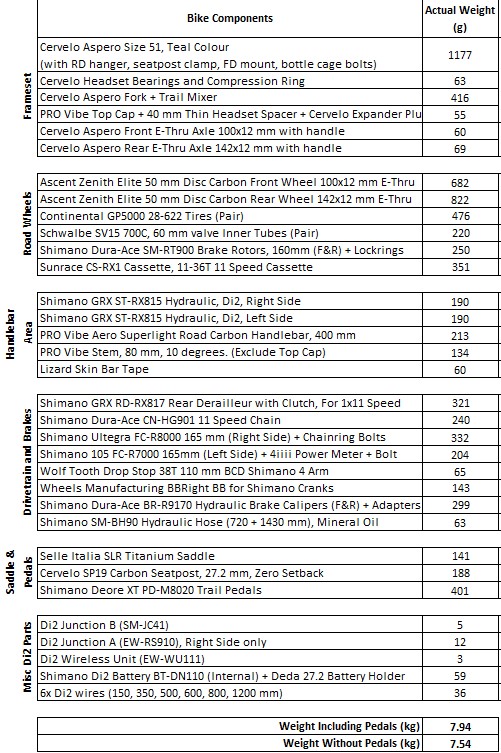
Full specifications of the Cervelo Aspero in road setup. Weighs about 7.5 kg without pedals.

As for the gravel setup, it will definitely be heavier, due to the heavier wheelset and larger cassette.

Installed the XTR RT-MT900 rotors onto the Hunt wheelset.


Full gravel setup

I think this setup is perfect for gravel riding!

The gravel setup weighs about 8.1 kg without pedals, with the additional 600 grams of weight coming from the wheelset.

Although it is possible for this Aspero to be set up as a road bike as shown above, it is not so likely that I will use it for road riding. I would just take the Focus Paralane instead, as it has more road specific components, such as a slightly larger chain ring and road shifters.

In any case, this Aspero is so versatile that it can be setup as a full road bike or full gravel bike, or anything in between.

Saturday, August 7, 2021

Cervelo Aspero: 650B and 700C Gravel Wheelset Comparison

Since I now have both a 700C and 650B wheelset for my Cervelo Aspero gravel bike, it is a good chance to do a side-by-side comparison. This will be useful for those who cannot decide between a 700C or 650B gravel wheelset.

As the wheels are different, the weight comparison is merely for reference. The Hunt 650B Adventure Carbon Disc wheelset is one of the best 650B wheels around, and is also very lightweight. On the other hand, the DT Swiss G 1800 wheelset is a basic aluminium gravel wheelset that is rather heavy.

650B wheel on the left, with brown sidewall WTB Venture 47 tires.

Both are using 11-42T 11 speed MTB cassettes.

650B wheel with WTB Venture 47 tires have a diameter of 681 mm.

700C wheel with WTB Byway tires have a diameter of 698 mm.

As you can see, there is a diameter difference of about 17 mm between these two wheelsets. It is expected, and this size difference will mean a different axle-to-ground height, and also BB ground clearance. The ride characteristic will also be slightly different, which is where the Trail Mixer position may be used to adjust the ride feeling.

Axle centre differs by about 8.5 mm, which is about half the diameter difference of 17 mm.

700C wheelset is noticeably larger than the 650B wheelset.

Very different tire treads. Smooth centreline on the 700C Byway, and grippy treads on the 650B Venture 47.

Tire width is different, as a smaller 650B tire can have a wider tire compared to a 700C tire, without frame interference.

Venture 47 measures true to size at 47 mm, on a 24 mm internal rim.

Byway measures 37 mm on a 24 mm internal rim, smaller than the claimed 40 mm width. I'm OK with this width as it is midway between the 27.5 mm GP5000 road tire and the 47 mm Venture 47 tire.

The 700C Byway has a tire width that is 10 mm narrower than the 650B Venture 47, which may or may not be a good thing. I'm hoping that the smooth centreline on the Byway will give me low rolling resistance on tarmac.

The height of the tire sidewall is very different. The black areas are about the same height, but the 650B tire has an additional brown sidewall height which adds a lot to the air volume inside the tire.

DT Swiss G 1800 front wheel with Byway tire and rotor weighs 1600 grams, which is quite heavy. Also partly because I am using inner tubes.

Hunt 650B carbon front wheel with Venture 47 tire and rotor weighs less, at 1448 grams. Although the tire is heavier, the carbon rim and tubeless setup saves quite a bit of weight.

DT Swiss G 1800 rear wheel with rotor and cassette weighs 2224 grams, which is also heavy.

Hunt 650B rear wheel with rotor and cassette weighs less at 2036 grams.

700C wheelset weight is thus 3824 grams, while the 650B wheelset weighs 3484 grams. If I used a high end carbon rim for the 700C wheel, plus tubeless setup, the final weight will be lighter than the 650B wheelset, as the 700C tires are usually lighter.

Main Differences:
1) 700C tire width is 10 mm narrower than the 650B tire.
2) 700C tire diameter is 17 mm larger than the 650B tire.
3) 700C wheelset is 340 grams heavier than the 650B wheelset.
4) 700C tire has a smooth centreline tread, which should make it roll smoother on tarmac.

It is nice to compare the specifications, but the final test is how well it rides on the road. For this 700C gravel wheelset, I need it to ride well on the road, while also being wide and grippy enough to handle some light gravel.

After extensive testing on the road and gravel, I found that this 700C gravel wheelset is rather disappointing. My expectation was smooth rolling on tarmac, due to the smooth centreline in the middle of the Byway tire. However, I could still feel a significant amount of drag, and it feels pretty slow to accelerate or cruise. In fact, my 650B wheelset feels even faster, even though the Venture 47 tire has a more knobbly tire on it. It could be due to the heavier DT Swiss G 1800 wheelset, instead of the Byway tire. Hard to conclude unless I put the Byway tires onto a lightweight set of 700C carbon gravel wheels to compare again.

As for light gravel riding, the Byway tire also does not perform very well. Due to the smooth centreline, it does not have sufficient grip. Compared to the 650B tires, I have to slow down a lot more on loose corners, to avoid sliding during cornering. This makes it a relatively poor gravel tire as well.

I just came across an article reviewing this exact tire, and the conclusion was the same as what I discovered. The rolling resistance was quite high, which is unexpected since there is a smooth centreline that is supposed to reduce rolling resistance.

In all, this Byway 700C tire is neither fast rolling on road, and also not grippy enough for proper gravel riding. I'm sure there are some good 700C gravel tires out there, but this is not the one. Unfortunately this 700C tire does not provide the characteristics that I want, so it is back to the 650B gravel wheelset on my Cervelo Aspero gravel bike.

Friday, July 23, 2021

Focus Paralane: Wide Gear Range with Sunrace RX1 Cassette

After I installed the Wolf Tooth Roadlink DM onto the Dura-Ace rear derailleur, the capability of the rear derailleur has theoretically increased. It should now be able to work on larger cassettes, beyond the recommended 30T largest sprocket.

I plan to install the Sunrace RX1 11-36T cassette onto the Focus Paralane, to increase the gear range for better climbing. This cassette comes from the Cervelo Aspero gravel bike, where I used it for gravel riding.

The previous cassette is 11-32T, which is good but I still need one more lower gear for steeper slopes. For 11 speeds, I believe this is the widest cassette that I can go, before the gear steps get too big for comfortable road riding. Remember, this Focus Paralane will also be my primary road bike, as I have installed all my best road bike components on it.

With the rear derailleur modified, the next step is to install this 11-36T cassette and see if it all works well together.

To recap, this 11-36T cassette from Sunrace weighs 351 grams. Not so lightweight, but still acceptable.

A 1.85 mm spacer is needed behind this cassette, as I will be using it on a 11 speed freehub body.

The red coloured lock ring and cassette spiders are the trademark of Sunrace cassettes.

Sunrace cassette installed on the Ascent Zenith Elite carbon wheelset! This wheelset and tires are probably one of the fastest available.

Here is how it looks at the lowest gear, with the rear derailleur fully stretched.

I purposely used a slightly shorter chain to provide higher chain tension, which will reduce chain slap when in the smaller sprockets. In this case, the rear derailleur cage is not over-stretched, so it is OK.

B-tension of the rear derailleur is adjusted to minimize the distance between the guide pulley and the 36T sprocket.

Still plenty of bolt length available on the B-tension screw, as this Roadlink can actually support up to 11-42T cassettes.

Chain position set in the middle of the cassette.

I used a cable tie to fix the Di2 wire to the Roadlink, so that there is no stray wire that can catch on objects.

With this Wolf Tooth Roadlink DM, the Dura-Ace rear derailleur can be used on the 11-36T cassette.

A front single drivetrain provides a clean setup and works for me, as long as you choose your gear ratio and gear range carefully.

After extensive testing, I am happy to report that this wider range 11-36T cassette works well for me. I get to keep all the high gears for relatively fast road riding, and yet I gain one additional low gear for climbing steeper slopes. I lose the 14T that was on the 11-32T cassette, but the jump from 15T to 13T is not an issue.

New gear range with 11-36T cassette

Shifting across all gears is good, except for the most outward gear, which is when I shift from the 12T to the 11T sprocket. For this shift, if I maintain high chain tension while shifting, it will not shift smoothly outwards to the 11T. Instead, the chain will remain on the 12T sprocket, while the rear derailleur has already moved to the 11T position. This leads to chain rubbing sound, until I perform the shift again.

To solve this, I need to reduce the chain tension by pedaling softly for a split second, during this outward shift. This will allow the chain to shift outwards from the 12T to the 11T smoothly with no delay. Most likely this issue is due to the larger distance between the rear derailleur guide pulley and the 11T sprocket, as the whole rear derailleur has been moved downwards due to the Roadlink.

I expect that this problem will become more severe if an even larger cassette is used, such as 11-40T or 11-42T cassette. Therefore, if there is a need for a larger cassette, just change to a MTB or gravel rear derailleur instead, like the Deore XT or GRX versions.

Other than this issue, there are no other shifting problems with this cassette and rear derailleur. Seems that this Roadlink is actually pretty useful and not just a gimmick.

Saturday, November 28, 2020

Cervelo Aspero: Sunrace RX1 11-36T Cassette

On the Cervelo Aspero, the gravel setup has a 11-34T Ultegra-grade cassette on the wheelset. The sprocket sizes on the 11-34T 11 speed cassette are 11-13-15-17-19-21-23-25-27-30-34. When I'm riding gravel, I usually use the smaller 34T inner chainring for lower gearing. Due to cross chain issues, I cannot use the top gear (11T) on the rear cassette. Of course, I can shift to the larger chain ring for higher gearing, but this is usually not necessary.

This means that my gravel gearing is from 27 to 70.6 gear inches (shown below), which is not quite high enough. When I need to go faster, I will need to use the large chain ring. The low gear is good, although I will sometimes wish for an even lower gear when climbing on off-road terrain.

There are effectively 16 non-overlapping gears on this setup, biased towards the small chain ring for gravel riding.

I was thinking of getting a cassette with an even larger sprocket, for even lower gearing. For Shimano cassettes, the next step up would be an 11-40T cassette, which is too big a jump. The rear derailleur also will not be able to reach both the 40T sprocket and 30T sprocket on the gravel and road setup respectively, as I tested earlier.

Then, I came across this Sunrace CSRX1 cassette which is marketed as a gravel cassette, with a 11-36T gear ratio. I had previously used a Sunrace cassette on the MTB, and it worked pretty well. Therefore I was willing to give it a try as I think the quality should be quite decent. There is also another important advantage over the 11-34T cassette which I will reveal later.

Disassembled view of the Sunrace CSRX1 11-36T cassette!

Largest two sprockets are 32T and 36T, mounted on an aluminium spider.

Next three sprockets are 21T, 24T and 28T, also mounted on an aluminium spider.

Remaining gears are all individual sprockets from 11T to 19T.

Large spider with 32T-36T sprockets weighs 127 grams

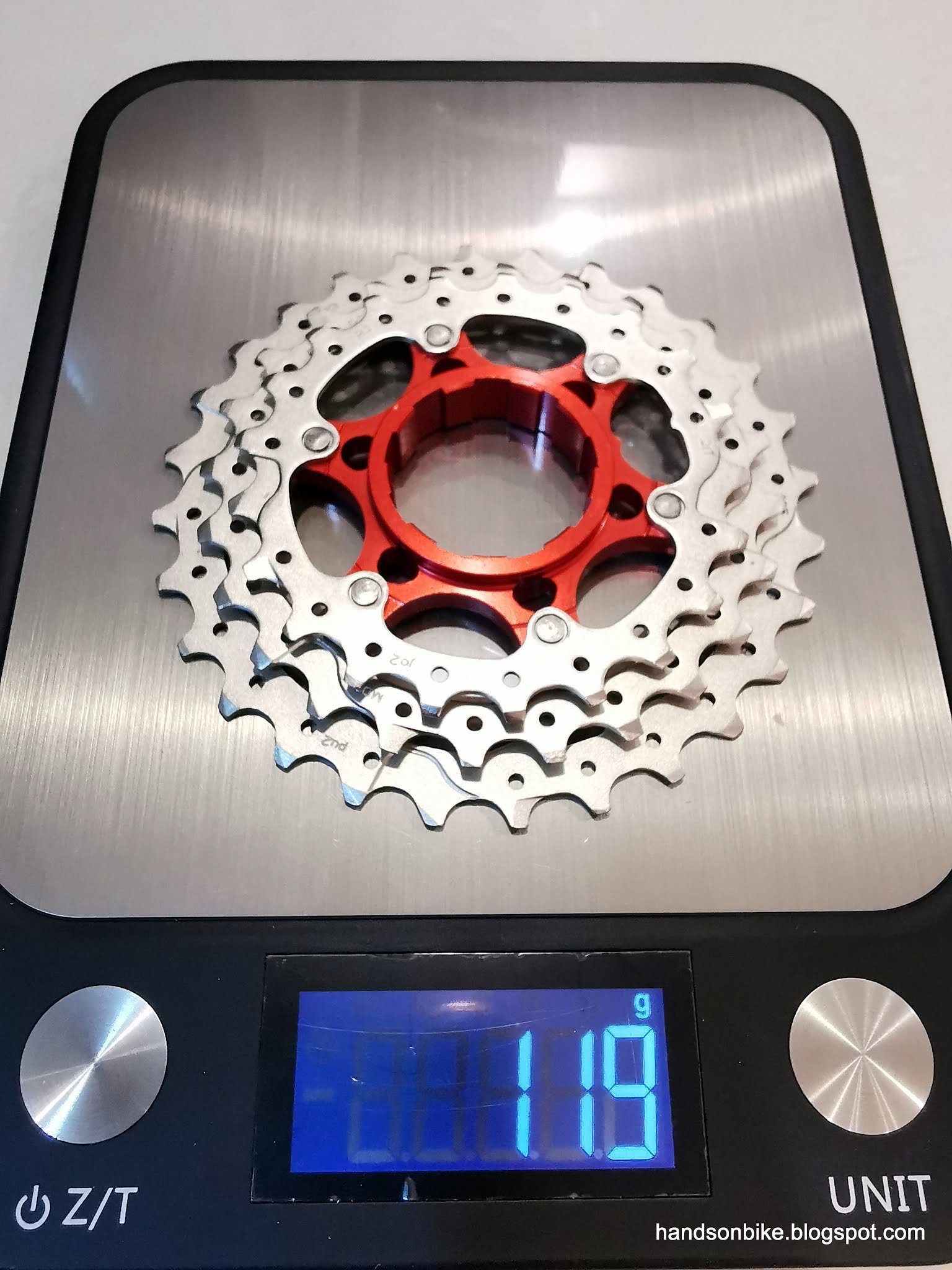
Small spider with 21T-24T-28T sprockets weighs 119 grams

There are two bright red aluminium spacers which weigh 5 grams in total.

Aluminium lock ring weighs 5 grams

Entire cassette weighs 351 grams, which is 14 grams more than the 11-34T cassette, and a huge 145 grams more than the Dura-Ace 11-30T cassette.

One interesting detail is the small stamped circle just above the larger spline, to help identify and orientate the sprocket during assembly to the freehub body.

I was not sure if I needed to use a 1.85 mm spacer behind the cassette, as I could not find any documentation online. If the CSRX1 cassette is designed for road hubs only, a 1.85 mm spacer is not required.

However, if the CSRX1 cassette is designed for older 8/9/10 speed hubs, then a 1.85 mm spacer will be necessary. Only way to find out is to try it out!

Without the 1.85 mm spacer, the 11T sprocket barely protrudes above the freehub body. When I tightened the lock ring, it will bottom out on the freehub body, leaving the sprockets still loose.

After adding the 1.85 mm spacer, there is more clearance for the lock ring to tighten properly.

In conclusion, this Sunrace CSRX1 11-36T cassette is designed based on 8/9/10 speed freehub body length. It can be fitted on older hubs without any spacer. However, since I am installing it on the new 11 speed road ready Hunt 650B Adventure Carbon Disc wheelset, an additional 1.85 mm spacer is necessary. 

11T to 36T sprockets all visible! The quality of the nickel plating looks good.

The bright red anodised aluminium spider can be considered an iconic feature of Sunrace cassettes.

Overall view of the gravel wheelset with the new cassette and Venture 47 650B tires!

Distance between the guide pulley and the largest 36T sprocket is set to the minimum possible.

When the gravel wheelset is changed to the road wheelset, with 11-30T cassette, the distance will become larger. Shown here is still the 36T sprocket.

How it looks when the chain is on the largest 36T sprocket

Gravel drivetrain!

Backpedaling in the 36T sprocket may cause chain drop, so avoid this.

The GRX RD-RX815 Di2 rear derailleur has been adjusted to accommodate both 11-36T cassette and 11-30T cassette, which is a pretty big difference. It is able to shift properly across all gears, in both inward and outward directions, for both cassettes. This is very impressive, to have such a robust rear derailleur that can cater to a large difference in cassette sizes, without adjustment between cassette swaps.

Sometimes the shifting is slightly delayed on the 11-30T cassette, but shifting is always successful, so it is acceptable. Considering that the rear derailleur was adjusted for the 11-36T cassette, I can accept this slight issue on the 11-30T cassette. Otherwise, the shifting performance of this Sunrace CSRX1 cassette is no problem at all.

The first advantage of this CSRX1 cassette is to have a slightly lower gear with the 36T sprocket, compared to the previous 34T low sprocket. As shown below, the lowest gear is now 25.5 gear inches instead of 27 gear inches. Not much, but good to have anyway.

With the 11-36T cassette, there are 15 distinct gears. Note and compare the lowest and highest gear when using the smaller chainring, against the previous table which shows the 11-34T cassette.

The second and more beneficial difference is the higher gear ratio that I get when using this new 11-36T cassette. Previously, the HG800 11-34T cassette has gear steps of 11-13-15-17-19..., while this CSRX1 cassette has gear steps of 11-12-13-15-17...

Note the presence of the 12T sprocket on the Sunrace cassette, which avoids the big gear ratio change compared to shifting from 13T to 11T directly.

As mentioned earlier, when I am in the smaller chain ring, I can use all the gears except the top gear (11T). Previously, on the 11-34T cassette, the second-top gear is the 13T sprocket. Now, on the 11-36T cassette, the second-top gear is the 12T sprocket.

Gravel range on HG800 11-34T cassette: 27 - 70.6 gear inches
Gravel range on RX1 11-36T cassette: 25.5 - 76.5 gear inches

The gearing effect of this new cassette is a slightly lower low gear, and a higher high gear, which means a wider gear range, spread over 10 speeds. This is for pure gravel riding, when I only use the small 34T inner chain ring. The new top gear ratio of 76.5 gear inches is enough even for fast gravel riding, which means that I can stay in the small inner chain ring almost 100% of the time.


Updated bike specifications, with the Sunrace CSRX1 11-36T cassette.

Overall bike weight is still about the same. In road bike mode, 7.4 kg without pedals. In gravel bike mode, add 700 grams, to be 8.1 kg without pedals.

I am happy with this change, as I have expanded the usable gear range, with no discernable downsides, except for a very slight weight increase and a slightly slower shifting performance.