Showing posts with label eTap AXS. Show all posts

Sunday, October 20, 2024

Birdy AXS: Suncord 4 Spoke Carbon Wheelset

New wheels for the Birdy AXS 12 speed folding bike! I will be upfront and say that I got these carbon wheels mainly for the looks, and partly for the lower weight. Other than that, I don't really care about the aerodynamics or performance of this wheelset.

Let's jump right into it and let the pictures tell the story!

These carbon wheels are made by Suncord, which is known for making aftermarket components for the Brompton.

These carbon wheels have a unique 4 spoke design! I initially wanted the 5 spoke design but was told it is no longer available and they have moved to 4 spokes for better comfort and lower weight.

Suncord logo splashed across the rim, in a style that reminds me of SRAM.

20" 406 wheel size, same as the Ascent Cirrus Elite carbon wheelset that is currently on the Birdy.

I chose the carbon weave design with a gloss finish, as it would be easier to clean compared to a matte carbon finish.

Due to the 4 arm design, there are no spoke holes on the rim at all. What you see here is the valve hole.

This also means that there is no need for rim tape since there are no spoke holes.

Internal rim width is 18.5 mm, which is slightly narrow but not too narrow like 16 mm.

External rim width is a healthy 26.5 mm.

Rim height is 38 mm, which is a nice balance between visuals and susceptibility to side winds.

The 4 arms blend into a large section in the middle where the hub is. This hub has Centerlock rotor mounting.

There is no traditional hub and hub shell in the middle. Rather, the carbon forms a cavity for the internals of the hub to be inserted and bonded.

Other side of the front wheel showing the "hub".


Non-drive side of the rear wheel showing the Centerlock splines. Interface between the hub and the carbon parts is interesting.

I believe the carbon rims/spokes are the same for the front and rear wheels, just that the hub components are different.

A glossy top coat makes these carbon wheels look shiny!

Front wheel weighs just 456 grams

Rear wheel is just 593 grams!

Ascent Cirrus Elite Carbon Wheelset (20" 406)
Front Wheel: 560 grams
Rear Wheel: 657 grams
Total: 1217 grams

Suncord 4 Spoke Carbon Wheelset (20" 406)
Front Wheel: 456 grams (104 grams less)
Rear Wheel: 593 grams (64 grams less)
Total: 1049 grams

This Suncord 4 spoke carbon wheelset is more than 160 grams lighter than the Ascent Cirrus Elite, which itself is already pretty lightweight! The only other 20" 406 wheelset that I know of that is lighter, is the Dahon Kinetix Pro wheelset that weighs just 998 grams. Even so, that wheelset has a narrow and shallow rim, as well as being rim brake compatible only, which makes it lighter than disc brake compatible wheels.

At the same time, I also ordered the Shimano HG spline freehub body, just in case I want to put on other cassettes.

Shimano HG spline freehub body, made of titanium to ensure durability while saving weight over a steel version.

Freehub body weighs 91 grams, which is heavier than aluminium ones but lighter than steel.

It uses a hybrid metal spring + magnets to activate the pawls. I first saw this kind of magnetic pawls on the Ascent Zenith Elite wheelset.

For this kind of hybrid pawl and ratchet system, the metal spring provides minimal spring force, to minimize the rolling resistance and energy lost during freewheeling. However, just reducing the spring force from a traditional pawl spring system would cause the drivetrain to slip and skip when you pedal hard, as the weak spring cannot prevent the pawls from slipping out of the ratchet during high torque conditions.

Therefore, the magnets on the pawls are designed to keep the pawls fully engaged in the ratchet, without requiring a high spring force to keep them there. Ideally, this system would maintain the engagement required during high torque conditions, while minimizing the energy lost during freewheeling. Hopefully it helps to reduce the freewheeling sound as well!

In the next few posts I will show the installation of the Suncord 4 spoke carbon wheelset onto the Birdy AXS.

Friday, November 17, 2023

Folding Bike 3-way Component Swap

This was a relatively complex bike modification project, as it involved 3 different bikes with many different components. Main reason for all these swapping is to upgrade to the latest components, and sell away the older and more basic components.

Flowchart showing the bikes before the component swap.

After the component swap

Sunday, April 16, 2023

Birdy AXS: Bike Geometry and Size Comparison with Fnhon

Before I disassemble the stock Birdy City folding bike for modifications and upgrading, I thought it would be a good idea to study the stock configuration, separated into Drivetrain Overview, Suspension and Brake System, Folding the Birdy Bike, and this post, which is a comparison post.

In this post, I will compare the geometry and size of the Birdy bike (unfolded and folded) with the Fnhon DB12. Other previous folding bike comparisons I have done are:


The reason I am comparing the Birdy to the Fnhon DB12 is because I plan to use the Birdy to replace my Fnhon DB12 as my go-to folding bike. Instead of adding a bike which makes it more difficult for me to choose, I prefer to do a 1-to-1 replacement. It will become my ideal bike for casual riding and also when bringing it to other places by car.

As such, the bike does not need a Brompton's compact fold, nor need to be wheeled around when folded. As long as it fits in a standard car boot it is fine. I do want the bike to be lightweight and fast, with high quality shifting and braking performance.

Overview of the bike shape and dimensions. Fnhon is using 20" 451 wheels, while the Birdy is using 18" 355 wheels (stock condition).

Saturday, March 4, 2023

SRAM Rival eTap AXS Road Shifter and Brake Caliper

For those who have not used SRAM road components before, here is a brief introduction. At the very top level, there is SRAM Red, followed by Force and then Rival. All 3 of these groupsets already have full wireless shifting, with no wires required anywhere.

Each of the shifters has its own coin battery, while the front and rear derailleur has a battery attached to each of them. Although it is a bit more troublesome to charge or replace many different batteries, it is super easy to setup. I liked how easy it was for me to setup the SRAM Force AXS rear derailleur and SRAM GX AXS shifter on the Fnhon DB12 folding bike.

I recently had the chance to study the SRAM Rival eTAP AXS road shifters and hydraulic brake caliper close up. Check out the detailed photos below to learn more about it!

The Rival shifters and brakes (right side only) comes in a HUGE box!

Friday, October 7, 2022

Shimano GRX Di2 vs SRAM Force eTap AXS: Rear Derailleur

Traditionally, rear derailleurs are either road type or MTB type, and were designed quite differently to meet the different requirements.

Road rear derailleurs are small and lightweight, and have short cages to match the road cassettes. On the other hand, MTB rear derailleurs are built to be tougher and thus heavier, and they also have long cages to match the wide range MTB cassettes. Most importantly, it is equipped with a clutch to prevent chain slap and chain drop when riding on bumpy terrain.

Then, in comes gravel riding, and neither road nor MTB rear derailleurs are completely suitable. Road rear derailleurs are a bit too delicate for gravel riding, and the absence of a clutch causes the chain to bounce too much and result in chain drops. MTB rear derailleurs work a bit better, but are also not completely suitable as they are not suited for closer range cassettes.

Shimano has their GRX range of gravel rear derailleurs, while SRAM has the Force 1x series for gravel setups. Here is a comparison between the two different gravel rear derailleurs by Shimano and SRAM.

There are 4 types of gravel rear derailleurs by Shimano. Either mechanical or electronic shifting, and either front single or front double drivetrains. Pick the one that matches your setup!

GRX Rear Derailleur RD-RX815, which is for 2x11 speed gravel drivetrains, up to 34T cassette size.

Saturday, May 14, 2022

Shimano Di2 vs SRAM eTap: Battery and Charger

Both Shimano and SRAM have their own electronic shifting drivetrains, and with that, batteries are required. Shimano has both internal and external batteries for their Di2 systems, while SRAM has only external batteries for its eTap and AXS systems.

Since I have both electronic systems, I wanted to do a comparison showing the differences in the batteries and also the battery chargers.

The Fnhon folding bike started with an 11 speed Shimano Di2 system, and was recently changed to a 12 speed SRAM AXS system. For details about how the systems were set up, refer to the Fnhon DB11/12 folding bike page.

The biggest difference between these systems is that the Shimano battery is wired to all the shifters and derailleurs, and powers all of these components with a single central battery. On the other hand, the SRAM system is wireless, and thus each derailleur requires its own battery. The SRAM shifters have their own coin battery as well.

SRAM eTap battery! Had to get it from a local shop as batteries can't be bought online.

7.4 volts and 300 mAh capacity. Lots of regulatory symbols!

Shimano Di2 battery has a larger capacity of 500 mAh, while the voltage is the same at 7.4 volts.

SRAM battery has its own battery cover for protection, when the battery is removed from the bike during transportation to avoid unintended battery drain.

Interestingly, the red cover has a switch that you can set to indicate whether this battery has a full charge or not.

Shimano Di2 battery has a transparent cover, but this is rarely used as you can leave the battery on the bike during transportation.

Side by side size comparison shows that the Shimano Di2 battery is much larger.

It is quite a lot larger, about 2 to 3 times larger by volume.

Difference in contact points. The Di2 battery plugs into the battery mount, while the eTap battery plugs to the derailleurs.

Shimano Di2 battery weighs 71 grams.

SRAM battery is a lot lighter at just 24 grams. Easy to carry a spare if you are worried about running out of juice.

Shimano Di2 battery is charged using a battery charger which is rather big in size.

Insert the battery, and the LED will show that it is being charged. The LED turns off when the battery is full.

SRAM battery charger, sold separately from the battery and other components.

This charger is a lot smaller in size.

LEDs show the charging status.

Size comparison of the battery chargers. The SRAM charger is much more compact in size.

Indicator lights on the chargers when the batteries are being charged.

In conclusion, the SRAM battery is smaller, but you need two of them if you run both a rear and front derailleur. Also, the SRAM system has a shorter run time, as the wireless protocol requires more power compared to the Shimano wired system.

On the other hand, the small SRAM battery makes it easy to carry a spare, or swap the front and rear battery if one of them runs out of juice.

Each system has its own pros and cons, although I am leaning towards the wireless system by SRAM which makes it super easy to set up, since no wire routing is required.

Friday, January 28, 2022

Fnhon DB12: SRAM eTap AXS 12 Speed Drivetrain

With much effort, the modification of the Fnhon folding bike has been completed! Since it has been converted from 11 speed to 12 speed, the name will change accordingly to Fnhon DB12.

Check out the previous posts for all the parts that are necessary to make this modification. For this post, I shall let the pictures do most of the talking instead of writing too much.

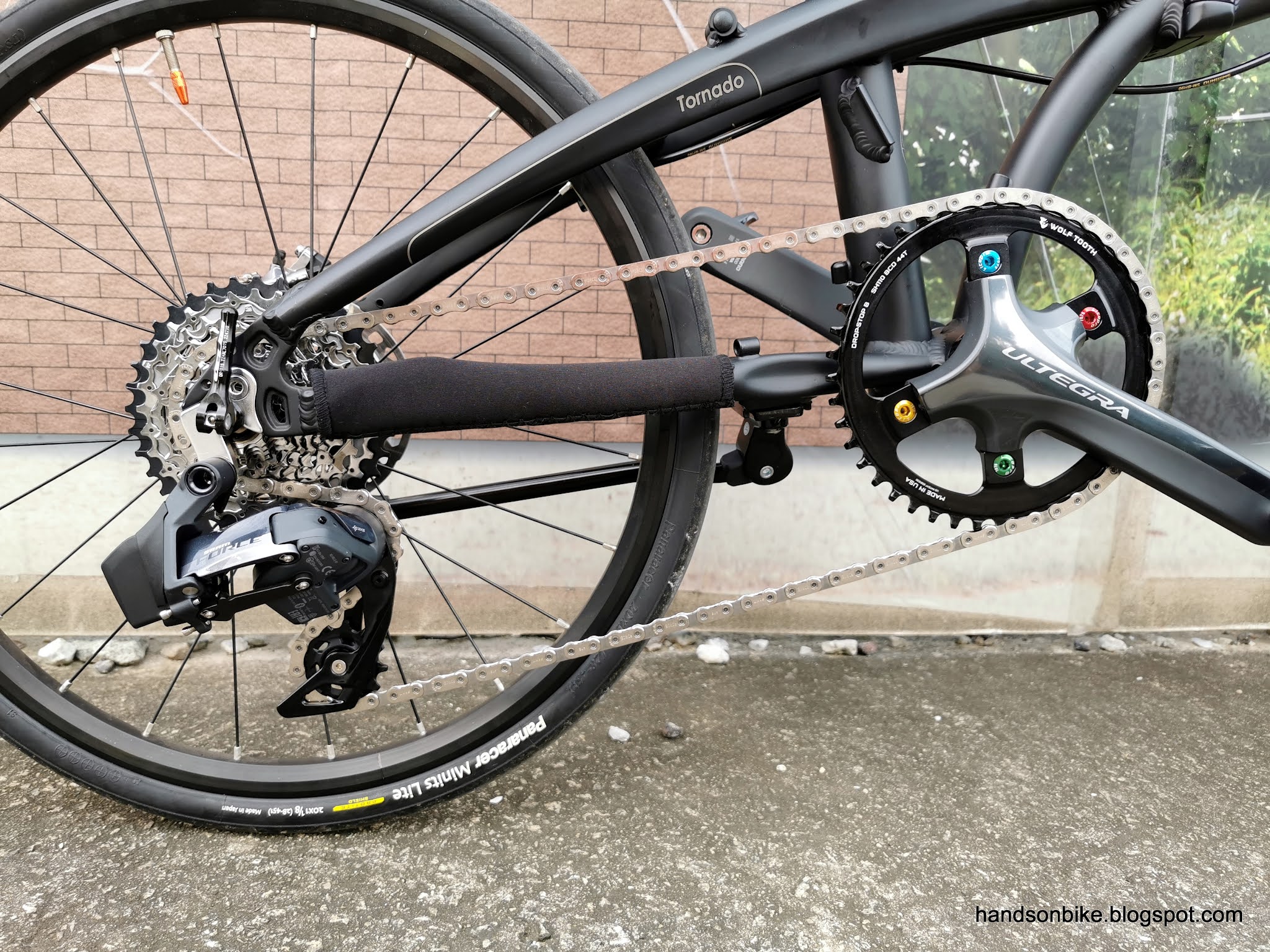
Full 1x12 speed setup completed! Minimal wire/cable routing, with only brake hoses required.

Unholy alliance of SRAM AXS drivetrain parts with an Ultegra 6800 crankarm.

Wolf Tooth 44T chain ring that is compatible to the SRAM 12 speed Flattop chain

Flattop chain gives a distinctive look to the drivetrain, this can be spotted from far away.

Heart of the SRAM AXS system! The 12 speed cassette and the Force AXS 12 speed wireless rear derailleur.


As mentioned in the earlier post, I made the chain as long as possible, without going slack in the smallest sprocket. This is opposite to the official recommendation, where the chain is made as short as possible, without over-stretching the rear derailleur in the largest sprocket. 

My intention of using a longer chain is to reduce the amount of tension on the rear derailleur cage, especially in the lower gears. There are pros and cons to this approach, which I will explain using the pictures below.

This is the rear derailleur in the top gear (smallest 10T sprocket). The chain is sized such that it just puts a bit of tension on the rear derailleur cage, without the chain going slack.

There is minimum chain tension and rear derailleur cage tension at this gear, which can lead to chain slap when riding on uneven terrain. This is where the clutch is supposed to do its job to minimize chain slap.

The rear derailleur sticks out quite a lot from the frame, unlike the Shimano shadow type rear derailleur where it is a lot closer to the frame.

At the lowest gear (largest 36T sprocket), the chain tension and rear derailleur cage tension does not go too high, as the cage is not stretched till it is almost straight.

Still a healthy clearance between the rear derailleur cage and the wheelset rim.

Pros of using a long chain:
1) Less chain tension can improve shifting performance.
2) Less rear derailleur cage tension means improved cage spring durability.

Cons of using a long chain:
1) With a lower chain and cage tension, the rear derailleur cage tends to bounce more when riding over uneven ground. This can be mitigated if your rear derailleur has a clutch.
2) Slightly more weight.

Pros of using a short chain:
1) Higher chain and cage tension can help to reduce chain slap.
2) Slightly lower weight.

Cons of using a short chain:
1) High chain tension can cause poorer shifting performance.
2) High cage tension can cause reduced cage spring durability.

Both ways will work fine, it is just that I usually prefer the long chain method for a front single drivetrain, where it is possible due to excess chain capacity (without front double chain ring).

Next, I will move on to the handlebar side, where the sole highlight is the new GX AXS wireless shifter. All other components such as the XTR brake levers and Ergon grips remain the same.

Final position of the shifter, after making a few adjustments to find the optimum position with good ergonomics.

Just a pod hanging off the brake lever clamp band, without any wire or cable coming out of it.

From the rider's point of view. I like how it looks with just two clamp bands, with no wires running around.

Looks good from the front as well, with just two brake levers and two hydraulic hoses visible.

Again, another unholy alliance where the SRAM shifter is attached to the Shimano brake lever with a third-party adapter.

Final bike specifications and weight! It actually gained about 70 grams over the previous version, mainly due to the heavier saddle, rear derailleur and bottom bracket.

The weight comparison is not entirely fair, as I changed other items at the same time, along with the 12 speed components.

For example, the non-related components that I also changed are the bottom bracket (+35 grams) and saddle (+65 grams). This contributed to a 100 gram increase, which is not related to the 11 to 12 speed change.

Therefore, if we exclude this non-related 100 grams, changing from the previous 11 speed Di2 setup to this 12 speed AXS setup saves about 30 grams. I would say there is no significant increase or decrease in weight from this modification.

Lowest gear ratio of 27 gear inches makes it easier to climb Lorong Sesuai.

Extended testing on the Green Corridor.

Went all the way to Peirce Reservoir for slope testing!

Here is a good look at the 1x12 speed drivetrain. Rear triangle looks very neat without any wires or cables.

The Flattop chain really gives the drivetrain a distinctive look. From far, I can see that this is a AXS 12 speed drivetrain, just by looking at the chain.

I am quite happy with this successful modification, as I have managed to increase the gear range, while tidying up the bike with no cables or Di2 wires. The overall weight difference is negligible as well. Most important of all, I have learnt quite a lot from this modification, as I was not familiar with the SRAM AXS system.

However, the downside of this SRAM AXS modification is poorer shifting performance, compared to the Shimano Di2 drivetrain. There are occasional mis-shifts at the smaller sprockets, which I am unable to resolve even with  rear derailleur adjustments. Solving the mis-shift issue at some gears would cause other gears to develop noise or mis-shifts instead.

On the other hand, the shifting performance at the lower gears (larger sprockets) are very smooth. In fact, sometimes it is so smooth that I cannot feel the gear change from the pedals! The lack of a gear indicator or display also forces me to look down at the cassette often to know which gear I am in. On the previous Di2 system, the Di2 display would show the gear number, and also emit a beep sound when I am at the extreme gears (1st or 11th gear)

Finally, there is more driving noise and chain vibration that can be felt through the chain and pedals, especially in the smaller sprockets.

That said, I don't regret changing to this AXS wireless system. It is something that is unique and good to try.