Showing posts with label Alfine 11. Show all posts

Sunday, November 18, 2018

Fabike C3: Assembly Part 2 - Road Bike Setup

In the previous post, the main components of the Fabike C3, such as the wheelset and the drivetrain were installed. Once that is done, the cockpit area can be set up properly. Let's now take a closer look at the new handlebar setup and also the full bike!

A completely new cockpit setup, with new handlebar, shifters, Di2 display and bar tape.

PRO PLT aluminium handlebar, mounted on the previous Controltech 80mm stem.

With the new Deore XT Di2 display, SC-MT800. Shows the selected gear and also the battery level.

Internal cable routing, for the Di2 wire and also the rear brake hose. The rubber grommet of the rear brake hose does not fit into the hole on the frame when fitted around the brake hose.

Thomson Elite seatpost after cutting to the correct length. Di2 battery is hidden inside this seatpost.

Using the same Dura-Ace 7900 5 arm crankset with the same 46T Gates chainring.

Belt tension adjusted with the eccentric bottom bracket


With Alfine Di2 motor unit mounted

Top view of the rear hub area and the Gates CDX carbon drive belt, with a length of 113T.

Maintenance-free drivetrain setup. With belt drive and internal hub, there is no chain or derailleur which will rust when used in wet weather.

Front hub with 12mm E-thru axle. The silver coloured DT Swiss front hub looks a bit out of place here when located next to all the other black components.

View of the DT Swiss ER 1600 Spline DB 32mm front wheel, with the Dura-Ace RT900 disc rotors.

Rear wheel with the same 160mm Dura-Ace RT900 disc rotors and non-series RS805 brake calipers.

View of the full bike! Looks and rides just like a normal road bike, which makes this an all-weather commuting road bike!

Other than the belt drive, the other components look the same as on normal road bikes. Also note the bent seat tube to allow a short chain stay and yet sufficient rear tire clearance.

Using the Canyon Endurace road bike as a reference, I tried to make the setup exactly the same on the Fabike C3, so that these two bikes will feel the same when I ride them. Previously, the Avanti Inc 3 commuting bike was more upright with a different geometry, which made it ride differently from the Canyon Endurace road bike.

The gearing is as shown below, which is the same as on the Avanti Inc 3. With a gear inch of 24 to 99, it is a good range that is more than enough for city commuting.

Gear ratios and range of the Fabike C3.

Using the bottom bracket as a datum for the whole bike, I adjusted the saddle position and handlebar position on the Fabike C3 to follow the Canyon Endurace. Basically, set the same distance from the bottom bracket to the saddle, and likewise to the handlebar.

However, after I set up the Fabike C3, I found that the saddle height and handlebar height is actually higher than the Canyon Endurace. Why is this so, even though I used the bottom bracket as a datum? Both the bikes have a distance of 64.5cm from bottom bracket center to the top of the saddle.

Putting the new Fabike C3 next to the Canyon Endurace, the saddle height is different by about 1 cm.

The shifter position on the Fabike C3 is also higher than the Canyon Endurace, by about 1 cm.

Upon checking again, I found that the bottom bracket height is different on these two bikes. On the Canyon Endurace, the distance from the center of the bottom bracket to the ground is about 27.5cm, while the distance on the Fabike C3 is slightly further at 28.5cm.

In other words, due to the eccentric bottom bracket adjustment, the Fabike C3 has a bottom bracket height that is 1 cm higher. As I used this point as the datum, both the saddle and handlebar position will be 1 cm higher, as what I have measured.

Therefore, these two bikes have the same riding geometry, just the the Fabike C3 is raised by 1 cm overall. This was my intention all along when I got this new Fabike C3 frame, which is to have a commuting bike that has the same geometry and riding feel as the Canyon Endurace road bike.

This bike is not quite all-weather yet, as the SKS mudguards have not yet been installed. That will be shown in the next post where all the accessories will be installed on this bike.

Saturday, November 10, 2018

Fabike C3: Assembly Part 1 - Component Installation

With all the components gathered, this new Fabike C3 commuting bike is now ready to be assembled! As already shown in the previous posts, there are many new components, such as the front wheel, brakes, handlebar, seat post and etc.

Before installing the components, I want to cut the fork steerer tube to the correct length. This will enable me to fix the handlebar position, which will then allow me to fix the shifter positions. Only when that is done, I can connect the Di2 wires, and also set the correct length for the hydraulic brake hoses.

I wanted this Fabike C3 to have the same geometry as my Canyon Endurace road bike, which is why I measured and used the same setup for the handlebar height, using the bottom bracket as the datum. Once this is done, I can cut the steerer tube to the required length, as it is definitely too long.

Cutting the carbon steerer tube at this blue line. After that, a spacer and top cap will be placed on top of the stem.

With the handlebar position fixed, all the Di2 wires can be connected, and the hydraulic brake hoses can be measured and cut to the required lengths. For this setup, the Junction B will be stored internally, within the down tube.

Wrapping the Junction B in sponge to prevent rattling, before stuffing it inside the down tube. The other bundle is actually the wire from the Di2 battery in the seat tube, which has a Di2 wire that is too long.

After running the Di2 wires internally, I can install the eccentric bottom bracket, followed by the crankset. This Dura-Ace 7900 crankset is the exact same one which I removed from the Avanti Inc 3, and I plugged it straight into this new frame.

However, I noticed that the Gates front chainring was rubbing against the frame, on the right side chainstay! There is insufficient clearance on this frame...

No clearance between the chainring and the frame, on the right side chainstay.

On the previous setup, the chainring was located on the INSIDE of the crankset, in order to match the chain line from the Alfine 11 Di2 internal hub at the rear. However, this is not possible on this frame due to interference.

In this case, I have to place the chainring on the OUTSIDE of the crankset, in order to avoid interference with the chainstay. This causes the chain line to be a little bit offset from the rear sprocket, but hopefully it will be OK.

Switching the chainring placement to the OUTSIDE of the crankset. Looks better in this case.

With the chainring located on the outside, there will be about 2mm of clearance with the chainstay, which is good.

Next, the rear wheel will be installed, and it will involve using the special rear dropout design described earlier.

First, the non turn washers will need to be slotted onto the hub axle. Then, the hub axle needs to be rotated so that the flats on the hub axle matches the opening on the frame.

In this orientation, the non turn washers cannot slot into the dropout. Therefore, the frame needs to be widened by a few millimeters, to allow both the hub axle and the non turn washers to be installed. Check out the pictures below.

Orienting the hub axle to slot it into the frame. Frame needs to be spread open slightly to allow the non turn washers to be slotted in at the same time.

After the hub axle is in place, rotate the hub axle, so that the profile of the non turn washers match the profile on the inside of the frame dropouts. Then, slot the non turn washers into the frame, to close up the frame.

Not sure if you are able to understand or follow the steps, but it is a very troublesome method, as many areas need to be aligned at the same time, for both left and right side of the hub axle. Also, note that I did not install the rear brake caliper yet, as spreading the frame will mean that the brake caliper will move to the side, and possibly bend the brake rotor.

Removing the rear wheel will be similarly tricky, as the non turn washers need to be pushed out from its slot on the frame, followed by rotating the hub axle to come out through the opening in the dropout. If I ever get a rear wheel puncture on this bike, I am not sure if I will bother to fix it at the side of the road, or catch a transport home to fix it later.

Anyway, that is probably the most difficult part of setting up this bike. With that settled, all other issues should not pose a big problem.

New Gates Centertrack 113T belt is needed for this frame, as the chainstay is quite short. I could not reuse the other longer 115T or 118T belts that I already had.

Once the belt is installed, it can be tensioned by rotating the eccentric bottom bracket as shown. One of the rare occasions where this tool is actually used!

Adjustment of this eccentric bottom bracket is not as straightforward as it seems. It is important to make sure that both sides of the eccentric bottom bracket are aligned, to prevent the crankset spindle from being tilted. However, since the adjustment is only done at the left side, it is necessary to make the right side follow the adjustment closely.

This synchronized adjustment is only possible if the 3 bolts on the eccentric bottom bracket are tightened, to minimize the play between the left and right side eccentric bottom bracket. However, if the 3 bolts are too tight, it will be clamped onto the frame and cannot be adjusted. This makes adjustment quite tricky. Once done, the 3 bolts are tightened to clamp both the left and right side to the frame, to fix the position.

As mentioned earlier, the change of front chainring position will cause the chainline to be offset slightly to the side. However, based on my testing, it seems to be OK as the belt is still able to roll on and off the chainring without any problems.

There are some other issues which I noticed during the installation of the components, which I will highlight below. These are not critical issues, but something that can definitely be improved upon by the frame maker.

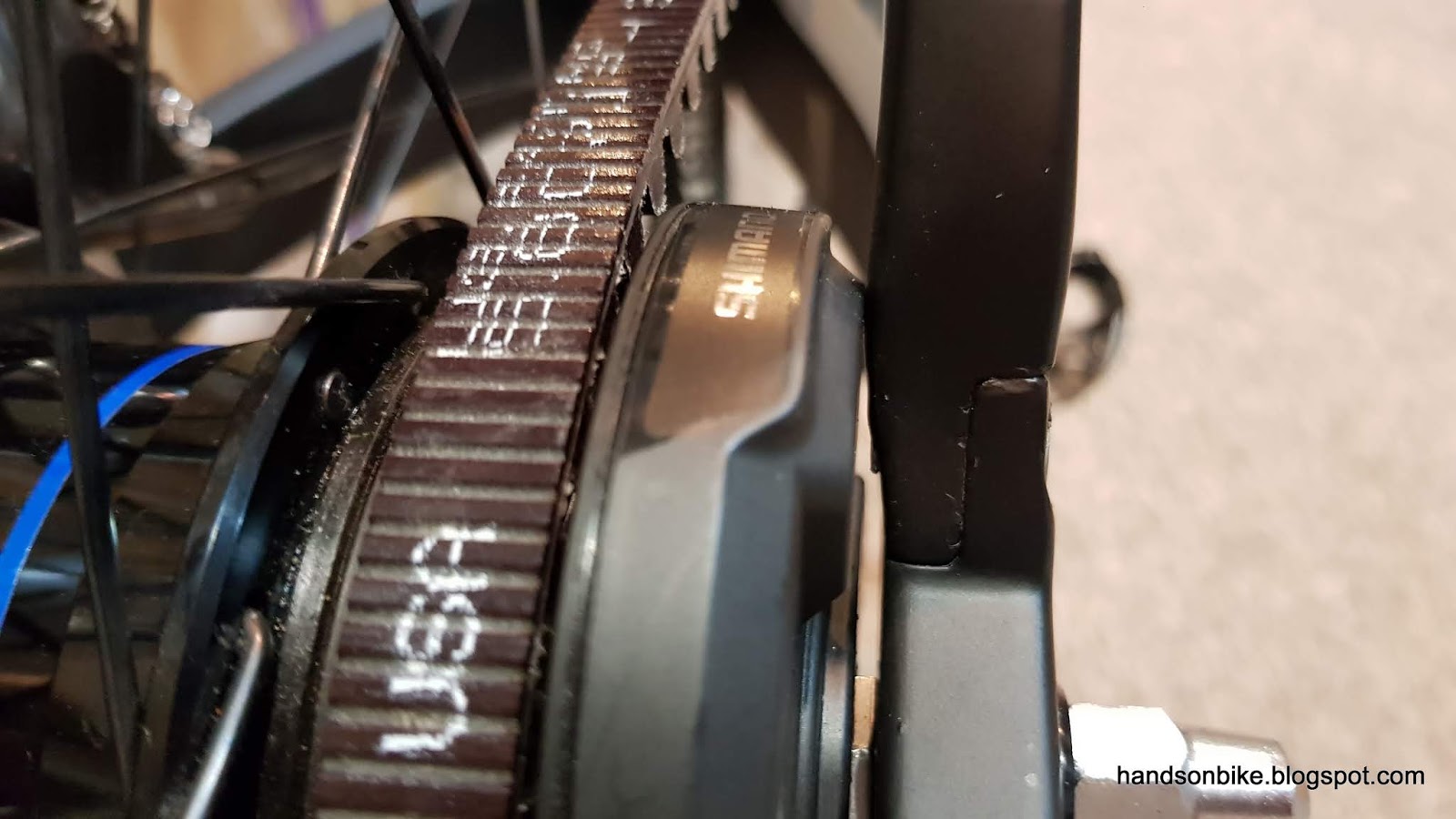
Slight touching between the Di2 motor unit and the inside of the right side seat stay. Can be solved by changing the angle of the non turn washer, or creating more clearance on the right side seat stay.

Once the hub axle angle is fixed by the non turn washer, the angle of the Di2 wire points downwards by 45 degrees, instead of being horizontal. This is not as neat, and can be solved by changing the angle of the non turn washer.

Rubber grommets at the head tube for Di2 wire and hydraulic brake hose do not fit well. The Di2 wire grommet fits too loosely into the hole on the frame, while the grommet for the brake hose becomes too big, and cannot be fitted into the hole on the frame. Can be solved by sizing the hole and rubber grommet properly.

When the wheels are installed, there is quite a small clearance between the tire and the frame. To be fair, these are 28C tires which come up to 32mm wide on these rims. Hopefully the mudguards will fit in this small gap!

Same for the front, there is small clearance between the tire and the fork. Need to fit the mudguard into the small gap without rubbing the tire.

Mounting point for front mudguard is hidden at the back of the fork, which is neat. Slight peeling off of the paint here, but not a big issue.

More to come in the next post!

Wednesday, October 10, 2018

Fabike C3: Eccentric BB, Headset, Rear Dropout

After studying the Fabike C3 frame and fork in the earlier post, let's take a more detailed look at the unique features of this frame. Being a belt drive compatible carbon frame bike already makes it unique, but that is not all. There are other interesting features of the frame that are rarely found on other bikes, or even exclusive to Fabike only.

For a belt drive or single speed bike, it is necessary to tension the belt or chain without a rear derailleur. The usual methods are to use a horizontal dropout, a sliding rear dropout, an eccentric bottom bracket, or an external chain tensioner. Regardless of the method, the fundamental idea is to allow adjustment of the chainstay length, or more precisely, the distance between the centre of the front chainring and the centre of the rear sprocket. Each method has its pros and cons, let's take a look.

Horizontal Dropout:
- Nutted axles are usually recommended, as quick release axles are sometimes not tight enough to prevent rear hub movement during strong pedaling.
- Realignment of the rear wheel is needed whenever the rear hub is removed from the dropout.
- Probably the most lightweight method as there is no additional part required, unlike other methods.
- Not suitable for disc brake bikes as the rear brake caliper (which has a fixed position on the frame) cannot always be aligned properly with the disc rotor.
Horizontal dropout allows the whole hub to slide forward/backward for chain tensioning.

Sliding Rear Dropout:
- Suitable for disc brakes as the disc brake mount slides together with the dropout, ensuring proper alignment between brake caliper and rotor.
- Relatively heavy and looks bulky.
- Need to align the left and right side dropouts properly, to prevent the rear wheel from slanting to one side.
- Wheel removal or installation is easy as it is just a horizontal dropout.
- No problem with using quick release axles or thru-axles.
Sliding rear dropout, where the brake caliper moves along with the rear hub.

Eccentric Bottom Bracket:
- Suitable for any types of brakes as the rear dropout is just a standard vertical dropout.
- Clean appearance as the large eccentric bottom bracket is not so obvious compared to other tensioning methods.
- Relatively heavy as the additional eccentric bottom bracket needs to be quite solid.
- Consistent belt/chain tension, as the tension is not affected when the rear wheel is removed or installed.
- Easy to make fine adjustments, just by rotating the eccentric bottom bracket.
- Bottom bracket height will vary, depending on how it is adjusted.
- Can cause creaking if not greased or installed properly.
Off-centre hole is where a standard bottom bracket is installed. This was from the Avanti Inc 3.

Chain Tensioner:
- Not so neat appearance, as it looks very much like a conventional rear derailleur.
- Can also be made by converting an old rear derailleur.
- DATT dropout mounting point needed, and this is most commonly used when converting a normal bike with derailleur to single speed/internal hub.
- Adds some weight as compared to horizontal dropout.
- Chain length is not really important as the chain tensioner will just take up the slack.
- Wheel removal is easy as it works on a standard vertical dropout.
Chain tensioner will be used, when all other methods are not available.

For me, my preference is to use an eccentric bottom bracket, as it looks the neatest, and is the easiest to use. Once it is set properly, there is no need to adjust it anymore. Wheel removal or installation is also easy as the rear dropout is just a normal vertical dropout.

I first came across an eccentric bottom bracket on the Avanti Inc 3, and I want to have the same design on this new Fabike C3 frame. The previous C2 frame was using a sliding rear dropout, but this new C3 version is now using an eccentric bottom bracket.

Looking inside the bottom bracket shell. Can see the rear brake hose which is routed internally, which was already installed when the frame was delivered.

This eccentric bottom bracket shell design is actually quite clever. Instead of using a non-standard, large 55mm diameter hole like on the Avanti Inc 3, this Fabike C3 frame uses a more standard size. The hole on this Fabike C3 frame has a diameter of 46mm, which is actually the same size as that used for a Press Fit 30 bottom bracket! In other words, if you don't need an eccentric bottom bracket, the same frame can accept a Press Fit 30 bottom bracket. Clever way to make sure that the frame design is not limited to using a less common eccentric bottom bracket!

Of course this requires an eccentric bottom bracket that has an outer diameter of 46mm to fit this frame. It is quite easily found, and is similar in design to the 55mm diameter eccentric bottom bracket.

Fabio from Fabike was kind enough to include this eccentric bottom bracket at no extra charge, and it seems to be an OEM version as there is no brand logo on it. Wheels Manufacturing also has it available if you need one aftermarket. The version that I have converts a Press Fit 30 bottom bracket shell to an eccentric type with 24mm Shimano crank spindle size.

Press Fit 30 to 24mm, eccentric bottom bracket. One good thing is that this weight of 168 grams already includes the sealed bearings for the bottom bracket.

Clamping area should be at the bottom as advised by the eccentric bottom bracket maker. Notches at the side allow adjustment by rotation.

I am pleased with this bottom bracket design, as it allows the usage of an eccentric bottom bracket, and is also quite lightweight as the bottom bracket bearings are already included. The only tricky part is aligning the left and right side, when rotating the eccentric bottom bracket. Moving on, let's take a look at the headset.

The headset design is quite standard, which is no problem at all. It is of an integrated headset cup design, which means that the cups for the bearings are already molded/machined into the frame. There is no need to press in any headset cups which means lower weight and also less work for me. This design is the same as that used on the Canyon Endurace.

Integrated headset cups for the sealed bearings. Just place the bearings into the cups and it is done!

Headset parts, also included with the frame. The blue part is the top headset cover, which comes in a few different colours for you to choose. The two sealed bearings are of different size, with the larger one at the bottom for more rigidity.

Weight of headset is 70 grams which is quite standard. Not possible to save weight here when the headset cups have already been integrated into the frame.

Weight of top cap and spacers. Just an rough estimate, as the exact spacer height has not been measured or determined yet.

Finally, the most unique part of this frame is the rear dropout design. This is an exclusive design which was created by Fabike, and I have never seen this design before. Fundamentally it is a vertical dropout, but it is different as the non-turn washers for the internal hub is integrated into the dropout design.

Normally, the non-turn washers for the internal hub are fitted outside of the dropout. This means that the coloured non-turn washers will be visible from the sides of the bike.

Blue non-turn washer visible at the rear dropout area, in between the dropout and the axle nut.

Usual installation steps for non-turn washers:
Install hub into dropout > Slide non-turn washers onto hub axle > Rotate hub axle + washers until washers can slide sideways into dropout > Tighten axle nuts

For this unique Fabike design, I think there are two main purposes for designing a new non-turn washer. First, it is to hide the non-turn washers on the inside of the rear dropout, for a cleaner appearance from the outside. The other reason is to make the dropout design interchangeable, so that the same frame can also accept normal rear hubs with quick release axles or thru-axles.

My initial thought was that this non-turn washer slides upwards into the corresponding slot on the frame rear dropout. This steel non-turn washer can be flipped if the angle of the flat needs to be reversed.

One problem with this design is that the installation method is quite unusual. The slot on the dropout (on the carbon frame) is only wide enough for the flat portion of the hub axle to slide through. This angle is different from the angle of the steel non-turn washer. In other words, it is not possible to slide the hub axle and the non-turn washer vertically into the frame at the same time.

The official method from Fabike is to first widen the dropout temporarily by manually widening the frame slightly, then adjust the hub axle angle to slot through the frame. The non-turn washers should already be on the hub axle. After that, rotate the hub axle, to align the non-turn washers with the shape on the frame. Once aligned, the non-turn washers can be slid sideways into the slots on the frame. It is quite difficult to visualize here, will try to elaborate more in a later post.

While testing this method using another hub, I found a problem with this non-turn washer design. For internal hubs, the flat area on the hub axle does not extend all the way to the lock nut! In this case, the special non-turn washers cannot be slid all the way in to touch the lock nut, there will be a gap remaining.

Flat area on the hub axle does not extend all the way to the locknut, which prevents the non-turn washer from touching the locknut.

This is a big problem, as the non-turn washer needs to rest flat against the lock nut of the hub. There cannot be a gap, or the clamping force from the axle nuts will deform the threads on the hub axle. The only way to solve this is to file the hub axle, so that the flat area extends all the way to the lock nut.

Filing the flat areas of the hub axle is quite straightforward, as long as you don't damage any other parts of the hub. The only point to take note is to avoid filing away too much of the lock nut. This needs to be done 4 times, twice on each side.

After filing the hub axle, the flat area has been extended to reach the lock nut.

The non-turn washer should be able to rest flat on the lock nut of the hub axle, once done correctly.

As described earlier, the non-turn washers need to slide into the frame sideways, instead of vertically upwards from the bottom opening. The fitting between the non-turn washers and the shape on the frame is quite tight, so it is difficult to align it properly for installation. In order to make this a bit easier, I decided to file a small chamfer on the outside edges of the non-turn washers, to make it easier to slide the washers sideways into the frame.

Manually filing the chamfers onto the edges of the non-turn washers.

Weight of the axle nuts is 34 grams.

By now, it should be obvious that this Fabike C3 has a special dropout design, which take quite a bit of effort to modify, adjust and improve. I would have much preferred it to use just a conventional vertical dropout design with standard non-turn washers. That would make the installation so much easier and hassle free. The only downside are the visible non-turn washers from the outside, but that does not bother me at all.