Showing posts with label MTB. Show all posts

Sunday, September 24, 2023

12 Speed Cassette Comparison: XTR CS-M9101 vs Dura-Ace CS-R9200

Hot on the heels of the previous comparison post (12 speed vs 11 speed): Instead of comparing within the same category (XTR to XTR, or XTR to Deore XT), I can also compare across categories, from MTB to Road. This kind of cross-category comparison is usually not meaningful, as they have very different intended usage. For example, it is not so useful to compare shifters, derailleurs or cranksets across categories.

For cassettes, cross-category comparisons are possible, because the design and intended usage is more similar. In fact, old MTB cassettes (up to 42T sprocket) has becomes the new gravel cassettes. A more extreme case is that older MTB cassette ratios such as 11-34T for a 2x10 or 3x10 speed MTB drivetrain, is now found on road bike cassettes nowadays.

Today's comparison will be rather brief, as the details of each cassette can be found in their respective posts. This time, the comparison is between two 12 speed cassettes. The XTR 10-51T CS-M9101 vs Dura-Ace 11-30T CS-R9200.

Large 10-51T 12 speed cassette, the XTR CS-M9101. It is also available in a tighter 10-45T specification.

Dura-Ace 12 speed cassette, CS-R9200 is available in 11-30T and 11-34T versions.

Saturday, September 23, 2023

XTR Cassette Comparison: 11 Speed M9001 vs 12 Speed M9101

Following up on the previous introduction post on the XTR 10-51T CS-M9101 12 speed cassette, here is a comparison post that is related. Before XTR moved to 12 speed, it had a 11 speed cassette, the CS-M9001 cassette. Although both are XTR cassettes, the differences are much more than just adding one more gear.

XTR 12 speed cassette on the left has 8 riveted gears and 4 loose sprockets, while the 11 speed cassette on the right has 4 sets of riveted sprockets, and 3 loose sprockets.

Sunday, September 17, 2023

XTR 12 Speed Cassette CS-M9101 10-51T

I had a chance to borrow a Shimano XTR 12 speed cassette to study, and I decided to make a few comparison posts from this. Usually, my comparison posts on cassettes are based on road cassettes such as Dura-Ace or Ultegra, as they are much more common on my bikes. I do have a few posts comparing MTB cassettes (XTR vs Deore XT vs SLX), or the S-Ride vs SRAM MTB 12 speed cassettes.

Let's take a look at this XTR cassette in detail, and compare it to other cassettes in separate posts.

Shimano XTR CS-M9101 10-51T 12 speed cassette! Also available in 10-45T specification.

All 12 gears shown here. Largest 3 gears are black in colour to help hide the sheer size of the cassette.

Sunday, March 5, 2023

XTR Pedals: M9100 Race vs M9120 Trail

Here is another comparison post, where I will compare different XTR SPD pedals. Previously, I had compared two different generations of XTR Trail pedals, PD-M9020 vs the newer PD-M9120. This time, I will compare two pedals from the same generation, but of different types.

There are two types of XTR SPD pedals, the Race type and the Trail type. The main difference is the presence of a pedal cage around the SPD mechanism on the Trail type pedal. From what I understand, the pedal cage is to help support the shoe and the foot in case the rider did not clip in successfully, or if the rider is using a non-SPD shoe for short or casual riding.

On the Specialized Aethos, I installed the Race type XTR PD-M9100 SPD pedal, which is a minimalist SPD pedal with no pedal cage. With that information available, I can do a detailed comparison between the Race type (PD-M9100) and the Trail type (PD-M9120).

XTR level packaging! The Trail pedal needs a bigger box due to the larger pedal size.

Trail PD-M9120 vs Race PD-M9100. Make sure you get the correct type for your usage.

PD-M9120 Trail pedals on the left, PD-M9100 Race pedals on the right.

Thursday, August 20, 2020

Cervelo Aspero: Off-Road Riding and Chain Ring Clearance

As a gravel bike, the Cervelo Aspero is able to tackle light trails with ease. Dirt tracks and grassy routes should be no problem for this bike, as long as suitable tires are used.

Since I have already changed from the Panaracer GravelKing SK to the WTB Venture 47 gravel tires, the bike is now more capable of going off-road. As such, I decided to explore some off-route sections that are a bit further away from my place.

Normally, if I rode a MTB from my place to the trails, I would be tired by the time I reached there. This is due to the distance and also the low efficiency of pedaling a MTB on the roads.

However, with a gravel bike, the same distance is easily covered, as the road bike geometry and drop bar makes it more suitable for riding longer distances efficiently. The gravel tires also roll better than a MTB tire, but of course not as well as a standard road bike tire.

In any case, I managed to reach the trails feeling relatively fresh, excited to ride some real off-road sections. If it gets too rocky or technical, I will just get off the bike and push. Going to explore the off-road sections on the Cervelo Aspero gravel bike!

This is at the Dairy Farm area, along the park connector. Going down this off-road section will lead to the Bukit Timah MTB trail.

This is the gravel/dirt track that runs parallel to the MTB trail. Very beautiful place, only accessible on bike or on foot. You could ride all the way into the distance!

Here is the start of the Bukit Timah MTB trail. I know there are some sections that are quite challenging, but I'm going to check it out anyway. This section with gravel is no issue at all.

Took a shortcut out from the MTB trail, as it was getting too technical. This dirt track outside is much more suitable for my gravel bike.

Some areas are a bit muddy, but it was generally dry on that day.

The outside trail cuts across the real MTB trail, which runs from the left to the right of this picture.

By exploring the MTB trail, now I have a good idea on what terrain the Cervelo Aspero can handle. It rolls fast through the trails, but technical sections slow me down as I don't have much off-road skills. 

I would definitely be able to tackle those sections on a real MTB, but on the other hand, a more skilled MTB rider would also be able to tackle those sections on this Aspero gravel bike. No matter what, I had a great time doing some off-road exploration, testing the limits of the gravel bike!

The Aspero is a great gravel bike, and I really like the WTB Venture 47 tires.

Lots of mud on the tires and basically everywhere, even though the ride was mostly dry. Guess it only takes one muddy section to dirty the whole bike.

Lots of mud under the downtube and all over the drivetrain!

Stripping the components off the bike for a thorough cleaning with water and sponge.

Looks just like a MTB after a trail ride.

Not good! Lots of circular marks on the frame caused by mud that accumulated on the chain rings.

After cleaning the mud off, I found that these areas have been permanently scratched by the mud.

The scratches are not caused by the chain ring itself, but by the abrasive mud that got stuck onto the chain rings that go round and round.

Another view of the scratches on the frame.

On the outer chain ring area, there are less scratches than at the inner chain ring area.

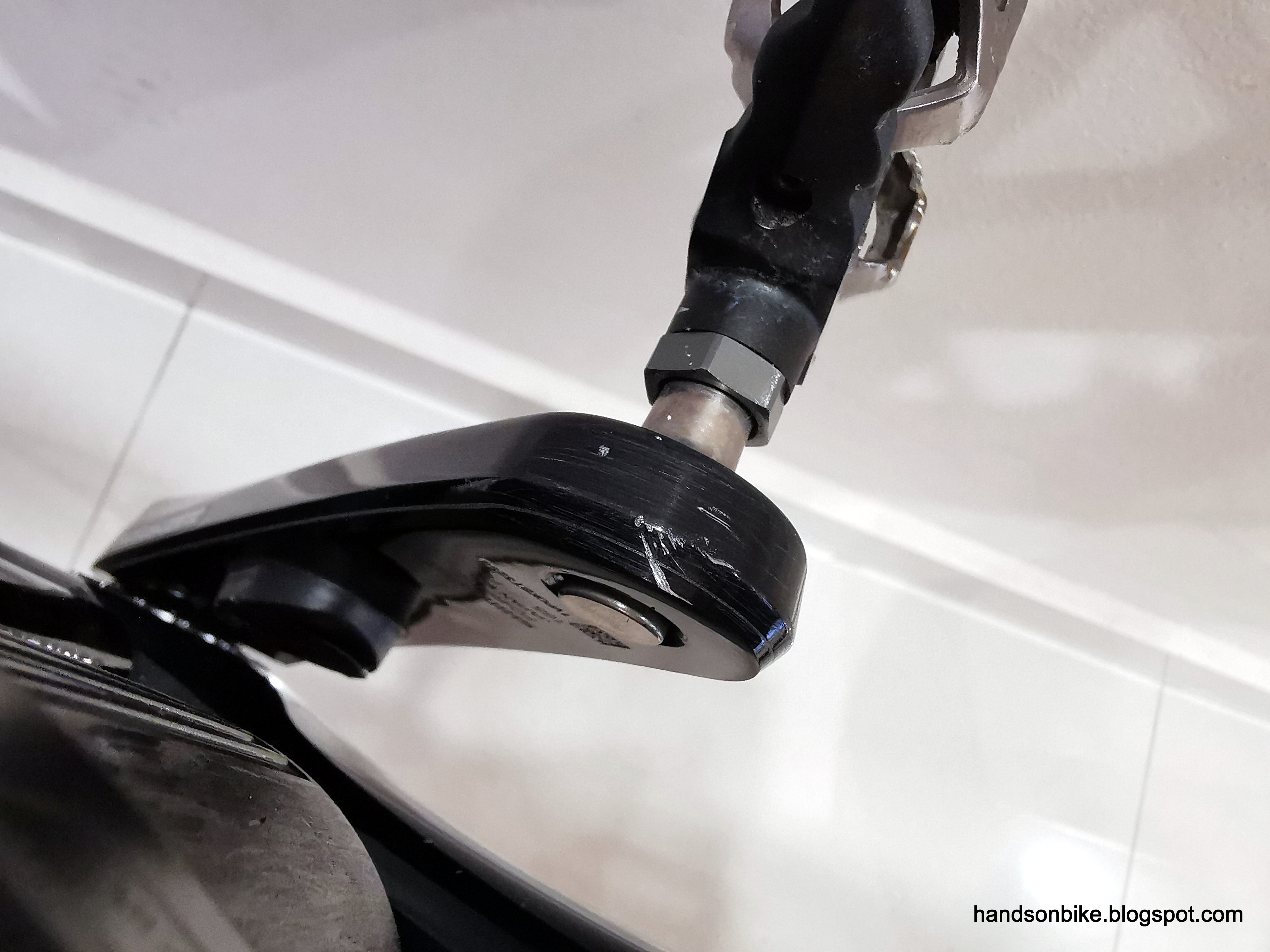
There are also some scratches at the ends of the Dura-Ace R9100 crank arms, caused by contact at off-road sections. This is despite the short 165 mm crank arm length.

I was surprised at the scratches on the frame, as I was not expecting that. However, I am personally not too bothered by it. As a gravel bike, it is OK to have some scratches as a result of off-road riding.

Still, it is better to prevent further damage if possible. Not for strength reasons, but more of to protect the fabulous paint job on the Aspero frame.

Therefore, I got some clear protection stickers from my friend who is a MTB rider. They are used to pasting protective films on MTB to protect the frame, so they know what is good and how to apply it properly.

Before applying the protective film.

After applying the protective film. Somehow, the clear film magically hides the scratches! Not only are the scratches invisible, the film is invisible as well. Looks just as good as new.

Another suggestion was to check the chain line of the crankset, as it seems that the chain rings may be too close to the frame. Although the Aspero is compatible with 50/34T road cranksets, the chainline will affect the actual frame clearance.

Small clearance of 1 mm between 34T inner chain ring and chain stay.

Small clearance of 1 mm between 50T outer chain ring and chain stay.

Previously when I installed the Wheels Manufacturing bottom bracket, I did not add the optional spacers, as it was not needed. Now, with the clearance between the chain rings and the chain stay to be so small, it will be a good idea to add some spacers. 

1 mm spindle spacer added on the drive side, to push the chain rings outwards for more clearance.

I wanted to add a 1 mm spacer on the non-drive side as well to balance the Q-factor, but it was too much. Even a 0.5 mm spacer was not possible, as the safety pin on the crank arm could not be inserted. Therefore, there is no spacer on the non-drive side.

After adding 1 mm spacer on the drive side, the inner chain ring clearance is now 2 mm.

Outer chain ring clearance also increased to 2 mm.

With the chain ring clearance increased, there would be less chance of having the same scratches on the frame when riding off-road. Together with the additional protective film, the frame itself would be better protected.

A side benefit of having a chain line that is 1 mm more outwards, is the availability of 1 more gear.

Previously, when I was in the small inner chain ring, I was only able to use up to the third-from-top gear sprocket (15T). It is the 11 speed 11-34T HG800 cassette. If I shifted to the 13T or 11T sprocket, the cross chain condition will cause excessive rubbing between the chain and the front derailleur chain guide. This is despite the auto trimming of the Di2 front derailleur.

Now, with a crankset chain line that is 1 mm more outwards, I can use up to the second-from-top gear sprocket (13T) when in the front 34T chain ring.

Previous highest gear when on small chain ring: 34/15 x 28" = 63 gear inches
New highest gear when on small chain ring: 34/13 x 28" = 73 gear inches

With this adjusted chain line, I am able to use a higher gear when on the inner chain ring, without having to shift to the outer chain ring to achieve a higher gear. Now I understand why the new GRX crankset has a chain line that is 2.5 mm more outwards compared to a normal road crankset chain line.

Finally, having rode off-road on the Aspero, I found that the stem may be slightly too long. The PRO Vibe stem length is 90 mm, but during descending on rough terrain, I felt that the weight shifts forward too much. Makes it too "exciting" during descending. Therefore, I decided to change to a slightly shorter 80 mm stem, which moves the centre of gravity a bit rearwards for safer descending. Not too sure how much difference 10 mm will make, but no harm trying.

The 80 mm stem is strangely 2 grams heavier than the 90 mm stem.

At the same time, since I was changing the stem, I decided to change the headset spacers as well, to the thin wall type. Previously I had changed to the special PRO Vibe spacers, but I was not too happy with how it looked. It was also relatively heavy, at 32 grams for a 40 mm length.

Therefore, I got some thin wall carbon spacers, which should be ideal for matching both the stem shape and also the headset cover.

Thin wall carbon spacer on the right, which has a smaller outer diameter than the usual type on the left. The inner diameter is the same.

40 mm tall, thin wall spacer weighs 12 grams.

The normal carbon spacer weighs twice as much given the same length, as a 20 mm tall section weighs 12 grams.

With the 40 mm thin wall carbon spacer installed! Matches better to both the stem at the top and the headset cover at the bottom.

I'm pretty happy with how it looks, better than the previous iterations (thick carbon spacer, or aero PRO Vibe spacers).

Summary of changes, after the off-road ride:
1) Added 1 mm spindle spacer to the drive side, for more chain ring clearance.
2) Added protective film around the bottom bracket and chain stay area.
3) One more higher gear can be used when on the 34T inner chain ring.
4) Changed from 90 mm to 80 mm stem to shift the weight backwards slightly.
5) Changed to thin wall carbon headset spacers for better appearance.

Sunday, March 29, 2020

Polygon Cozmic CX3.0: Sunrace MZ90 11-50T 12 Speed Cassette

Just a couple of months after I changed the rear derailleur and shifter on the Polygon Cozmic CX3.0 MTB to XTR, I decided to change the cassette as well. It is not possible to change to a Shimano 12 speed MTB cassette, as the Microspline freehub is needed. This means that a new rear wheel is needed.

I didn't want to spend money to upgrade the 26" rear wheel to have a Microspline freehub, as 26" wheels are considered obsolete in the MTB world. Although it still rides fine, I would rather spend money on getting a new MTB frame with 29" or 27.5" wheels.

Why would I want to change the S-Ride 12 speed cassette? That is because it has some flaws, which I hoped a better cassette would solve. For example, the shifting performance is not ideal when paired with the XTR 12 speed shifter and rear derailleur, as I think the spacing between the sprockets is not Shimano compatible. It does work OK when paired with the S-Ride 12 speed shifter.

The second reason is because the chain tends to derail from the sprocket during backpedaling. This happens in the lowest (largest) 2 sprockets, when the chain line is quite extreme. I have tried other bikes with a full Shimano 12 speed MTB groupset (XTR or Deore XT or SLX) and they don't have this backpedaling issue.

As Shimano does not make a 11-50T 12 speed cassette, I will have to look to other brands for 12 speed super wide range cassettes. SRAM Eagle 12 speed cassettes are also not compatible with my MTB, as a XD driver is needed on the rear hub. Therefore, I decided to get the Sunrace 12 speed MTB cassette to try out.

The Sunrace MZ90 12 speed cassette has a sprocket size of 11-50T, which is really wide, and it is compatible with standard freehub bodies. Although I don't get the 10T sprocket, I am fine with it as 11-50T range is already very big.

11-50T Sunrace MZ90 12 speed cassette. Looks pretty high end!

Weighs just 525 grams, quite a lot lighter than the S-Ride or the SRAM NX cassettes.

Gear steps: 28-32-36-42-50T. Big step from 42T to 50T. The 42T and 50T are made of aluminium for lower weight.

Gear steps: 11-13-15-17-19-21-24-28 and so on. Pretty standard gear steps.

Largest 4 sprockets are riveted together onto this massive red aluminium spider.

The largest 2 sprockets are cantilevered far out from the spider, enabling 12 sprockets to be squeezed onto the standard freehub body.

Next 3 sprockets (21-24-28T) are riveted onto the second spider.

Nothing special of note here.

All the 12 gear sprockets!

The red spacers are made of aluminium, which are usually only used on higher end cassettes.

There is even a free gift of the RD dropout extender with extra long B-tension bolt, in case you want to use your existing rear derailleur that is not rated to reach the large 50T sprocket.

Sunrace MZ90 11-50T 12 speed cassette assembled onto the bike! The red coloured spider is really eye catching.

Still looks enormous no matter how many times I see it.

Silver coloured sprockets match quite nicely with the XTR rear derailleur.

At gear 3, the RD cage is at its lowest point.

At the lowest gear (gear 1), the RD cage is fully stretched as shown.

Latest picture of the bike, with the Sunrace 12 speed cassette being the newest component on this bike.

The Sunrace cassette is a significantly big step up in quality, compared to the S-Ride cassette. First, the shifting performance is improved, as I think the gear spacing is more or less compatible to Shimano.

Also, there is no longer any chain drop from the sprocket, when I backpedal at the lowest 2 gears. This is due to some clever shaping and design of the sprocket teeth which helps to hold the chain onto the sprocket.

This Sunrace MZ90 12 speed cassette is not cheap (around SGD $110 from Taobao), especially for a cassette that is not from Shimano or SRAM. However, it is considered the best of the rest, and it seems to work well with these Shimano components. Overall, I would say it is a good upgrade, especially for older bikes that do not have the Microspline or XD freehub bodies.