Showing posts with label QR Skewers. Show all posts

Saturday, July 29, 2023

Birdy AXS: Chain Length, Freehub Grease and QR Axle Changes

Final post on the Birdy AXS 12 Speed folding bike! At least for now, until some new project or ideas pop into my head.

Throughout the whole upgrading process from the stock 9 speed Birdy City, I have learnt a lot about the Birdy folding bike. Especially for the folding design, where it is different from any other bike.

There were a few issues which were not fully resolved earlier, but they have now been fixed. 3 of the problems have been highlighted below, along with how I solved them.

First issue was the chain length on the Birdy drivetrain. As I transplanted the SRAM AXS 12 speed drivetrain from the Fnhon DB12 folding bike, I reused the existing chain as the mileage was quite low.

However, the chain stay length of the Birdy is longer at 430 mm, compared to the 400 mm of the Fnhon DB12. Therefore, using the same chain length with the same cassette and chain ring, on a longer chain stay, makes the rear derailleur cage stretch out too much.

At the largest sprocket (lowest gear), the rear derailleur cage is very stretched out and looks over the limit.

Wednesday, August 22, 2018

Dahon MuSP: Wheelset, Tires and Brakes

Moving on to the second part of the Dahon MuSP build, let's check out the wheelset, tires and the brake calipers.

As I have already used on many bikes, the Wheelsport wheels are a good combination of weight, price and performance. Also, they come in a variety of specifications (406 or 451 size, 74 or 100mm front OLD, rim or disc brakes) and also colours, so they can fit almost any bike you want.

Dahon MuEX: Sunny 406, 74/130mm, Black
Dahon Boardwalk: Smart 1.0 406, 74/130mm, Gold
Crius AEV20: Smart 1.0 406, 74/130mm, Black
Wheelsport Fantasy: Smart 1.0 451, 100/130mm, Black

Therefore, it is a natural choice to get a Wheelsport wheelset again for this new Dahon MuSP folding bike. Also, this is the only brand which has a blue coloured wheelset, which is one of the requirements for this bike.

For the Dahon MuSP, the wheelset specifications that I require would be the Smart 1.0, 451 sized, with 74mm front and 130mm rear OLD. The blue colour specification is not so commonly available, so I had to wait patiently for the blue wheelset to arrive.

Smart 1.0, 451 size, blue colour! The special spoke pattern always makes it stand out from other wheelsets.

Black bladed spokes which looks nicer than standard round spokes. I noticed that the blue on the hub and the rims are a different shade of blue.

Front wheel weighs 580 grams, which is not that lightweight. Mostly due to the 30mm high rim profile.

Rear wheel is 799 grams

This gives a total wheelset weight of 1379 grams! It is a rather average weight for a 451 wheelset, which will surely be heavier than a 406 wheelset as it is larger in size. If you have a more generous budget, you can consider a custom carbon wheelset, which is significantly lighter at around 1100 grams!

Zefal/Velox cloth rim tape to replace the original plastic rim tape. Slightly thicker and tougher to prevent punctures caused by sharp rim holes.

For 451 tires, there are not many good choices. If you want narrower tires for lighter weight, get the Schwalbe One (23-451), which only weigh 323 grams for a pair.

However, if you want wider tires for more comfort, the Panaracer Minits Lite (28-451) would be a better choice. This is exactly the same one as what I used on the Java Freccia mini velo, before I disassembled it.

Brand new Panaracer Minits Lite tires. I had to get new ones as I had already sold away the previous tires which were very lightly used.

28-451 sized, which is wider for a more comfortable ride.

Average weight of 200 grams each, for 400 grams per pair.

Schwalbe SV7A 451 inner tubes weigh 100 grams each.

Blue Wheelsport wheelset with the Panaracer tires installed!

Lightweight titanium QR axles will be used to reduce the weight slightly.

Front 74mm QR axle weighs 23 grams

Rear 130mm QR axle weighs 27 grams.

This pair of titanium QR axles weigh just 50 grams in total, which is about half the weight of standard steel QR axles.

Moving on to the brake calipers, this is the first time I can install standard reach road brake calipers on a folding bike. Although the stock bike comes with Shimano Sora brake calipers, I wanted to install the full Ultegra groupset, which also has the latest brake caliper design.

Ultegra R8000 road brake calipers. On first look, it may look similar to the previous 6800 version, but it actually has a lot of subtle but important differences.

Quick release lever has been redesigned so that when closed, the tip of the lever is hidden within the brake arm instead of sticking out.

There is no longer a gap on the top brake arm, as the mechanism has been redesigned.

Rear of the brake caliper, with 2 black nuts used.

Cam roller mechanism has been redesigned, to use a stamped steel design to hold the roller. Note the new adjustment screw at the left side (green colour).

Additional steel plate for stiffening the whole brake caliper, by linking up the left and right pivots.

New adjustment screw is located on the side brake arm, instead of at the top arm.

Ultegra R8000 brake calipers weigh 362 grams for a pair, which is a 10% increase compared to the Ultegra 6800 generation. This is due to the additional steel plates for stiffening the brake caliper.

The new Ultegra R8000 brake calipers are reported to have improved brake power, although it comes at the expense of additional weight. I can't wait to install them to try it out!

Thursday, October 10, 2013

TAT Titanium QR Skewers for the Dahon Vitesse X20-TT

A couple of months ago, I wrote about the quality of different QR skewers available in the market. From the post, you will be able to see and differentiate between good and poor QR skewer designs.

For Dahon or Tern wheelsets, a shorter front QR skewer is required, as the front hub (74mm) is narrower than standard front hub widths (100mm). This greatly limits the choice of QR skewers available. A front 74mm and rear 130mm QR skewer is required for most Dahon or Tern bikes. For models with rear internal hub, a rear QR skewer length of 135mm will fit better.

Out of the many brands of QR skewers available for  Dahon / Tern bikes, I find that TAT makes one of the better QR skewers out there. The quality of the QR skewer is quite good, with nicely machined parts. Also, the hardware is mainly made from Aluminium or Titanium, which makes the QR skewer really lightweight.

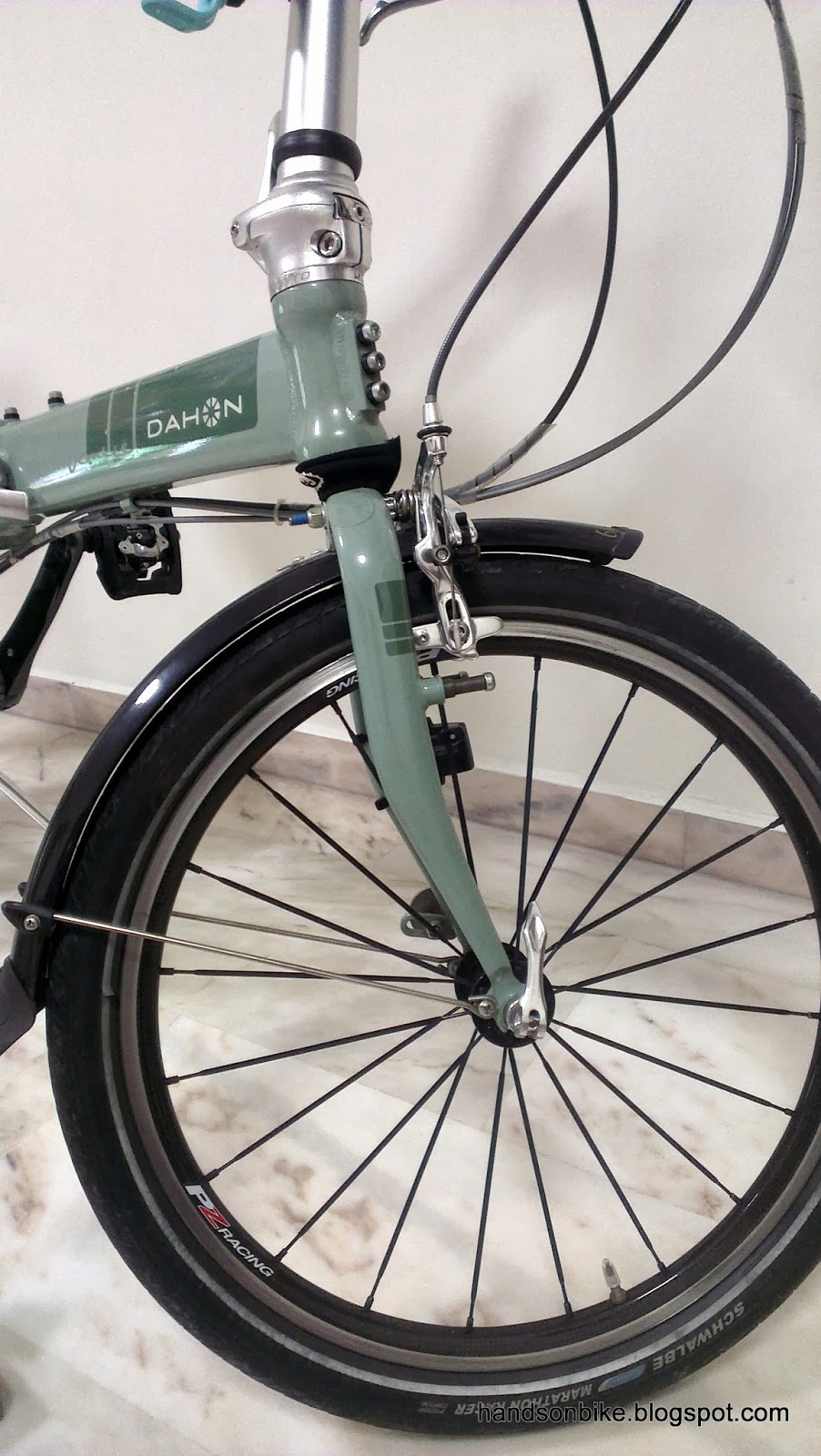
In view of that, I got a set of TAT Titanium QR skewers for the Dahon Vitesse X20-TT. This is because the stock PZ Racing QR skewers are already rusty at the pivots.

Silver coloured TAT Titanium QR Skewers, 74/130mm for Dahon or Tern bikes

Good quality lever and brass washer for smooth and firm clamping action

PZ Racing front QR skewer is already rusty at the pivots

Same for the rear QR skewer

New shiny front QR skewer! See how the brass washer works to smoothen the clamping action.

Smooth and firm clamping action. Try it to believe!

New QR skewer for the rear wheel too.

Silver QR skewer goes well with the silver Tektro R559 caliper brakes, LitePro headset and Fnhon handlepost!

View of the rear with the new TAT QR skewers

This is a very simple upgrade that can be done by anybody, just remove the old skewers and insert in the new QR skewers. Just make sure that the length is correct for the wheelset. With this TAT Titanium QR skewers, I don't have to worry about the QR skewer rusting. One less rusty part to spoil the look!

Tuesday, August 27, 2013

Difference between Good and Bad QR Skewers

The quick release skewer is an often overlooked component on a bike. Despite looking small and flimsy, it plays an important role on the bike: Holding the wheels in place! Without a quick release skewer, the wheel would pop out whenever you go over a bump. Contrary to popular belief, the QR skewer does not bear weight on its axle. Rather, the load is borne by the ends of the hub, and the QR skewer merely clamps everything in place.

Of course, QR skewers did not always exist. Before it was invented by Mr. Campagnolo in the 1930's, cyclists have to loosen axle nuts before they could remove the wheel from the frame, which is comparatively more troublesome. Nowadays, QR skewers are found on most mid to high end bikes, with only the most basic entry level bikes still using traditional nutted axles for the wheels.

However, not all QR skewers are made the same! There are 2 main types of QR skewers: The internal cam type and the external cam type. From the pictures below, you can see the difference.

Dura-Ace QR skewer with an internal cam mechanism

QR skewer with an external cam mechanism

The most common type of QR skewers that we see nowadays are the external type. It is usually lighter in weight, and easier to manufacture. This makes it cheaper too. However, compared to the internal type with all metal parts, it does not have such a strong clamping force, and the performance is also poorer due to inferior parts being used (further elaborated below).

For normal usage, either type of QR skewer will work fine. However, if you want to know more about the difference between good and bad QR skewers, read on!

Let us take a look at the external cam type of QR skewers, as it is more common and the mechanism can be seen easily. Look at the two pictures below. They are both external cam type QR skewers, and they also look similar, but there is actually a crucial difference.

QR skewers that come with the Wheelsport wheelset

 New QR skewers from TAT

Did you spot the difference? If yes, good for you. You can tell the difference between a well designed QR skewer and a normal QR skewer. If not, read on to find out!

Look at the concave shaped washer under the lever cam. On most (90%) QR skewers, this piece is made of hard rubber or plastic (1st picture). When the lever is closed, the rubber compresses and some of the clamping force is lost. This is why you get a mushy feeling when you use this type of QR skewer. What you are feeling is the concave rubber washer compressing under load. Although it will still work, you will need to apply a higher force at the lever to close the QR skewer properly, as some of the force is used to compress the soft rubber washer instead of clamping the hub tightly.

On the other hand, look at the concave washer on the QR skewer in the 2nd picture. It is a solid metal washer made of brass. When closing the lever, the brass washer reduces the amount of friction in the cam mechanism (compared to the rubber washer), and it gives a nice, solid locking action. The brass washer does not compress and the clamping force is fully utilized to secure the wheel. Not only does the locking action feel smoother, the clamping force is easily achieved with less effort.

Another difference is the material used to make the QR skewer. This also indirectly affects the weight of the QR skewer.

QR skewers from the Wheelsport wheelset. All the pivots and axle are made of normal steel, with aluminium levers.

 TAT Alloy/Titanium QR skewers. Titanium pivots and axle, aluminium levers and nut.


The titanium QR skewer is a good 40 grams lighter than the normal steel QR. This is despite it using a heavier brass washer. Another important feature is that because there is no steel used (besides the spring), it does not rust! Compare this to another QR skewer that has some rust on the exposed steel pivot.

Rusted pivot on the PZ Racing QR skewer

More pictures of the TAT Titanium QR Skewer below:

Comes in 74/130mm lengths for Dahon/Tern bikes

Nice shiny hardware


Bought both the black and the gold coloured QR skewers

Now you know the difference between good and normal QR skewers. Besides looking at the material used (titanium or steel) and the weight, also look at the type of concave washer that is used! A QR skewer with a brass washer will have a smoother operation and also more solid clamping action. Although this may not make a difference to most people, the quality shows up in the details.

This "brass washer" concept also applies for seatpost QR levers, but that is a story for another day...
 
Seatpost QR lever with brass shim (instead of rubber/plastic washer)

For more info about QR skewers, you can refer to the links below.
Good vs Bad QR Skewers
Sheldon Brown - QR Skewers

Thursday, February 10, 2011

Journey of the Boardwalk: Part 3 (105 Crankset, OTA Seatpost & Dahon Tour Bag)

Went out to buy a Dahon Tour Bag the moment it was available in Singapore. It was the ideal bag for light touring/commuting: Waterproof, strong outer shell, ease of removal, comes with carrying strap, and has many compartments. Note that only the newer Dahon bikes come with the front mounting point required for the support truss.

Also managed to get the lightweight OTA seatpost from a friend, who brought it over from Taiwan. It weighs only 350g, as compared to the original D7 seatpost that weighs 590g. Looks good too! Only problem is the seat clamp, which had dimensions that were slightly off from the seat rail width. Had to do a bit of bending and squeezing before the seat could be mounted properly.
Was in Hong Kong for a short holiday in July, and came across these two bicycle shops along Tung Choi Street in Mongkok.

The shops are quite interesting as they sell many different things that can't be found in Singapore or other places. For example, just for Dahon seatposts, they have like 6 different types of seatposts for sale. You can see the prices on the seatposts if you enlarge the image, and using the exchange rate of SGD $1 to HKD $5.5 at that time, you can get a rough idea of the price. Not cheap. By right photography was not allowed, but luckily I was not caught and chased out haha.

Tried my luck asking for Dahon specific skewers, which has a 74mm front width, as opposed to the usual 100mm. I was in luck as they had one pair in stock, in a nice gold colour. And that was how I got my special, unique skewers for my Boardwalk.

At this point, the only major component that has not been upgraded was the crankset. Read some reviews and found that the Shimano Hollowtech II cranks are really light and strong, and the external bearings make the cranks really stiff too. Decided to look around for good deals. As always, the first stop to look for good deals would be at Gee Hin Chan.

Brought my bike there one day and asked to upgrade the crankset to Shimano 105 crankset, with new Bottom Bracket too. Had a choice of last year's black 105 cranks, or the 2011 version of the 105 cranks, in silver colour. Decided that the black matched my bike more than the silver one. Because the 2011 version has just arrived, they didn't have it in black colour yet. For some reason the newer 2011 version was also cheaper by around 10%.

Of course must change the crank bolts to gold, to match my gold skewers! And as I expected, gold goes really well with black, especially on the 105 crankset. Removed the inner 39T chainring as I didn't need it.

Had thought of changing the BB to also a gold coloured version, probably a Token brand one. But it would have costed 3 times more than the 105 BB. In any case, the 105 BB works well and looks good on the bike, being an intermediate colour between the frame and the crank arm.

Could feel an immediate improvement in the stiffness of the cranks! There is no flexing when you push down hard on the pedals, and it feels smoother due to the sealed bearings in the 105 BB. Definitely worth the upgrade, although it is rather pricey. 10/10 for the looks of the crankset alone!

In the next part of the Boardwalk journey, I will talk about how I changed the bike from 8 to 9 speeds, changed the tires, and customised my own 9 speed cassette.