Showing posts with label Focus. Show all posts

Saturday, August 19, 2023

Focus Paralane: Ultegra 12 Speed Crankset R8100

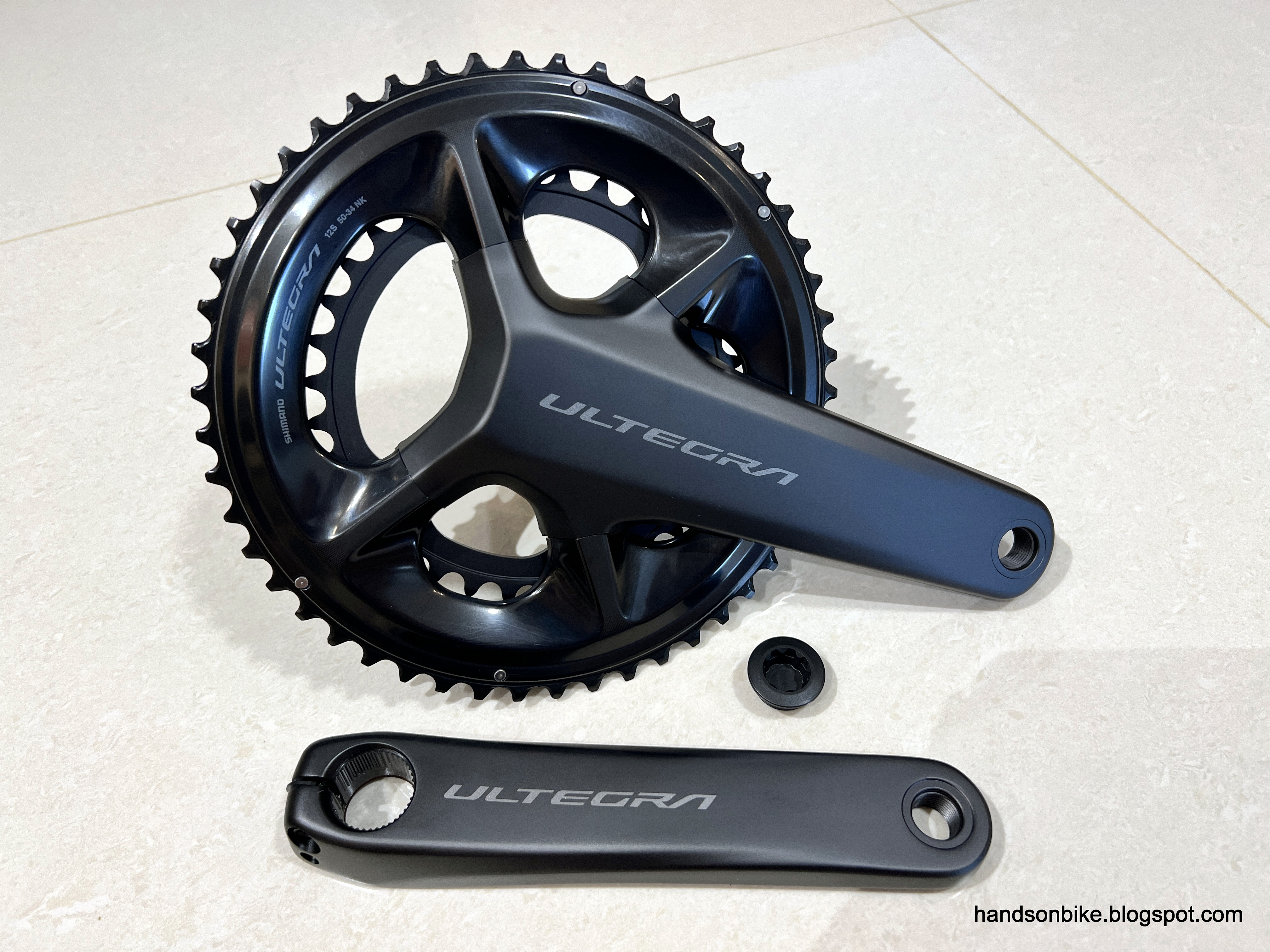
The final piece of the Focus Paralane Ultegra drivetrain modification, the Ultegra crankset! I wanted to transfer the Dura-Ace components from the Focus Paralane over to the Specialized Aethos, which is why I needed to get new components.

I had already installed the Ultegra Di2 rear and front derailleurs for Shimano road 12 speed, and to complete the look, I also ordered the Ultegra 12 speed crankset, FC-R8100. This will replace the Dura-Ace FC-R9200 crankset that is currently on the Focus Paralane.

Ultegra 12 speed crankset, FC-R8100. I prefer the clean smooth design of this crankset over the edgy design of the Dura-Ace crankset.

Sunday, August 13, 2023

Focus Paralane: Ultegra Di2 12 Speed Rear and Front Derailleurs

When I was building up the new Specialized Aethos lightweight road bike, I wanted to put Dura-Ace components onto the Aethos. However, it was too expensive to get another set of Dura-Ace components on the Aethos, when I already had one set on the Focus Paralane.

My solution is to move the Dura-Ace components from the Focus Paralane over to the new Specialized Aethos, then get a cheaper set of components for the Focus Paralane. Previously I splurged on Dura-Ace components for the Focus Paralane, because it was my only road bike which doubled up as an all-weather commuting bike. Also, Dura-Ace 12 speed was more readily available than Ultegra 12 speed at that time (early 2022).

Now that I have the Aethos as the pure road bike, I didn't feel the need to put the best components on the Focus Paralane. This was why I chose the 12 speed Ultegra Di2 components to replace the Dura-Ace Di2 components on the Focus Paralane.

I will be moving the Dura-Ace RD-R9250 rear derailleur and FD-R9250 front derailleur over, while I will not be transferring the Dura-Ace shifters and brakes as it is too troublesome to uninstall and reinstall them again on the Aethos. The hydraulic hose length might not be long enough which would require a hose change as well. I would rather do a fresh, hassle-free, Shimano J-Kit installation of new shifters and brake calipers on the Aethos.

Here are the new Ultegra Di2 rear derailleur and front derailleur!

Ultegra Di2 RD-R8150 12 speed rear derailleur

Wednesday, November 16, 2022

Focus Paralane: Changing Rear Rotor Size from Diameter 160 to 140 mm

I am always swapping or changing parts around on my bikes, to try out different setups and components. The latest setup on the Focus Paralane all-weather commuting road bike is the 2x12 speed Dura-Ace Di2 groupset.


Now, I will change the rear disc rotor from 160 mm to a smaller 140 mm diameter. It will be the same XTR MT900 rotors, just in a smaller size. Reason is to common the rotor size with another upcoming bike, the Specialized S-Works Aethos, so that I can swap wheels easily if both have a 140 mm rear rotor diameter.

XTR MT900 rotor, in 140 mm diameter. I have previously used a 140 mm rotor on the Fnhon DB12 folding bike.

SS means it is the smaller 140 mm size, while S would mean 160 mm diameter.

Sunday, November 13, 2022

Focus Paralane: Garmin Rally XC200 Power Meter SPD Pedals

Recently I had the chance to test out a pair of Garmin Rally XC200 Power Meter SPD pedals. These are new power meter pedals from Garmin. What's cool about these pedals is the small size and the SPD compatibility.

Previous iterations of power meter pedals are usually rather large, and with a bulge at the pedal axle. For this version, Garmin has managed to shrink down all the electronics, such that it all fits inside the pedal axle! At the same time, the SPD platform is what I prefer, so that I can use it with my Shimano RX8 gravel shoes

I have previously been using one-sided crank based power meters, such as the 4iiii Dura-Ace or the 4iiii 105 versions. Being one-sided, it takes the power generated by the left leg, and multiplies it by two to give an estimate of your total power. This assumes that your power is equal on the left and right legs, which is usually not the case. If it is not equal, the total power will not be accurate. This is the case on the Focus Paralane, where the 4iiii 105 left crank arm is currently installed.

I decided to install the Garmin pedals on the Focus Paralane, since it is the bike I ride most often. Let's take a look and see how it compares to my existing pedals.

XTR M9120 Trail pedals, next to the Garmin Rally XC200. SPD mechanism looks similar.

Saturday, November 5, 2022

Focus Paralane: Switching to 105 R7000 Power Meter

It was not long ago when I completed upgrading the Focus Paralane to a full Dura-Ace Di2 groupset. However, on that groupset, there was one component which is not from the latest R9200 groupset, and that is the left crank arm.

I was still using the older R9100 left crank arm with 4iiii power meter, as it is useful to have power readings even though I am not training with the help of a power meter.

When I was using the Dura-Ace R9100 2x11 speed crankset, the right and left crank arms were matched as a set. Then, when I changed to 12 speeds, I only swapped the right crank to R9200, leaving the left crank arm still as R9100 with power meter.

Now, I plan to install the unused R9100 crankset on another bike, and I would like to move the R9100 left crank arm with power meter over as well. Therefore, I need a left crank arm for the Focus Paralane.

I actually have many spare left crank arms, as I have two different left crank arm power meters, the R9100 and also a cheaper 105 R7000 version. In fact, the R7000 power meter was on the Focus Paralane previously, when it was a 1x11 speed setup.

The 105 R7000 left crank arm with power meter is currently on the Cervelo Aspero, but I think it would be more useful on the Focus Paralane, given that I ride it more often and on the road, where power readings are more useful than when riding on gravel.

This gives me a rare chance to have both the Dura-Ace R9100 and 105 R7000 power meter left crank arms off the bikes, for a side by side comparison.

105 R7000 crank arm on top, Dura-Ace R9100 crank arm below. 
They are both of 165 mm crank arm length.

Different surface treatment, and the R9100 crank arm looks more well used given that it has been in use since it was first installed on the Canyon Endurace.

Wednesday, October 26, 2022

Focus Paralane: Phase 2 Assembly Completed

After finally getting the 12 speed Dura-Ace crankset, I can complete Phase 2 of the 12 speed upgrade to the Focus Paralane. Previously I had all the new 12 speed components except the crankset.

Dura-Ace R9200 12 speed crankset, with 50/34T chain rings.

Sunday, October 23, 2022

Focus Paralane: Dura-Ace 12 Speed Crankset R9200

On the Focus Paralane all-weather commuting bike, I had already upgraded most of the groupset to a 12 speed Dura-Ace system. Only one component was missing, and it was the 12 speed crankset. Due to production delays, I was not able to get the crankset at the same time as the rest of the components.

During Phase 1 of this upgrade, all the components have been changed to the latest Dura-Ace R9200 groupset, except for this crankset. Even so, there is no issue with using the older R9100 crankset in the 12 speed drivetrain, as they are mostly compatible, although you may not get 100% of the function.

Now that I have this 12 speed R9200 crankset, I can complete the upgrade in Phase 2 of this project.

Unboxing the new Dura-Ace R9200 crankset! New packaging design for Dura-Ace.

I chose the 50-34T chain ring combination, and a crank arm length of 165 mm. According to my own experience and also bike fitting, this length is good for me.

Most of the box is actually just air, as the crankset has a shape that takes up quite a bit of space.

Dura-Ace R9200 crankset!

Sunday, September 4, 2022

Focus Paralane: Phase 1 Assembly Completed

Phase 1 of the Focus Paralane 12 speed upgrade is finally completed! To be accurate, the upgrade was actually completed more than 6 months ago, but I only found the time to write about it now.

This is considered Phase 1 as the upgrade is not completed, as the new 12 speed Dura-Ace crankset is not yet available, so I am still using the older 11 speed Dura-Ace R9100 crankset. Since the pros are also using this older crankset with the new 12 speed groupset, I guess it works well enough not to be an issue.

Here are the pictures of the completed bike, with new 12 speed Dura-Ace components!

Sunday, August 28, 2022

Focus Paralane: Dura-Ace 12 Speed Assembly Begins

With most of the new 12 speed components in place, I am now ready to upgrade the Focus Paralane from 11 speed to 12 speed! Check out the Focus Paralane - 12 Speed page for all the juicy details of the 12 speed components.

2x11 speed Focus Paralane, before disassembling it for the upgrade. Mudguards and accessories have been removed. Weighs 7.6 kg in this bare configuration with pedals.

Ended up stripping nearly everything off the frame, except for the stem and handlebar.

Saturday, August 13, 2022

Focus Paralane: Dura-Ace Wheelset Sub-Assembly

Time to set up the wheelset! I will be transferring the Continental GP5000 tires and the XTR RT-MT900 brake rotors over from the existing Ascent Zenith Elite wheelset. This new wheelset will then be reinstalled onto the Focus Paralane for a 12 speed setup.

GP5000 tires installed! No issues faced during installation, looking good so far.

Focus Paralane: Dura-Ace C50 Wheelset R9270

For the upgrade to the Dura-Ace 12 speed system on the Focus Paralane, the next component to arrive is the C50 wheelset.

Technically I could use the new 12 speed cassette on the existing Ascent Zenith Elite wheelset that I have, because the new 12 speed cassette is also compatible to the conventional freehub body. However, I decided to wait for the new wheelset and change it all at one go, so that I don't have to reinstall the cassette and brake rotors again.

The latest Dura-Ace wheelsets are available in C36, C50 and C60 versions, with the numbers indicating the rim profile. The C50 is the middle ground for all-round usage, while the C36 is better for climbing and the C60 is better for high speed.

Let me show you the details of this brand new C50 wheelset!

Here is the new wheelset! Not sure why I took a picture with the edges cut off...

Set of front and rear C50 wheels. 24 spokes on the front and rear wheels.

Focus Paralane: Dura-Ace 11-30T 12 Speed Cassette R9200

Another key component of the new Shimano 12 speed road drivetrain is the cassette. Not only is there one more sprocket, it now incorporates HG+ shifting, which provides fast and smoother outwards shifting. This feature comes from the MTB side where it is well appreciated by riders.

This cassette will be used on the Focus Paralane bike, to convert it from a 11 speed to 12 speed drivetrain.

How it looks out of the box. It has a cassette holder to hold the loose pieces together, and also make it easier for assembly to the freehub body.

Dura-Ace CS-R9200 12 speed 11-30T cassette weighs 223 grams, which makes it heavier than the equivalent 11 speed cassette with the same 11-30T gear combination (206 grams).

Saturday, July 30, 2022

Focus Paralane: Dura-Ace Di2 12 Speed Rear Derailleur R9250

Next component to be introduced for the new 12 speed road system is the rear derailleur! The new Dura-Ace R9250 rear derailleur has a lot of stuff packed into it, I will get into the details in just a while.

This is the next generation electronic rear derailleur, upgraded from the previous 11 speed R9150. This post will focus on the new 12 speed rear derailleur and what it can do. All these components will go onto the Focus Paralane road bike.

New Dura-Ace RD-R9250 Di2 rear derailleur for 12 speed road drivetrain!

Glossy black surface finishing, in line with the appearance of this groupset. Even the hardware such as bolts and screws are black in colour.

Wednesday, June 15, 2022

Focus Paralane: 2x11 Speed Drivetrain Installation

As a commuting bike, the Focus Paralane is nearly perfect, as it is a fast road bike with high end components. However, since I use it a a road bike for group rides as well, I find that the gear range is not quite enough. This is most apparent when riding down slope, as the highest gear (Front 40T and rear 11T) is 98 gear inches, which is not enough when riding fast down the slopes.

Therefore, if I am using it as a road bike for group rides as well, I need more gear range. There is already a wide 11-36T cassette on this bike, so I cannot use a wider range cassette without sacrificing the close gear steps. Best way is to install a front double system with two chain rings, to get the wider gear range and yet with close gear steps.

When I installed the Dura-Ace R9100 crank arms onto this bike, the chain rings were kept aside. Now, what I need to do is to just reinstall the chain rings onto the Dura-Ace crank arms.

Before that, I needed to check if this frame can accommodate a front derailleur properly. The stock Curana fenders had a cutout to avoid interference with the front derailleur, so with the SKS mudguards, there might be some issue.

Attaching the Dura-Ace FD-R9250 Di2 Front Derailleur to the front derailleur mount to check it out.

Sunday, February 20, 2022

Focus Paralane: PRO Stealth Superlight Saddle, PRO PLT Stem, GRX Rear Derailleur

On the Focus Paralane all-weather road bike, I have installed a few new components recently. This was partly done during the bike fitting session at LOUE Bicycles, where some components were swapped or adjusted to optimize my pedaling efficiency on the bike.

Prior to the bike fitting session, I had already purchased a new saddle, the PRO Stealth Superlight Saddle, as I have heard many good reviews about it. I was not able to test one before buying it, so it was a leap of faith to buy a new saddle. That said, most saddles are bought without testing, unless there is already a bike with your targeted saddle for testing.

Previously I have been using the Selle Italia SLR Kit Carbonio Flow saddle, which has served me well. I used it across quite a few different bikes, also in the SLR Titanium version. It is lightweight and quite comfortable as well. However, the saddle width seems to feel a little narrow, especially after I tested some slightly wider saddles recently.

These pictures were taken before the bike fitting session, where the new PRO Stealth saddle was installed onto the bike at LOUE Bicycles.

One of the many PRO Stealth saddles in the Stealth saddle family.

This is the superlight version, with a one piece carbon base, and of course the highest price tag.

142 mm wide saddles seem to be the most common nowadays. It has a claimed weight of 145 grams, more than the Selle Italia SLR Kit Carbonio Flow, which is just 121 grams. Still lightweight though.

The cardboard packaging has a tool to help you set your saddle position as shown. However, I am not sure how useful it is.

Here it is, the PRO Stealth Superlight saddle! Subtle decals at the top, not flashy white ones like the older Stealth saddles.

Large center cutout with carbon bridges going across. The nose is quite wide as well.

Carbon shell at the end, with the Stealth logo.

Side view, with a thin shell and low profile. Slight upward curve at the rear of the saddle.

Carbon saddle rails, with a 7 x 9 mm oval dimension.

Carbon rails are moulded right into the carbon shell! This is why it is so expensive.

Same integrated construction at the front of the saddle.

There are two threaded holes at the bottom of the saddle, which can be used to mount accessories like lights, cameras, tool kit, etc. Unless you DIY, a PRO camera bracket is needed.

Weighs 157 grams, instead of the claimed 145 grams. 8% overweight, which is unacceptable for such a high end product where weight is a key selling point.

Here is how it looks on the bike! From this angle it looks really wide.

More details on the saddle fit over at the LOUE Bicycles post, but the first impression is that it fits me well. There is better support due to the wider shape and upward curve at the rear.

Other than the saddle, the stem was also changed. Similarly, I had also purchased a new stem prior to the bike fitting, as I felt that the stem length was not quite correct.

To be fair to Timothy of LOUE Bicycles, he did not switch to the new saddle and stem just because I brought it along. Rather, he first noted that what I had on my bike wasn't quite suitable, and asked me if I brought anything to swap. What he recommended was exactly what I had brought along, both in terms of a wider saddle and also a longer stem, as shown below. Seems that I already had an intuition about what I needed to change on my bike, even before the bike fitting session.

A 90 mm version of the 80 mm PRO PLT Stem that I first used when building up the Focus Paralane.

90 mm stem installed on the bike! A slightly longer stem was recommended to get the proper reach and riding posture for road bike riding.

Looks exactly like a normal road bike, before I reinstalled the SKS mudguards.

Finally, another modification that I made was to change the rear derailleur. Previously, when I installed the Sunrace RX1 11-36T cassette on the Focus Paralane, I used a Wolf Tooth Roadlink DM adapter to extend the reach of the Dura-Ace rear derailleur. This is to allow the Dura-Ace rear derailleur (rated for max 30T sprocket) to reach the larger 36T sprocket.

It worked quite OK, but there was always a bit of problem when shifting between the smallest 12T and 11T sprockets. At this position, the guide pulley of the rear derailleur is too far away from the sprockets to produce reliable shifts. This is because the Wolf Tooth Roadlink DM basically just shifts the rear derailleur lower, allowing it to reach the larger sprockets. However, this also moves it too far away from the small sprockets, sacrificing shifting performance.

Since I have the GRX RD-RX815 rear derailleur available for use, I decided to install that on this bike. Previously it was used on the Canyon Endurace and then the Cervelo Aspero, for a 2x11 speed gravel/road hybrid drivetrain. Since I have already converted the Aspero to a dedicated front single gravel drivetrain, it uses a different rear derailleur (RD-RX817).

The GRX RD-RX815 is a rear derailleur that is designed for a maximum sprocket size of 34T, instead of 30T for the Dura-Ace rear derailleur. That means using this GRX rear derailleur on a 36T large sprocket is only slightly beyond the rated capability, which I believe it will handle with no issue. Most of all, I hope it can solve the intermittent shifting problems I faced between the 12T and 11T sprockets.

GRX RD-RX815 rear derailleur installed onto the Focus Paralane.

The GRX rear derailleur has a clutch, which can be useful for chain management, but probably not required on this road bike. It can be turned off to reduce shifting effort and thus conserve battery power.

After testing, I am pleased to find that it shifts well across all the gears, including the smallest 12T and 11T sprockets! Shifting performance restored.

The SKS mudguards look pretty stealthy, as the high profile carbon wheels helps to camouflage it.

With a new saddle, new stem and new rear derailleur (relative to this bike), the Focus Paralane has been refreshed yet again. My bikes are always evolving, as I test and swap various components, depending on my requirements (which also changes from time to time).
Saturday, February 12, 2022

Bike Fitting at Loue Bicycles - Using Pedal Stack Height to replace Cleat Shims

In the previous bike fitting posts at LOUE Bicycles, I wrote about how there is a need to add shims on the SPD cleats of my shoes, due to the slightly different leg length caused by my swiveling hips during pedaling.

A recommended addition of 1.5 mm was suggested for the left leg, to adjust the leg reach slightly to match the right leg. A 1.5 mm difference is actually quite small, compared to the overall length of the leg. On my road bike, the Focus Paralane which I used for the actual bike fitting, I will try to achieve the ideal bike fit to optimize the power output and pedaling comfort.

Bike fitting on the Focus Paralane, at LOUE Bicycles.

As for the other bikes, such as the folding bikes, it is not so critical, as I will be pedaling leisurely instead of at high power. I will probably switch between flat soled shoes or SPD shoes occasionally, on the dual sided SPD/platform pedals.

I have an idea to adjust the leg length, but not by adjusting the shim on the SPD cleats. Instead, I can use pedals of different stack height, which would have the same effect. If the pedal has a taller stack height (distance from centre of pedal axle to sole of the shoe), it will effectively shorten the distance from the saddle, which has the same effect as adding a shim on the SPD cleat under the shoe.

Measuring the pedal stack height is not easy, as it is difficult to find the centre of the pedal axle. Therefore, to simplify the measurement, I used the pedal thickness instead. Then, I assume that the stack height is just half of the pedal thickness. There might be some inaccuracy here, but I think this is good enough.

The idea is to use a pedal with a taller stack height (thicker) on the left crankarm, and a pedal with a lower stack height (thinner) on the right crankarm. This effectively gives a left leg reach that is shorter, which suits my purpose.

I tried to use the product spec provided by Shimano for the pedal stack height, but it doesn't match what I measure (thickness). I think the difference is what I mentioned above, that the actual stack height is measured from the centre of the pedal axle (virtual point) to the sole of the shoe (another virtual point). I can't measure those points directly or easily, which is why I chose to measure pedal thickness instead.

Moving forward, I will use pedal thickness to approximate the different stack height of the pedals that I have, to find a suitable pedal for the left and right side.

The pedal that is currently on the Focus Paralane is the XTR PD-M9020, which is rather lightweight.
I have an alternative SPD pedal, the new GRX PD-ME700 SPD pedals, which are similar in design to the other trail SPD pedals, but at a lower price point.

I know that the XTR pedal has the lowest stack height, so this will remain on the right side, while I will find a thicker pedal on the left side to reduce the leg reach.

Thickness of XTR PD-M9020 is 17 mm.

Here is the GRX PD-ME700 SPD trail pedals. I will do a separate introduction/comparison post later on.

Thickness of GRX PD-ME700 is 18.7 mm.

From these measurements, we see that between XTR and GRX pedals, there is a 1.7 mm difference in thickness, which works out to about 0.85 mm difference in stack height, theoretically. It is not as much as the 1.5 mm that I was advised to use, but I think it is acceptable, and better than nothing.

Installed the ME700 pedals on the left side of the Focus Paralane.

There is a bigger gap between the spring and the cleat platform on the ME700 pedals on the right side of the picture, versus the XTR pedals on the left of the picture.

Later on, I remembered that I actually have another pair of SPD trail pedals, the Deore XT PD-M8020 which is currently in use on the Cervelo Aspero gravel bike. For a comparison between XTR PD-M9020 and Deore XT PD-M8020 pedals, check out this comparison post.

Deore XT PD-M8020 SPD trail pedals

The M8020 pedals is actually slightly thicker than the ME700 pedals, at 18.8 mm.

With that, I swapped the pedals again, by installing the left side M8020 pedals on the Focus Paralane, and retaining the XTR M9020 pedal on the right side. This gives me a stack height difference of 0.9 mm, which is frankly a small amount.

Can I actually feel this small difference? I am not sure, but I will try it and see since I have the pedals to swap around.

XTR vs Deore XT pedals side by side

There is a small difference in stack height and thickness between these two pedals. I will follow the bike fitting advice to adjust the leg reach.

In the end, I used pedals of different stack height to account for the different leg reach, instead of adding shims under the SPD cleats. Although this means that the pedals on the left and right side don't match, I think it is a more elegant solution than adding shims under the cleats, which comes with other problems.

I think I will only do this pedal stack offset on my Focus Paralane and the Cervelo Aspero, since these two bikes are more sensitive to a bike fit. As for the other bikes, they are ridden more casually with casual shoes, and I don't think a small stack height difference actually matters.

I am glad I did the bike fit at LOUE Bicycles, as I really learnt a lot about myself and also the bike. It will be great to replicate the bike fit on other bikes with the data generated, instead of adjusting it bit by bit using trial and error.