Friday, March 20, 2015

Can I Install Tern Handlepost/Fork on Dahon Frame? Part 3: Considerations

Continuing on from Part 2 of the series, "Can I Install Tern Handlepost/Fork on Dahon Frame?", this is the third part of the series. In this post, I will be checking for the compatibility of the new Tern handlepost and fork with the Dahon Boardwalk frame.

In Part 2, I compared the Tern and Dahon/Fnhon handleposts side by side, and the differences have already been highlighted. The same comparison was also done for the Dahon fork and new Tern fork.

In summary, the critical differences between these components are:
1) Tern fork has a longer steerer tube than the Dahon fork, as the Tern handlepost requires a longer steerer tube to clamp onto.
2) Tern fork uses a starnut for pre-loading the headset bearings, different from the threaded compression bolt used on the Dahon fork.
3) Tern handlepost has an integrated headset Upper Cover shape at the bottom of the handlepost, which eliminates the need for the headset Upper Cover.

Based on these observations, the items which I needed to check and confirm in response to these findings were:
1) Is the Tern fork steerer tube long enough for the Tern handlepost, or is it too short?
2) With a starnut system, is the installation method different or still the same?
3) How will the whole headset and handlepost assembly look like without the use of the headset Upper Cover? Will the base of the Tern handlepost be compatible with my current headset and Dahon Boardwalk frame?

I started by studying the assembly of the headset and the Upper Cover. This was done using a spare LitePro headset that I had.

From left to right: Upper Cover, compression ring, headset bearing inside the bearing cup. The lower headset assembly is not shown.

If assembled without the Upper Cover, the headset assembly would look like the stack on the right.

When the Upper Cover is placed on the compression ring, it provides a flat platform for the base of the handlepost to rest on. There would be a small gap between the bottom edge of the Upper Cover and the bearing cup to allow for movement during steering.

If the Tern handlepost is to be installed, the Upper Cover will no longer be needed. This is because the base of the Tern handlepost will also fulfill the role of the Upper Cap, which is to press onto the compression ring. In other words, the Tern handlepost will rest directly on the headset compression ring.

Comparing the bottom profile of the headset Upper Cover with the base of the Tern handlepost. They look quite similar! 

When the base of the handlepost is placed on the compression ring, there should be a small gap between the handlepost and the bearing cup. There is a very small gap here, not sure if it is sufficient for smooth rotation.

It seems that the Tern handlepost can be installed onto the LitePro headset, although it can only be confirmed upon actual installation. Note that I had to remove the rubber seal at the bottom of the handlepost as it was rubbing against the headset bearing cup.

Next, I checked the height of the headtube for the Dahon frames, as the headtube height directly affects the length of the steerer tube that protrudes above the headset. If the headtube is tall, there would be less steerer tube sticking out from the top of the headset.

Dahon Boardwalk frame with a headtube height of 89mm.

Dahon Vitesse frame with a headtube height of 89mm. Similar frame design as the Boardwalk and Speed frames.

Dahon MuEX frame with a headtube length of 101mm. This is 12mm taller than the Boardwalk/Speed/Vitesse frames.

After measurement, I found that the Mu frame has a taller headtube than the Boardwalk/Speed/Vitesse frames. This extra height is 12mm, which corresponds to the different steerer tube lengths. As stated earlier, the Mu fork has a steerer tube that is 123mm long, while the Boardwalk/Speed/Vitesse fork has a steerer tube length of 111mm. This difference in steerer tube length is solely due to the difference in headtube height.

Other than the headtube height, the clamping height of the handlepost base is also important. This is directly related to the length that the handlepost wraps around the steerer tube. By logic, a taller clamping length should give a stiffer and stronger interface between the fork and handlepost.

Dahon/Fnhon handleposts have a base thickness of around 26mm. This is not exact as the base is sloped.

However, upon actual measurement, the clamping height of the Dahon/Fnhon handlepost is only 12mm.

The Tern Physis handlepost has a base thickness of 53mm, twice as much as the Dahon/Fnhon handlepost. This means that the clamping height of the Tern handlepost is likely to be twice as much as a Dahon/Fnhon handlepost.

As you can see from the base thickness, the Tern Physis handlepost has a much thicker base, which requires a longer steerer tube to clamp onto. This is one of the factors that will give greater stiffness over the Dahon/Fnhon handlepost and fork design.

Next step is to find out the length of the headtube that is normally required to install the Tern handlepost and Tern fork. This is done by inserting the handlepost onto the fork, and aligning them such that the handlepost base is at the optimal clamping height.

When the Tern handlepost is at the optimal clamping height on the steerer tube, the headtube length required is 101mm. This is 12mm too long, as the Dahon Boardwalk headtube length is only 89mm.

This is how it should look like if the headtube length is 101mm long. The end of the steerer tube should rest just below the circular surface for the top cap.

From this, we can conclude that the steerer tube for the Tern fork is too long for my Dahon Boardwalk headtube. Before we go any further, let us just try out the Tern fork and Tern handlepost in the Dahon Boardwalk frame.

Tern fork in the Dahon Boardwalk frame, without the headset Upper Cap. The Upper Cap is not installed as the Tern handlepost does not need the Upper Cap.

The exposed steerer tube length is far too long at 49mm! I will need to cut away the steerer tube to shorten it for this frame.
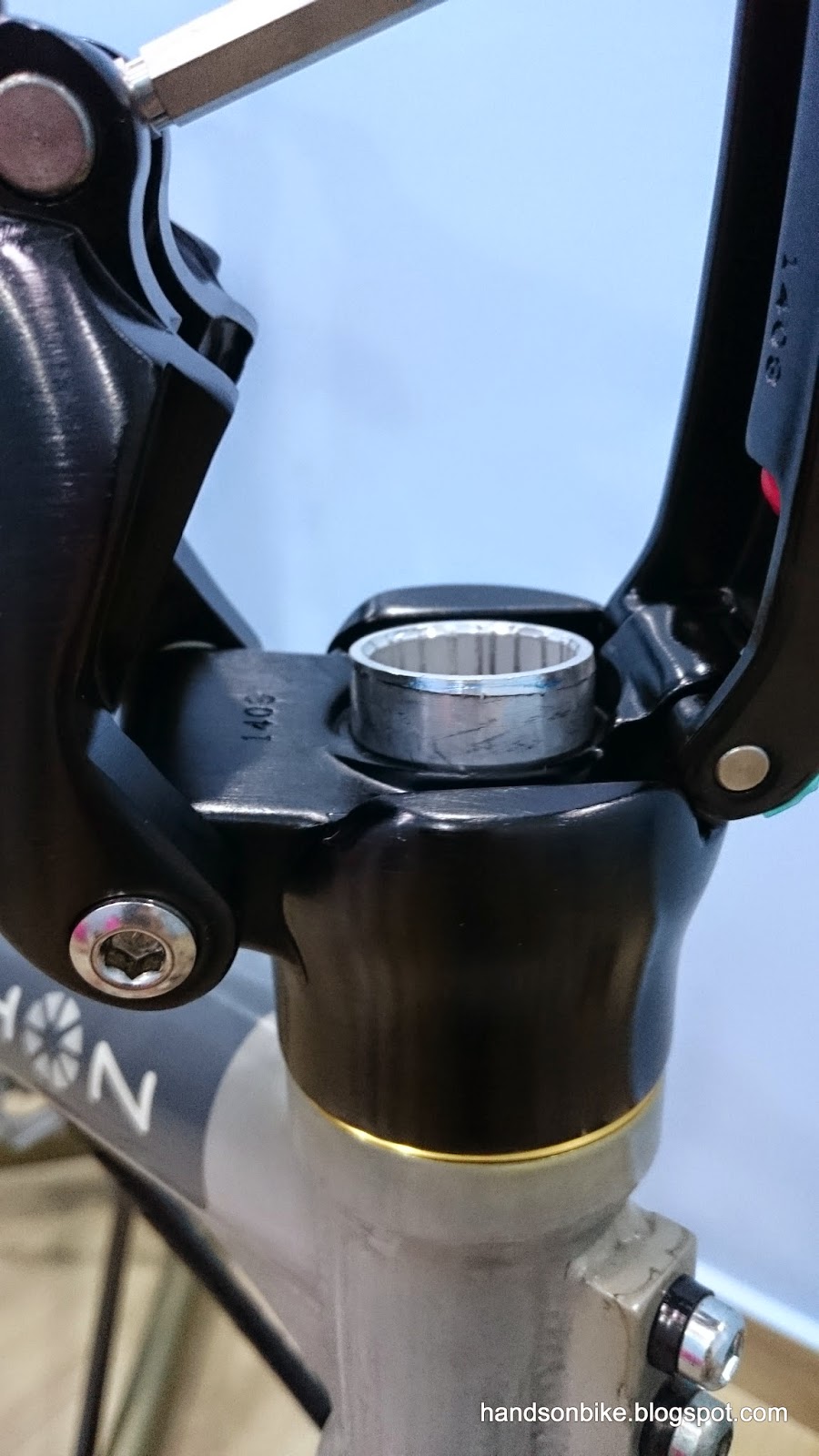
With the Tern handlepost installed onto the Tern fork. As you can see, the steerer tube is too long as it protrudes quite a bit above the base of the handlepost.

The extra length of the steerer tube is measured to be about 9mm. To be safe, I will cut away about 12mm of the steerer tube, so that the steerer tube is just below the top edge of the handlepost base.

By now, it is quite clear that the Tern fork steerer tube is too long for my Dahon Boardwalk frame. It will be necessary to cut short the steerer tube to ensure that it is compatible with the Tern handlepost. From the calculations and measurements shown above, cutting away 12mm seems to be about the right amount.

***
As a side note, you may have noticed that from the measurements above, the ideal headtube height to suit the Tern fork and Tern handlepost is 101mm. This is exactly the headtube height on the Dahon MuEX frame!

In other words, if I wanted to install a Tern fork and Tern handlepost on a Dahon Mu frame, it would go on perfectly without needing to cut the steerer tube! This is something worth considering for those who has a Dahon Mu frame, and want to install a Tern handlepost.
***

Now that all the considerations and measurements have been done, the next step would be to do the actual modifications required. The main task would be to cut the steerer tube, but it is not so straightforward as the starnut is still in the way.

In the next part of this series, I will show how I did the modifications and installation of the Tern handlepost and Tern fork onto the Dahon Boardwalk.

Part 4 is now up! Click here to continue reading.

Saturday, March 14, 2015

Can I Install Tern Handlepost/Fork on Dahon Frame? Part 2: Comparison

In the first part of this series, I introduced the Tern handlepost and fork, and I plan to install them on my Dahon Boardwalk. However, some of the dimensions and designs are different, and so fitting the Tern parts on the Dahon bike is unlikely to be so straightforward.

Before we proceed further to installation, it is important to compare the Dahon/Fnhon and Tern parts, so that we can determine the feasibility and possibility of this upgrade. The best way would be to do a one to one comparison, and take note of the differences. Once the differences are known, it would be much easier to figure out how to make the parts fit each other.

Let's start with the fork. As introduced in the previous post, the general construction of the fork is the same, however there are some key differences which affects the function and compatibility.

Weight:
To make an accurate weight comparison, we will need to include the weight of the compression bolt (Dahon) or the weight of the top cap (Tern), as it is an integral part of the fork.

Weight of Tern fork plus top cap is 454 grams.

The weight of the Dahon fork plus compression bolt is about 488 grams, as referenced from the fork used during the building of the Mu Ex bike. The weight of the compression bolt alone is 48 grams.

However, do note that the fork for the Mu Ex bike has a steerer tube length of 123mm, as compared to the 111mm for the Dahon Boardwalk. This means that the actual weight of the Dahon fork on the Dahon Boardwalk will be a bit less than 488 grams.


Compression Design:
This is where there is a big difference between the Tern and Dahon fork, although the function is the same. The purpose of this compression function is to preload the headset bearings and to remove any play between the headset parts.

The Dahon fork uses a threaded compression bolt, which screws into the steerer tube that is threaded internally. This means a special compression bolt is required, while the steerer tube also needs to be threaded. Although it works well, it probably means a higher production cost and heavier weight.

Dahon fork's steerer tube is threaded internally, for the compression bolt to tighten into

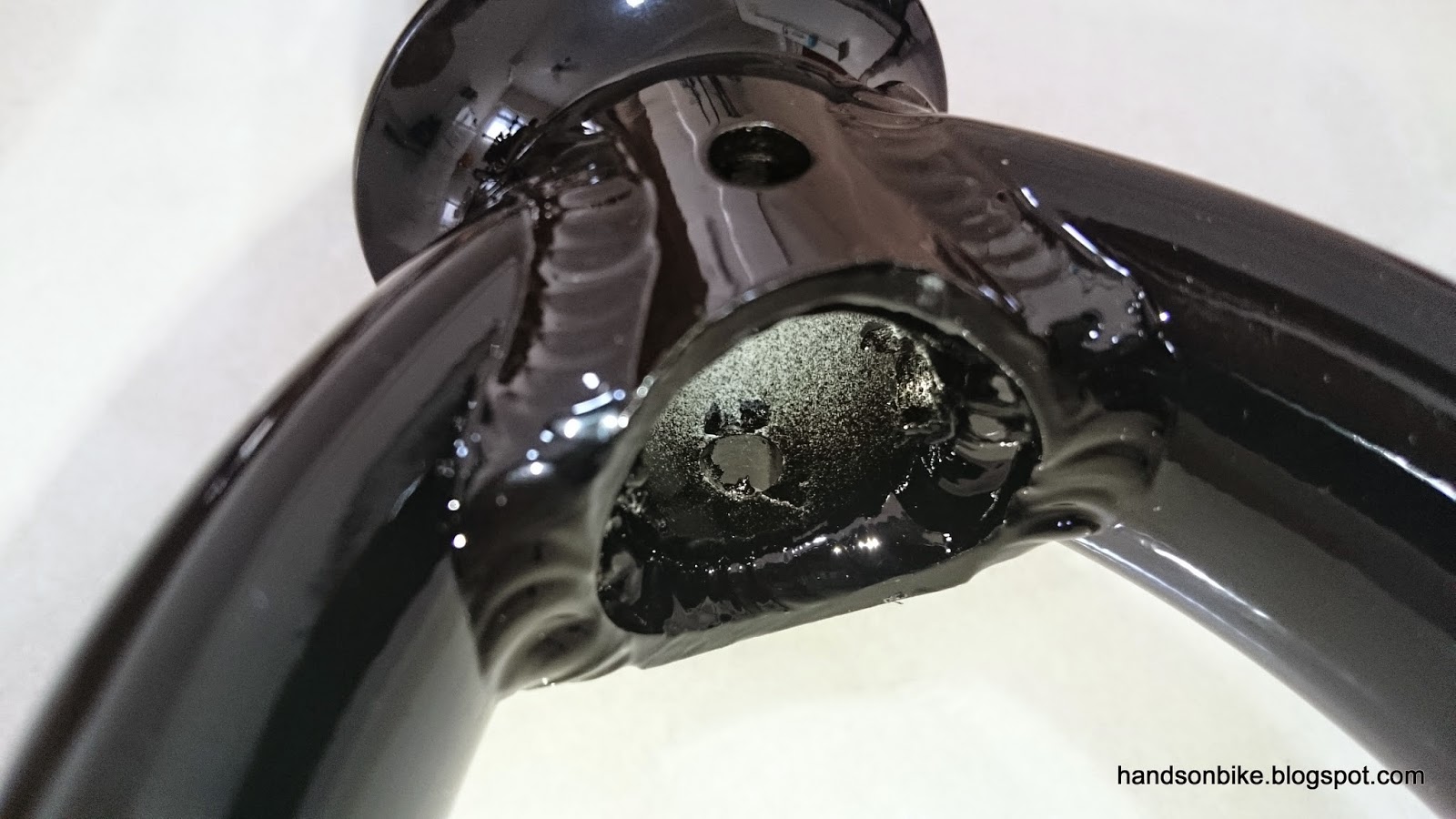
As for the Tern fork, it uses a more traditional starnut design plus top cap for preloading the headset bearings. This starnut is inserted into the steerer tube, and it is a one way fit which means that it will not come out the same way. This is a lighter weight design, and also means that there is no need for a special compression bolt and a threaded steerer tube. Lower production cost and lower weight, but not sure what is the downside.

Tern fork steerer tube with a pre-inserted starnut

Any standard top cap with bolt can be used to preload the headset bearings


Steerer Tube Length:
This is the most important difference, which is the reason why I needed the Tern fork in the first place. The Tern handlepost requires a longer steerer tube to clamp onto, which is why the Dahon fork is not compatible with the Tern handlepost.

Dahon forks comes with 2 different steerer tube lengths. The 111mm version is for Boardwalk/Speed/Vitesse frames, while the 123mm version is for Mu frames. This is due to the taller head tube on Mu frames.

Dahon fork steerer tube length on the Dahon Boardwalk. 109.5mm, slightly short of the nominal 111mm.

Tern fork steerer tube length of 140mm, much longer than the Dahon fork.

Comparing the steerer tube lengths side by side


Position of Brake Mounts and Magnetix Mount:
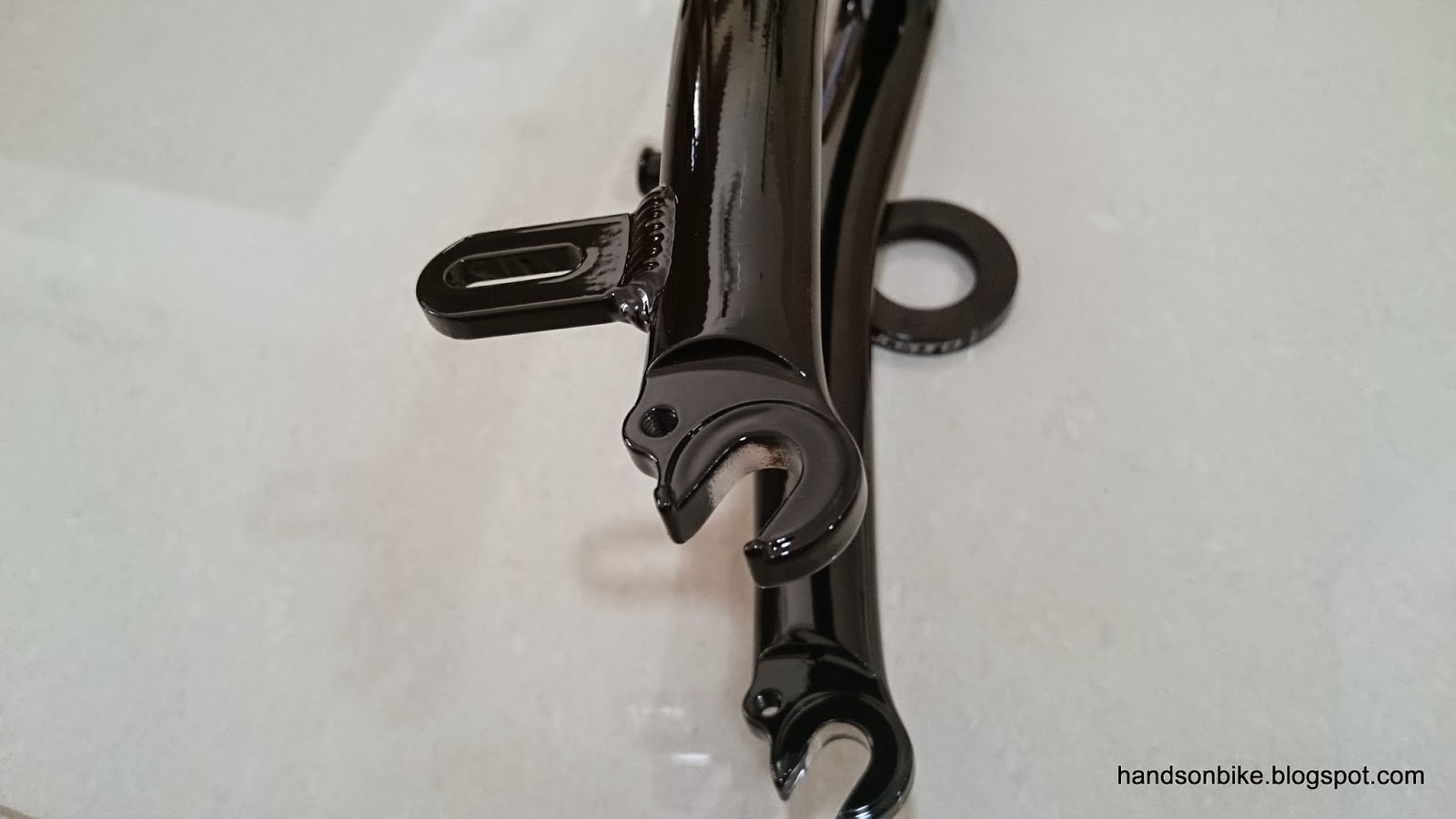
Lastly, there are some differences in brake mountings and Magnetix mountings between the Dahon and Tern fork. Due to the different folding method used, the V brake mountings and Magnetix mountings are the total opposite between the Dahon and Tern fork.

Dahon fork has the V brake mountings facing the front, while the Tern fork has the V brake mountings facing the rear.

The Dahon fork has the Magnetix mount on the left side of the fork, while the Tern fork has the mount on the right side. This will affect the folding of the bike.

Now, let us compare the Dahon handlepost with the Tern handlepost. There are many differences here, and some of them contribute to the added strength and stiffness of the Tern handlepost. Let's find out what they are!

Weight:
The Tern handlepost is quite a lot heavier than the Fnhon handlepost. This is mainly due to the more chunky construction at the joint area and the T-bar at the top. Hopefully the added stiffness is worth the additional weight!

Fnhon 4 bolt handlepost, weighing only 511 grams.

Tern Physis handlepost, 12 degrees tilt angle and 290mm long. Weighs 200 grams more than the Fnhon handlepost, at 710 grams.


Manufacturing Process:
The Fnhon handlepost is made up of a few pieces welded together, which means that weld lines can be seen at the joints. This does not affect the function, although it may not look so nice.

The Tern handlepost is 3D forged into one piece and thus there are no weld lines to be seen. This makes the handlepost look better and is also stronger.

Fnhon handlepost with welding joints at the top and bottom of the handlepost

Tern handlepost with no weld lines to be seen. Nice smooth shapes along the handlepost.


Bottom Design and Clamp Design:
The bottom of the handlepost is quite different between Tern and Dahon/Fnhon. For Dahon/Fnhon handleposts, the bottom of the handlepost is flat, and it rests on the Upper Cover of the headset.

On the other hand, the bottom of the Tern handlepost is specially designed, such that it mimics the shape of the headset Upper Cover. This means that the headset Upper Cover is integrated with the base of the Tern handlepost, eliminating the need for a separate part.

Another difference is the side clamp bolts at the base of the handlepost. Dahon/Fnhon handleposts have one clamp bolt to secure the handlepost to the steerer tube, while the Tern handlepost has two. Two clamp bolts should be more secure and stiffer than one. Also, the two clamp bolt design is more similar to traditional stem designs with two side clamp bolts.

Flat bottom of the Dahon/Fnhon handlepost

Standard design of Dahon/Fnhon handlepost. Compression bolt, single clamp bolt and headset Upper Cover (shown in gold colour).

Tern handlepost with a specially shaped bottom. A rubber seal is also included. Two side clamp bolts to tighten the handlepost to the steerer tube.


Locking Lever Design:
The Dahon locking lever design is really well designed and looks very integrated with the handlepost. With an internal clamping design, the locking mechanism is the most low profile and compact that I have seen across all folding bikes.

Fnhon locking lever design which follows the Dahon design. However, it uses the old type of black sliding clip as an additional safety catch.

Internal clamp mechanism of the Fnhon handlepost. Simple and works well. Best of all, it is hidden inside the handlepost.

The Tern handlepost actually uses an older Dahon locking lever design, with an external over-centre locking type of design. It is more bulky, but it can be easier to adjust and can potentially be stronger if designed well.

Old locking lever design on the Dahon Eco 2 handlepost. Same concept as the Tern locking lever design.

Tern handlepost locking lever with the mechanism all on the outside of the handlepost.


Length of Handlepost:
The length of the handlepost is important as it determines the riding position. One of the main reason I wanted to get the Tern handlepost is because it is short enough for my requirement. However, in order to get an accurate handlebar height, it is necessary to include the stem in the height measurement, as the type and length of stem will affect the overall length/height.

I also realised that for the Fnhon handlepost, I also needed to add the thickness of the headset Upper Cap as it adds to the overall height. This Upper Cap is already integrated with the Tern handlepost.

The Fnhon handlepost uses a 31.8mm stem on top, which adds to the overall height. Same for the Tern handlepost with the new Controltech Stem.

Fnhon handlepost plus 31.8mm stem, with a total height of about 340mm. Note that I included the gold Upper Cap at the bottom as it is part of the total height too.

Tern handlepost with the Controtech Stem, with a total height of about 330mm.

Comparing the two setups side by side. The base of the Tern handlepost can be seen to be much chunkier.

As measured earlier, the overall height of the Tern setup will put the handlebar about 10mm lower than the current Fnhon setup.


Width of Stem:
Lastly, the different stems used on the handleposts will affect the space available on the handlebar. This is due to the different clamp widths of the different stems.

Fnhon handlepost with the old stem has an internal width of about 41mm.

Fnhon handlepost with the old stem has an outside width of about 63mm. Clamp width is about 10mm each.

Tern handlepost with Controltech Stem has an internal width of about 55mm. More clearance between the stem clamps.

Tern handlepost with Controltech Stem has an outside width of about 88mm. This is much wider than the previous setup, which means less space at the sides for other accessories. Clamp width is about 16mm each.

With that, the comparison is complete! We now have a clear picture of the differences between the Fnhon and Tern parts. With this information, we can start to consider the effects and modifications required to fit the Tern handlepost to the Dahon Boardwalk frame. This is the ultimate target which I want to achieve.

In the next part of this series (Part 3), I will write about the considerations required for this project to continue.

Part 3 is  now up! Click here to continue reading.

Wednesday, February 18, 2015

Can I Install Tern Handlepost/Fork on Dahon Frame? Part 1: Introduction

As discussed in the previous blog post, I have always worried about the strength of the special 31.8mm stem on my Dahon Boardwalk. In fact, the clamps have broken before, thankfully not during a ride. That was the reason why I decided to get the better Controltech Stem to replace it.

The Controltech Stem requires a T-shaped handlepost for mounting a handlebar, similar to the setup shown in the picture below.

Syntace Stem used on the Tern Verge X18, but the clamp size is for 25.4mm handlebars, not 31.8mm.

As I am already using the Fnhon 4 bolt handlepost, this means that it is not directly compatible with the Controltech Stem, which requires a T-shaped handlepost. I could use the bar section of the stem (as seen below), and clamp that section in the 4 bolt handlepost. This will create a T-shaped handlepost for the Controltech Stem to fix onto.

The bar section of the stem (on the left) that I can use to convert a clamp type handlepost to T-shaped handlepost.

However, I don't really like this setup as it means multiple joints, which causes lower stiffness and is not an elegant setup. There will still be many bolts at the handlebar area as the 4 bolt handlepost is still there.

The only way to install the Controltech Stem elegantly is to use a T-shaped handlepost. The Controltech Stem will then join the handlebar to the handlepost, clean and simple. The problem here is that neither Dahon or Fnhon makes T-shaped handleposts in such a short length. In order to maintain the handlebar height at about the same level, I will require a handlepost that is approximately 29cm in length (from top to base). The shortest T-shaped handlepost from Fnhon is about 34cm in length which is way too long.

During my search for a suitable handlepost, I found that Tern handleposts are actually shorter, and are quite easily available from www.premiumbikegear.com. There are a few choices available, with different lengths, tilt angle and colour.

The problem is, a Tern handlepost cannot be fitted directly onto my Dahon Boardwalk. This is because the Tern handlepost requires a longer section of the fork steerer tube for clamping, as compared to a Dahon handlepost. In other words, to have a chance of using a Tern handlepost on a Dahon bike, I will also require a new Tern fork with a longer steerer tube. Since this is the only option I have, I decided to get both a Tern handlepost and a Tern fork. The only way to find out if a Tern handlepost will work on a Dahon bike is to try it out myself!

First, I need to choose the handlepost. For most bikes, the tilt angle should be 12 degrees. This will put the handlepost pointing straight up when mounted on the bike. Checking the Tern Bicycles website will show the different bike models that uses 6 or 12 degree tilt angles. As for the length, I went for the shorter 290mm (29cm) version as that is exactly what I need.

Tern handlepost is available in Black or Silver colour, with 2 different tilt angles and 2 different lengths.

Tern Physis 3D handlepost, in the specifications I need.

Looks very sturdy!

Measures 29cm from the base to the centre of the T-shaped portion. I found that a good way to measure the handlepost length is to set the base flat on the floor, and measure the height from the floor.

T-shaped top portion is machined separately, and press-fitted onto the top of the handlepost

Metal pin used for hooking onto the rubber strap on Tern bikes when the handlepost is folded down. I will remove this pin since it is not required.

Very tall clamping section with 2 clamp bolts. You can see the rubber seal at the base of the handlepost.

3D forged profile is strong and seamless, with no welding lines to be seen anywhere on the handlepost.

Base of the handlepost, with the rubber seal removed. This base profile is special as it replaces the Upper Cover of the headset. More details in the next blog post.

Inside of the handlepost base. Note the tall clamping portion.

External locking mechanism, used on earlier versions of Dahon bikes before the clamp mechanism was changed to internal. Although the external clamp looks bulky, it still works very well.

Note the distance between the base hinge and the lever hinge. This gives a really wide joint interface which is good for ensuring high stiffness.

Safety catch on the locking lever which prevents the lever from opening on its own. It does not take any load when the handlepost is adjusted and operated correctly. Therefore, the handlepost can function normally even if the safety catch is broken.

Weight of the Tern Physis 3D handlepost. Weighs 710 grams, a whole 200 grams heavier than the Fnhon 4 bolt handlepost which weighs 511 grams. Hopefully the additional weight is worth the improvement in stiffness!

Now that I have introduced the new Tern handlepost, it is time to look at the new Tern fork. For 20" Tern forks, there is only Black or White colours to choose from. All other specifications are the same. As stated above, the reason for getting a new fork is because I need a fork with a longer steerer tube to be compatible with the Tern handlepost.

Brand new Tern 20" fork!

Unwrapped and ready to go

Main difference from Dahon fork is that the V brake bosses are at the rear of the fork instead of at the front...

...and the mount for the Magnetix plate is on the right side of the fork leg instead of the left. This is due to the different folding method.

The steerer tube area and the inside of the fork is similar to Dahon forks. Can still use the Elosix front brake adaptor for caliper brakes.

Weighs 438 grams on its own, comparable to the Dahon fork.

The key part of this Tern fork is the steerer tube, which is 140mm long. For reference, the Dahon fork has steerer tubes of 2 different lengths, 111mm (for Speed/Boardwalk/Vitesse frames) and 123mm (for Mu frames).

Another new discovery for me is that the inside of the fork is not threaded. Rather, it has a starnut inserted in the steerer tube, same as standard road bikes or mountain bikes.

Although there is no problem in dealing with a starnut, the problem is that neither the fork nor the handlepost comes with a top cap to be used with the starnut. As shown in the handlepost installation manual below, a top cap is required to pre-load the headset bearings during installation.

Installation manual for the Tern handlepost

Luckily, the missing top cap is just a standard top cap, which is the same as those found on road bikes or mountain bikes. It is easy to find a top cap to use with this Tern handlepost and fork.

Standard top cap used for pre-loading the headset bearings.

A standard M6 bolt of suitable length is used with the top cap.

The M6 bolt will thread into the starnut during installation of the handlepost.

Total weight of the Tern fork + top cap is 454 grams, lighter than the Dahon fork + steel compression bolt at 488 grams.

With a new Tern handlepost and fork in hand, I will be able to do a proper comparison between the handleposts and forks of Dahon and Tern. By doing so, I can see how to make the Tern handlepost and fork fit my Dahon Boardwalk frame. Is it possible, and is it easy? To be continued in Part 2!

Click here for Part 2!