Thursday, January 3, 2019

SRAM NX Eagle 12 Speed Groupset

I first tried the budget S-Ride 12 speed MTB groupset on the Polygon Cozmic CX3.0, and it was quite an eye-opening experience. The wider gear range offered by the 11-50T cassette meant that I could pedal up steep slopes and still ride relatively fast on the roads, on the way to the trails.

Usually, for 27.5" or 29" wheels, a 30T or 32T front chain ring is used, and that is usually the optimum gear range for most riders. However, as my MTB is an older 26" version, I compensated for the smaller wheels by using a larger 34T front chainring. This gives a gear range that is similar to that of larger wheels with smaller chainring.

The S-Ride 12 speed groupset (without crankset) is of quite decent quality, and priced at a nice entry level pricing, for those who are looking for a cheap and affordable upgrade for their older MTB. Most older MTB groupsets are probably 3x9 speed or 3x10 speed, and by changing to a modern 1x12 speed, it simplifies the drivetrain and also breathes new life into an otherwise outdated bike setup.

By introducing the affordable 1x12 speed drivetrain to the market early, it had the first-to-market advantage, as no one else had the same product on offer. Higher end SRAM XX1/X01/GX Eagle 1x12 speed groupsets require a special XD Driver on the freehub, which is not available on older bikes. The XD Driver is necessary to accommodate the small 10T sprocket.

Now, with the SRAM NX Eagle groupset, the S-Ride groupset has lost the advantage, as the SRAM NX Eagle 1x12 speed groupset has exactly the same main feature, which is the 11-50T cassette.

As previously discussed, the 11-50T cassette has the key advantage in that it can be retrofitted onto the standard 9 spline freehub body, which is found on almost all older 8/9/10 speed MTB. Although it does not have the small 10T sprocket for a higher gear ratio, that is not so important for this class of rider, who probably does not need that high a gear ratio anyway.

For a start, this SRAM NX Eagle 1x12 speed groupset is very similar to the S-Ride 1x12 speed groupset, and is definitely a direct competitor. Although the SRAM NX Eagle is later to the market, and is also higher priced (about 1/3 more than S-Ride), it is from a more established brand which users might prefer.

Without further delay, let's take a look at this newly launched SRAM NX Eagle 1x12 speed groupset. A comparison with the S-Ride 1x12 speed groupset will be done in a separate post.

SRAM NX Eagle 1x12 speed upgrade kit, which means it does not come with the crankset.

A narrower 12 speed chain is needed to fit between the sprockets.

Weight is not accurate as it includes the plastic box. Probably around 280 grams or so without the box?

Gigantic box which houses the huge 11-50T cassette! I am always surprised at the size of the box that contains the cassette.

11T sprocket and lockring is clipped together on the inverted cassette

All 12 sprockets shown here! On its own, it does not look big, but note that the 3rd biggest sprocket is already a 36T! Remove the 2 largest sprockets and you will get a 10 speed 11-36T cassette.

Sprocket sizes (32T, 36T, 42T, 50T)

These 4 largest sprockets are riveted together on a spider

Strategic layout of rivets which secures the large sprockets on the spider

In case you are interested in the model number, it is PG1230. At first I thought the spider is made of stamped steel, but later realized that it is actually aluminium.

Weighs 361 grams for these last few sprockets which are riveted together on the spider.

All the other 8 sprockets and spacers laid out! What I really like is the design of the cutouts on the sprockets, which are strikingly different from Shimano sprockets.

Upon closer look, see how the 5 spoke design plus angled slots combine to create an edgy appearance. 

The spline design of the spider is also quite unique. Although it follows the 9 spline design, the shape seems to have special "escapes" at the radius areas. Is it to save weight or to minimize the machining process?

The special spline profile can also be seen on the individual sprockets. However, in this case it seems to be just to save a bit of weight, by removing material at the non-driving area.

The 11-50T SRAM NX Eagle cassette weighs 613 grams, which is heavy.

SRAM NX Eagle 12 speed rear derailleur. The empty cutout at the side is actually for a tool to set up the distance between the guide pulley and the sprocket, but it is only provided for higher grade rear derailleur.

Some hollow design to save weight, while still maintaining strength and giving a lightweight appearance.

Eagle logo spotted on the outer link, along with the NX logo on the side.

Type 3 Roller Bearing Clutch design, which is non adjustable. The Cage Lock button is also there to keep the cage extended for easy removal of the rear wheel.

Cable pulley for the shifter inner cable to make a U-turn, to reach the cable fixing bolt.

B-tension screw at the top, Top and Low limit screws at the bottom.

View of the cage set. Large 12T guide pulley and 14T tension pulley.

Big offset between the pivot of the cage set and the guide pulley. This allows the pulley to move downwards when shifting inwards on the cassette, allowing it to clear the large sprockets. This design is possible only because it is exclusively for a front single drivetrain.

SRAM NX Eagle 12 speed rear derailleur weighs 339 grams, which is heavier than a Deore M6000 rear derailleur.

SRAM NX Eagle 12 speed shifter, comes with shifter inner cable

The clamp band and clamp bolt is included in the box, but is not the fixed type.

To remove the inner cable, just pull back the rubber flap.

To insert a new inner cable, just put it through the hole on the orange part.

If you have a SRAM brake lever, you can attach the shifter directly to the brake lever without using the clamp band.

By attaching the bolt to either one of this holes, you can position the shifter further or closer away from the brake lever.

To release a gear, you have to push the release lever located behind with your thumb. No way to activate with the index finger like on Shimano shifters.

Resin main lever for shifting. No aluminium lever or angle adjustment like on higher grade models.

Bottom cover of the shifter is made of aluminium. It is actually the base where the other parts are assembled to.

How it looks with the clamp band attached. Other than fixing the clamp band to the handlebar, the clamp bolt is also the one that attaches the clamp band to the shifter.

Weight of SRAM NX Eagle 12 speed shifter, including clamp band and clamp bolt is 108 grams. Quite lightweight.

Clamp band and clamp bolt weighs 11 grams.

We can see that for a front single drivetrain, there are not so many components that need to be assembled. Just the cassette, chain, rear derailleur, shifter and of course the front chain ring. These will make up the drivetrain of the bike.

Being the 4th tier of SRAM Eagle components, it has to be of a lower price, which means that the materials used for the components are less premium and heavier. More resin and steel, instead of aluminium or carbon fibre.

The chain is quite standard in weight, while the shifter is actually quite lightweight as it uses a resin main lever instead of aluminium which can be heavier.

However, the cassette (613 grams) and rear derailleur (339 grams) are heavy, and not competitive in terms of weight.

In another post, I will compare this SRAM NX Eagle groupset with the S-Ride 12 speed groupset, which is very similar in terms of specifications and function.

Sunday, December 23, 2018

Shimano Ultegra R8000 vs 6800: Brake Calipers

Although hydraulic disc brakes are becoming more popular on road bikes, traditional mechanical caliper brakes are still used on many bikes, as they are simpler to adjust for the home mechanic and also more lightweight than disc brake setups.

In some cases, it makes more sense to use caliper brakes, as they are more suitable. For example, on the Dahon MuSP folding bike, a standard reach caliper brake comes stock on the bike. This is best paired to a road shifter, which is why the Dahon MuSP is a good choice for a road drop bar setup.

During the previous generation of road caliper brakes from Shimano, a cam roller mechanism was used to enhance the braking performance of the brakes. This can be seen on the Dura-Ace 9000, Ultegra 6800 and 105 5800 caliper brakes.

This time, the new Ultegra R8000 brakes were used on the Dahon MuSP. Although it looks quite similar to the previous Ultegra 6800 brakes, there are some subtle but important differences. Let's compare and see what the differences are!

Nomenclature:
6800 = Ultegra 6800 caliper brakes (previous generation)
R8000 = Ultegra R8000 caliper brakes (latest generation)

6800 has silver coloured pivots, and the quick release lever points downwards when closed.

R8000 has a redesigned quick release lever, which tucks in neatly with the brake arm when closed. The pivots are also black in colour for a more stealthy look.

6800 has one bolt and one nut on the two pivots, both of which are silver in colour.

R8000 uses a slightly different construction, and has two nuts on the two pivots. Also black in colour like the bolts at the front of the brake.

6800 has a casted aluminium piece in the middle, which is part of the cam roller mechanism. The adjustment bolt (seen at top) means that a joint is visible.

For R8000, the cam roller mechanism has been redesigned to be a stamped steel part (black piece in the middle), which has a similar cam roller mechanism. The adjustment bolt has been moved to the side, which means that the top arm can be one single piece.

6800 has a spring tension adjustment bolt (small bolt just above the spring), which is not really necessary.


R8000 does not have a spring tension adjustment bolt, but it is OK as it is not important.

R8000 has an additional steel stiffening plate that links the left and right pivots together. This reduces the flexing of the brake arms during hard braking, which improves the braking performance. Although it adds weight, I think it is worth it for the performance boost.

R8000 has the adjustment bolt located at the side, which allows the whole brake caliper to look more integrated with less gaps.

6800 weighs 341 grams as a pair. Not so lightweight, but it has good braking performance.

R8000 actually weighs more at 362 grams, due to the additional steel stiffening plate.

In summary, the differences between the new Ultegra R8000 brake calipers and the previous Ultegra 6800 brake calipers:

1) Improved braking performance
2) More integrated look with less visible joints in the construction
3) Heavier by about 20 grams
4) Slightly darker shade of grey
5) Black coloured pivots

That's about it, with all other aspects looking the same as the previous generation. As already mentioned, these are rather subtle differences that enhances the appearance and also the performance, but at the expense of a bit more weight.

Saturday, December 8, 2018

Polygon Cozmic CX3.0: S-Ride 1x12 Speed, Maxxis Tires, ODI Grips

It has been 5 years since I bought the Polygon Cozmic CX3.0 mountain bike, and some components are way overdue for a change! For example, the tires are still the stock Kenda tires, and it is definitely time to change it after 5 years.

At the same time, I decided to install the 12 speed S-Ride upgrade kit, just to see how a 11-50T cassette feels like. As shown in detail in the previous post, this 11-50T 12 speed cassette can fit on a standard 9 spline freehub body, which means it can be installed on the my stock Shimano MT55 26" wheelset.

For the choice of new tires, there is not such a wide range of 26" tires available, as the market has mostly moved on to 27.5" and 29" wheels. Still, the range is wide enough to make it a tough choice to choose a new tire. After much research, I finally decided on the tires shown below.

I needed to take into account the tire width, as the latest generation of 26" tires are normally wider than the stock Kenda tires which are only 2.1" wide. Due to frame and fork limitations, it is not possible to run tires that are too wide.

Based on my visual estimation, there is enough space to fit in a 2.2" wide tire, instead of the stock 2.1" tire.

Maxxis Ardent Race tires, which is a good choice for most terrain, including some on-road riding. 2.2" wide which I think is the maximum that can be installed on my Polygon frame.

Some technical information on these tires. There are so many tire choices that it is hard to choose one.

679 grams per tire, which is on the heavy side for a 26" tire. Just for comparison, road bike tires are only about 260 grams each!

After removing the stock Kenda 2.1" tires, it is compared to the new Maxxis 2.2" tires.

Look at the big difference in width! The difference will be less once mounted on the rims. Not sure which tread pattern (along the central channel) will roll better on the road...

Comparing the new 2.2" Maxxis tires with the stock 2.1" Kenda tires, after mounting on the rims. Noticeable increase in width, hope it fits into the frame!

New Maxxis rear tire clearance with chain stays, only just enough! Less than a finger's width.

Front tire clearance with the arch on the front fork, also barely acceptable.

I am relieved that the new Maxxis Ardent Race tires, which are 2.2" in width, is able to fit my frame and fork. This extra width will provide extra grip when riding off road.

Other than new tires, I decided to get fresh grips as the previous grips were wearing out. No real need to change, but these new grips (as tested on other people's bikes) felt so much better in terms of grip and comfort, which was why I got new ones at the same time as the new Maxxis tires.


ODI Rogue lock on grips!


The clamps and bolts come unassembled. All the parts are the same, with no left/right or mirror designs.


Clamps and grips weigh 135 grams. Not for weight weenies...


To install the clamps, need to snap fit it over the ends of the grips.


The end caps also snap into the clamps. This needs to be done before installing the grips onto the handlebar.

Overall view of the grips

These grips have big chunky blocks that are soft and grippy, while the clamps are well designed. One little complaint is that the grips are exactly the same parts for left and right side, instead of being a mirror image of each other. This means that I cannot position them so that the clamp bolts and ODI logo are symmetrical on the bike. No function issue, just an aesthetic one.

Moving on to the new 12 speed drivetrain, the S-Ride rear derailleur requires a standard DATT hanger, which my Polygon mountain bike does not have. As previously shared, the Polygon comes with a Direct Mount hanger, which is good for Shimano mountain bike rear derailleurs but not others.

Therefore, if I wanted to use the S-Ride rear derailleur on the Polygon mountain bike, I needed to change the hanger to a DATT type. It may seem impossible to find, but I managed to find an online bike shop from Australia that has the hanger for my exact Polygon frame!

Comparing the stock Direct Mount hanger (left) with the new DATT hanger (right). Same mounting design to the frame.

The Direct Mount design places the attachment point further back, eliminating the need for an extra link on the rear derailleur.

Once the hanger has been switched, the rear derailleur could be installed without any problems. No problems either for cassette, shifter and chain installation. Let's see how the components look on the bike!
S-Ride rear derailleur, mounted on the new DATT hanger.

S-Ride rear derailleur. Looks quite good, except that it is not low profile like a Shadow rear derailleur. I also wonder how effective the clutch is.

The large 11-50T cassette mounted on the rear wheel, along with the 12 speed chain.

The new 12 speed drivetrain and the new Maxxis tires! Same SLX front single 34T crankset.

S-Ride 12 speed shifter installed! The gear display is nice to have, especially since there are so many gears on the cassette.

ODI Rogue grips installed. Looking good!

View of the full bike! The fresh, larger Maxxis tires makes the bike look new again!

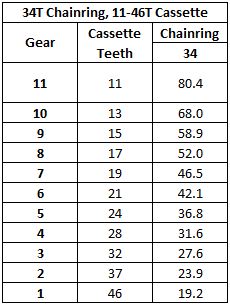
How does the new gear range compare with the previous setup? Let's take a look.

Previous setup with 1x11 speed 11-46T cassette 

New setup with 1x12 speed 11-50T cassette

On this new 12 speed setup, there is a lower gear, courtesy of the large 50T sprocket. Other than that, the gear range and gear steps are similar to the previous 11 speed setup. In this case, the additional gear might not necessarily be better, as I give up the good performance of the Shimano 11 speed rear derailleur and shifter. In any case, it is worth trying out this 12 speed groupset which is not too expensive.