Saturday, August 7, 2021

Cervelo Aspero: 650B and 700C Gravel Wheelset Comparison

Since I now have both a 700C and 650B wheelset for my Cervelo Aspero gravel bike, it is a good chance to do a side-by-side comparison. This will be useful for those who cannot decide between a 700C or 650B gravel wheelset.

As the wheels are different, the weight comparison is merely for reference. The Hunt 650B Adventure Carbon Disc wheelset is one of the best 650B wheels around, and is also very lightweight. On the other hand, the DT Swiss G 1800 wheelset is a basic aluminium gravel wheelset that is rather heavy.

650B wheel on the left, with brown sidewall WTB Venture 47 tires.

Both are using 11-42T 11 speed MTB cassettes.

650B wheel with WTB Venture 47 tires have a diameter of 681 mm.

700C wheel with WTB Byway tires have a diameter of 698 mm.

As you can see, there is a diameter difference of about 17 mm between these two wheelsets. It is expected, and this size difference will mean a different axle-to-ground height, and also BB ground clearance. The ride characteristic will also be slightly different, which is where the Trail Mixer position may be used to adjust the ride feeling.

Axle centre differs by about 8.5 mm, which is about half the diameter difference of 17 mm.

700C wheelset is noticeably larger than the 650B wheelset.

Very different tire treads. Smooth centreline on the 700C Byway, and grippy treads on the 650B Venture 47.

Tire width is different, as a smaller 650B tire can have a wider tire compared to a 700C tire, without frame interference.

Venture 47 measures true to size at 47 mm, on a 24 mm internal rim.

Byway measures 37 mm on a 24 mm internal rim, smaller than the claimed 40 mm width. I'm OK with this width as it is midway between the 27.5 mm GP5000 road tire and the 47 mm Venture 47 tire.

The 700C Byway has a tire width that is 10 mm narrower than the 650B Venture 47, which may or may not be a good thing. I'm hoping that the smooth centreline on the Byway will give me low rolling resistance on tarmac.

The height of the tire sidewall is very different. The black areas are about the same height, but the 650B tire has an additional brown sidewall height which adds a lot to the air volume inside the tire.

DT Swiss G 1800 front wheel with Byway tire and rotor weighs 1600 grams, which is quite heavy. Also partly because I am using inner tubes.

Hunt 650B carbon front wheel with Venture 47 tire and rotor weighs less, at 1448 grams. Although the tire is heavier, the carbon rim and tubeless setup saves quite a bit of weight.

DT Swiss G 1800 rear wheel with rotor and cassette weighs 2224 grams, which is also heavy.

Hunt 650B rear wheel with rotor and cassette weighs less at 2036 grams.

700C wheelset weight is thus 3824 grams, while the 650B wheelset weighs 3484 grams. If I used a high end carbon rim for the 700C wheel, plus tubeless setup, the final weight will be lighter than the 650B wheelset, as the 700C tires are usually lighter.

Main Differences:
1) 700C tire width is 10 mm narrower than the 650B tire.
2) 700C tire diameter is 17 mm larger than the 650B tire.
3) 700C wheelset is 340 grams heavier than the 650B wheelset.
4) 700C tire has a smooth centreline tread, which should make it roll smoother on tarmac.

It is nice to compare the specifications, but the final test is how well it rides on the road. For this 700C gravel wheelset, I need it to ride well on the road, while also being wide and grippy enough to handle some light gravel.

After extensive testing on the road and gravel, I found that this 700C gravel wheelset is rather disappointing. My expectation was smooth rolling on tarmac, due to the smooth centreline in the middle of the Byway tire. However, I could still feel a significant amount of drag, and it feels pretty slow to accelerate or cruise. In fact, my 650B wheelset feels even faster, even though the Venture 47 tire has a more knobbly tire on it. It could be due to the heavier DT Swiss G 1800 wheelset, instead of the Byway tire. Hard to conclude unless I put the Byway tires onto a lightweight set of 700C carbon gravel wheels to compare again.

As for light gravel riding, the Byway tire also does not perform very well. Due to the smooth centreline, it does not have sufficient grip. Compared to the 650B tires, I have to slow down a lot more on loose corners, to avoid sliding during cornering. This makes it a relatively poor gravel tire as well.

I just came across an article reviewing this exact tire, and the conclusion was the same as what I discovered. The rolling resistance was quite high, which is unexpected since there is a smooth centreline that is supposed to reduce rolling resistance.

In all, this Byway 700C tire is neither fast rolling on road, and also not grippy enough for proper gravel riding. I'm sure there are some good 700C gravel tires out there, but this is not the one. Unfortunately this 700C tire does not provide the characteristics that I want, so it is back to the 650B gravel wheelset on my Cervelo Aspero gravel bike.

Friday, August 6, 2021

Focus Paralane: Hylix Seatpost - Part 1

Ever since I got the Focus Paralane, I had a problem with the seat post. I needed a seat post with zero offset, but it is nearly impossible to find, as the seat post diameter is an uncommon 25.4 mm.

For quite some time, I had to make do with the stock BBB seat post which has a rearward offset. To compensate for this, the saddle had to be pushed as far forward as possible, but there is a limit. The pedaling ergonomics is not ideal as the knee joint is too far behind the pedal spindle.

Finally, I managed to find a lightweight 25.4 mm diameter seat post by Hylix, with zero offset. Not only the outer diameter needs to be correct, the inner diameter also needs to hold the Di2 battery inside. Let's take a look at it.

Parts of the Hylix seat post. Comes disassembled like this.

It is quite hard to find a good quality seat post that is 25.4 mm in diameter.

The seat post is just a carbon tube. This opening size is suitable for a Di2 battery.

Outer diameter is accurate at about 25.4 mm.

Internal diameter is about 21 mm, big enough for the Di2 battery with rubber holder.

The other end of the seat post has an aluminium sleeve bonded to it.

The carbon tube and aluminium sleeve are then machined together to make them fit perfectly.

Seat post is hollow all the way through.

The rest of the seat post. Here are the parts for the saddle clamp.

One piece carbon holder for the saddle rails. Strong and lightweight.

The aluminium holder goes through the seat post, like the Litepro seat post design.

The two round rods will then hold the saddle rails in place.

Carbon tube weighs just 104 grams.

Saddle clamp parts weigh 47 grams.

This gives a total seat post weight of 151 grams, before cutting. It is really lightweight!

Here is how the saddle looks on the original seat post, which has a rearward offset that is too much.

With the new zero offset seat post, the saddle can be moved forward by quite a bit.

Seat post needs to be cut, as it extends too far into the frame, interfering with the bottle cage bolts.

However, I discovered a problem with the saddle clamp parts, which is a manufacturing defect. The threaded holes on the rods are slanted, which prevents the bolt and clamp from tightening correctly.

The holes on the rods have been drilled and tapped in a slanted manner, as you can see here.

I reported this issue to the seller, and they will be sending out a new set of rods which are drilled correctly. However, while waiting for the replacement, I tried to see if I can use some other parts first, so that this seat post can be used now.

Saddle clamp from the original seat post on the left, the Hylix seat post on the right. The original clamp looks so much stronger.

If I switch from the two rods to the big clamp, it weighs more.

Unfortunately, this does not work, as the hole distance on the clamp does not match the position of the bolts.

Due to the manufacturing defect, I was unable to use the new Hylix seat post. Watch for the second part of this post, to see how it eventually worked.

Sunday, August 1, 2021

Boa Dial Replacement for RX8 Gravel Shoes

Ever since I got the Shimano RX8 gravel shoes 1.5 years ago, I have been using it on almost all my rides. This means that it is pretty well used.

Recently, I found that the rubber layer on the outside of the Boa dial was peeling off, due to wear and tear. It is still usable, but I also know that Boa provides a lifetime warranty for their Boa dials. This means that if the Boa dial is damaged or malfunctions, you can request for a free replacement.

Rubber layer on the outside of the Boa dial is peeling off.

Other parts of the shoe are fine, just that the dial is a bit worn out.

I contacted Boa to get a replacement, and it was sent out pretty quickly. It will be an equivalent Boa dial, although it may not have the exact same appearance.

It comes as a pair for left and right shoes. The difference is the rotation direction, which are mirror image of each other.

Left side (purple) is differentiated from the right side (red) by colour.

The new Boa dial has a black cover, which is different from the original RX8 dial which is transparent.

The Boa dial comes in two parts, one which is already fixed inside the black cover.

This part has 4 metal pawls on the outside, which will engage the ratchet on the inside of the dial that is fixed on the shoe.

Other than the replacement dials, a tool and new wire is provided.

Very detailed instructions, which I will need to follow very carefully.

The instructions for left and right dials are different, so take extra care to follow the correct instructions.

Using the tool, which is basically just a small Torx wrench to loosen the dial. I didn't realize that there was actually a small hole cleverly hidden in the middle of the dial!

This is the part from the left shoe.

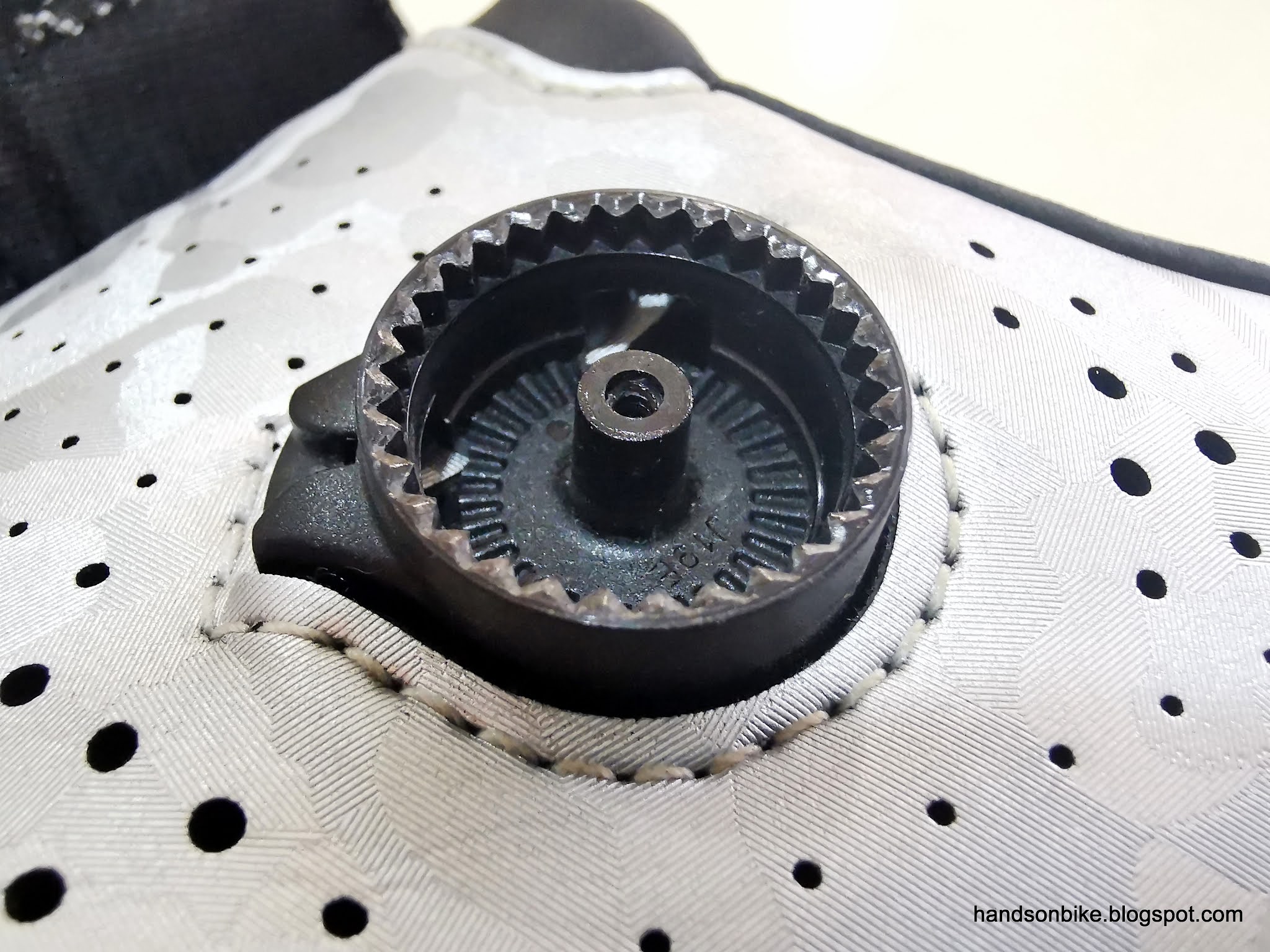
The ratchet is fixed to the shoe, so it cannot be replaced.

Taking a picture here, to remember how the wire runs through the loops of the shoe, before I cut the wire.

Close look at the ratchet on the shoe, after the wire is cut. The screw tightens into the centre of the dial.

Putting the end of the wire through this soft loop is not easy, as the open end keeps getting stuck inside the soft fabric.

Putting the wire through these plastic guides.

I reused the old wire, but with a new plastic disc. Note that the wire is fixed to the disc only by some very clever knots. Follow the instructions carefully!

At this point, I was feeling rather happy with my work, as I have managed to replace the Boa dial on the left shoe, using the new purple discs and the old wire.

However, when I was moving on to the right shoe, I made a terrible mistake. Before the dial can be replaced, I need to cut the wire first. 

I accidentally cut the wire on the left shoe, which is the side which I have just replaced!

This was a really silly mistake. I needed to cut the wire on the right shoe, which still had the old dial. However, I went to cut the wire on the left shoe, which I have just replaced with the new dial. So much for a smooth replacement.
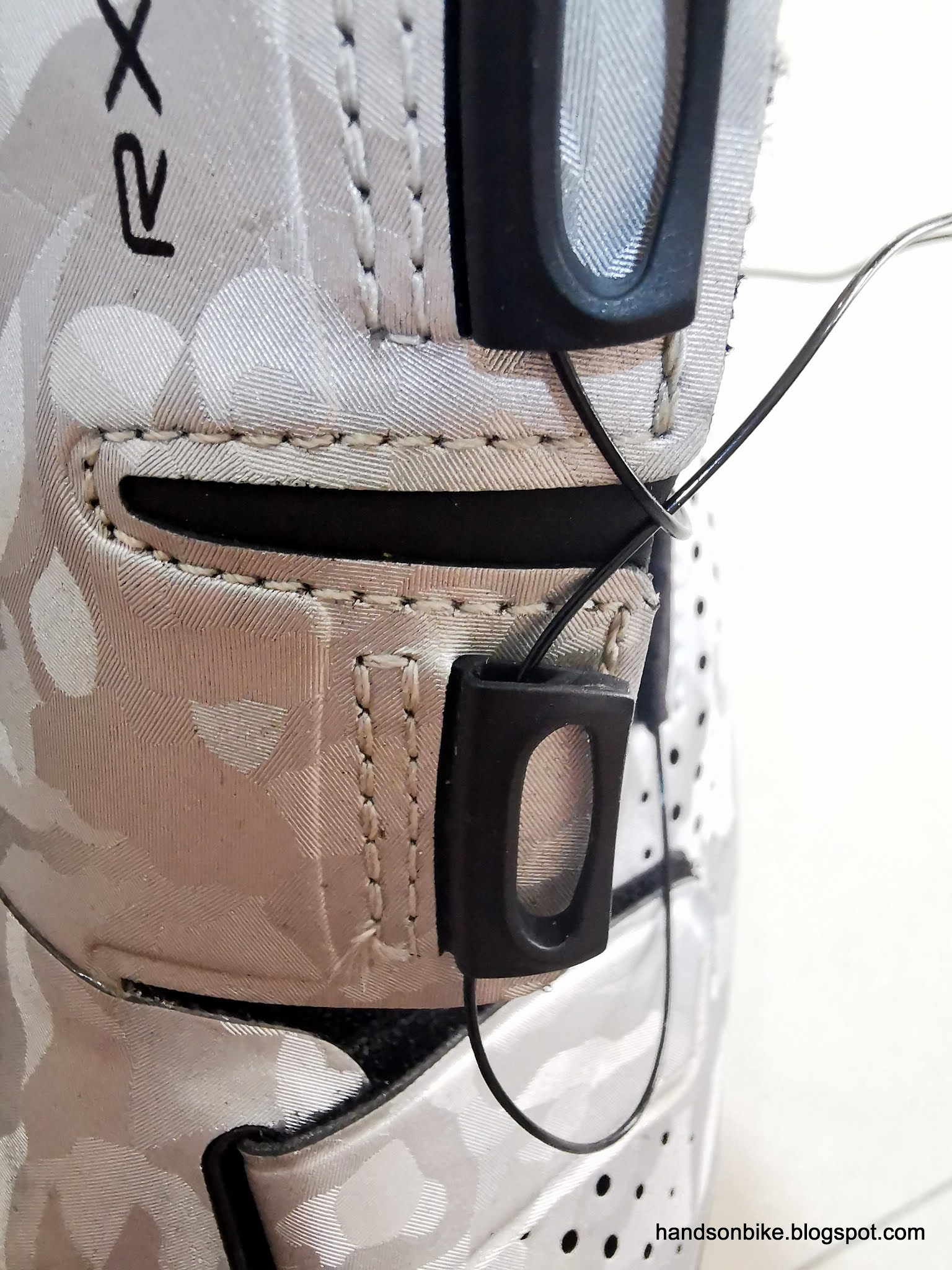
Luckily, I still had the new wire, which I did not use. It will take more work, but I still have the parts to replace both the Boa dials properly.

New dial on the left, old dial on the right. Different shades of red but the same design.

New dial is completely black, while the old one has a transparent cover. I like how the hole for tool access is cleverly hidden inside the letter "O".

New Boa dial installed! The black cover actually looks better than the original transparent cover.

New Boa dials! Feels somewhat like a new shoe again.

Other than the silly mistake that I made, the replacement was not difficult, just a bit tedious due to the small knots that I had to tie. I also took the chance to use a slightly longer wire length, so that the shoe can open a bit wider, to make it easier to insert the foot.

If your Boa dial is not working well, you can also contact Boa to get a replacement Boa dial.