Sunday, January 9, 2022

Shimano 11 Speed vs SRAM AXS 12 Speed: Chain and Chain Ring

For the modification of the Fnhon folding bike from 11 speed to 12 speed, I will be using the SRAM AXS drivetrain. One quirk of that drivetrain is the unique AXS Flattop 12 speed chain, which is not compatible to any other drivetrain.

Although SRAM does have its own 12 speed MTB drivetrain, it uses a different chain from the road/gravel 12 speed drivetrain. From what I understand, the Flattop chain has larger chain rollers, which means that it will not fit onto any of the existing chain rings or cassettes, which are matched to smaller rollers. In fact, roller size have not changed for a long time, even though the chains are getting narrower as we go to more speeds. For chains with 11 speed and below, they are mostly cross-compatible across manufacturers, even though performance may differ slightly.

Therefore, I had to get a new chain ring for this 12 speed conversion, even though I already have a few narrow wide chain rings available. I first used a Wolf Tooth narrow wide chain ring 5 years ago, and my most recent one was the cheaper Stone narrow wide chain ring.

I find both brands make good narrow wide chain rings, and both of them do make new narrow wide chain rings that are specifically stated to be compatible to the SRAM Flattop 12 speed chain. However, there was not a lot of good information on the Stone 12 speed chain ring, which was why I decided to get the Wolf Tooth 12 speed chain ring instead. Also, the Wolf Tooth version is apparently backward compatible to older chains as well.

In this post, I will do a comparison of the chain rings and chains, between 11 speed and 12 speed versions. Note that measurements will be off by a little bit, as the proper measurement tool to use would be a micrometer instead of a vernier caliper that I have.

Old 48T Drop Stop chain ring, vs the new 44T Drop Stop B chain ring.

Even with a side by side comparison, I couldn't really tell a difference in the teeth profile just by looking at it.

The new profile (in front) apparently has a deeper valley and a sharper tooth to match the 12 speed Flattop chain, which has larger rollers and a narrower inner width.

The narrow teeth on the new chain ring (right) has a sharper point than the older version.

Old tooth profile is around 4.64 mm from front to back.

New tooth profile is about 0.1 mm smaller. However, this measurement may not be accurate as there is no clear measurement datum on the tooth profile.

Thickness of older narrow tooth profile, 1.95 mm.

Thickness of new narrow tooth profile is noticeably thinner, at 1.7 mm. This is to match the new 12 speed chain with a narrower inner width.

Thickness of old profile wide tooth is 3.64 mm.

Thickness of new profile wide tooth is 3.34 mm. This also means lower tooth durability.

For the chain rings, all I can compare are the thicknesses of the narrow and wide tooth profiles. Comparing the old to new profile, the new profile has a 0.25 mm thinner narrow tooth profile, and a 0.3 mm thinner wide tooth profile. As it is thinner, it is compatible to older chains that are wider. However, it also means less chain stability as the chain has more space to move laterally on the chain ring teeth.

Next, let's compare the chains. The difference in chain dimensions is why a new chain ring was required.

SRAM Force AXS Flattop 12 speed chain, vs the Shimano Dura-Ace 11 speed chain. Comparison will be based on dimensions only, not other factors.

Putting the 11 speed chain on the old Wolf Tooth chain ring gives just a little bit of free play. Good for chain retention.

Putting the 11 speed chain on the new chain ring, with narrower teeth means there will be more free play. It is compatible, but chain retention ability might drop a bit.

In this case, the new chain ring is compatible to both older 9/10/11 speed and also the new 12 speed Flattop chain, as claimed by Wolf Tooth. It is NOT compatible to Shimano 12 speed chain.

However, the reverse is not true, as you can see below. The older chain ring is NOT compatible to the new 12 speed Flattop chain.

New 12 speed Flattop chain on the old chain ring. As the chain rollers are larger, they are not able to rest properly on the chain ring teeth. Completely incompatible.

12 speed Flattop chain on the new chain ring, fits perfectly as it should. This is why a new chain ring is needed for the Flattop chain.

Flattop chain rests nicely on the new chain ring. The chain link plates look really thin here!

Diameter of Shimano 11 speed chain roller is 7.65 mm, which is the same as almost every other chain.

Diameter of SRAM 12 speed Flattop chain roller is larger at 7.9 mm. This is why it does not fit properly onto existing chain rings or cassettes.

External width of Shimano 11 speed chain is 5.62 mm. This is the width that gets narrower with more speeds.

External width of SRAM 12 speed Flattop chain is even narrower, at just 5.05 mm!
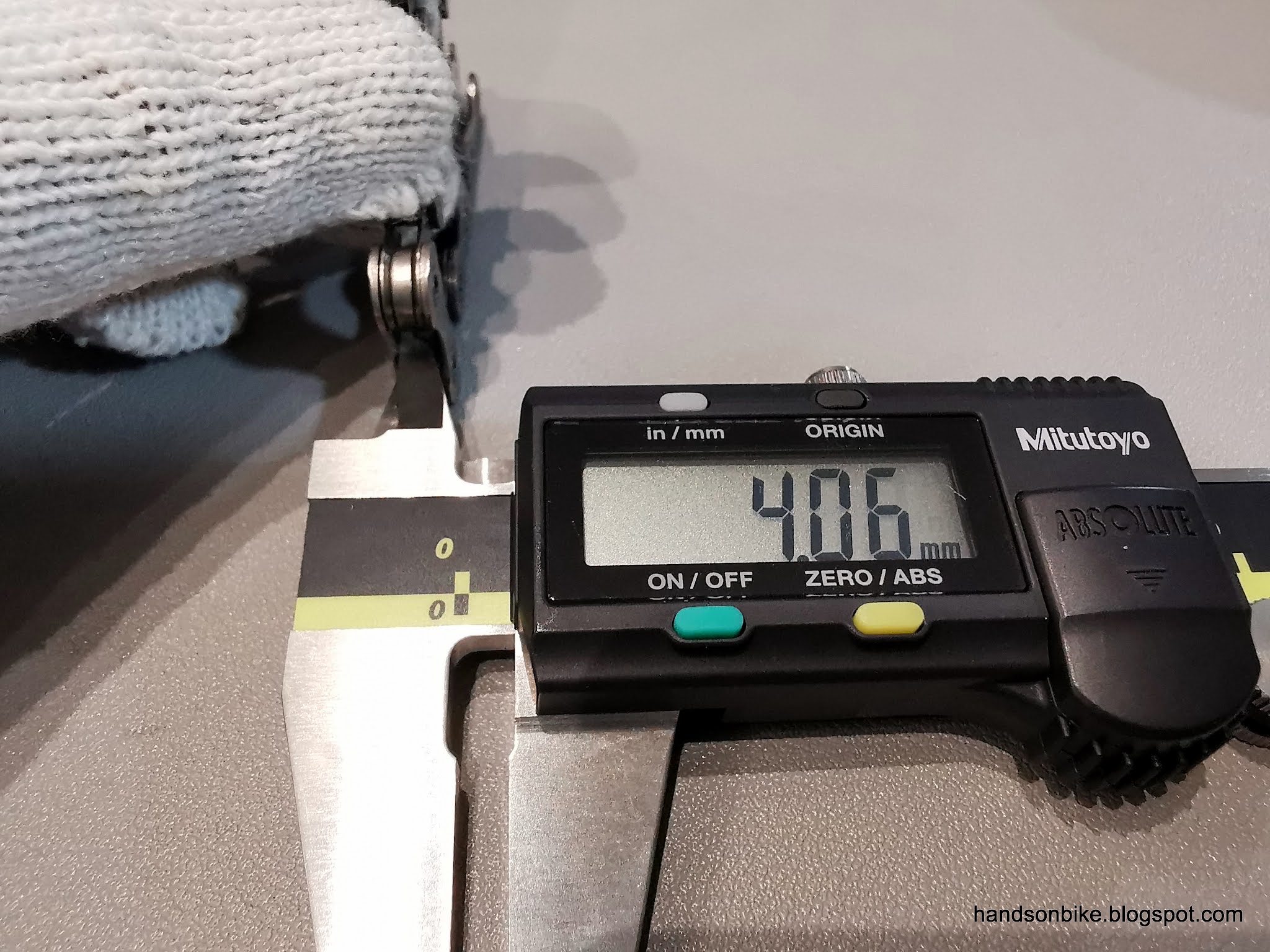
Internal width of Shimano 11 speed chain, between outer plates is 4.06 mm.

Internal width of SRAM 12 speed Flattop chain, between outer plates is 3.68 mm, almost 0.4 mm narrower. This does not really fit onto the old profile wide tooth which is 3.64 mm as shown earlier.

Internal width of Shimano 11 speed chain, between inner plates is 2.32 mm. This is the same across most multi-speed chains, from 9 to 11 speed.

Internal width of SRAM 12 speed Flattop chain is slightly narrower between inner plates, at 2.21 mm.

Thickness of Shimano 11 speed chain outer plate is 0.78 mm. The plate thickness decreases as the chain goes to more speeds.

Thickness of SRAM 12 speed Flattop chain outer plate is even thinner at 0.65 mm.

Thickness of Shimano 11 speed chain inner plate is 0.73 mm.

Thickness of SRAM 12 speed Flattop chain inner plate is really thin, at just 0.58 mm!

Comparison table

With a comparison table, all the chain dimensions can be seen clearly. Once again, note that these dimensions are based on my own measurements, in which there will be a small error. Also, there are manufacturing tolerances, so this is by no means a standard dimension.

Key Points:
1) Just a small 3.3% larger chain roller makes it completely incompatible to older chain rings, as the difference accumulates quickly across the chain links.
2) 12 speed Flattop inner chain width is reduced slightly, which necessitates narrower chain ring teeth as well.
3) Chain link plate thickness of the 12 speed Flattop chain is really thin, which is why they needed more material on the plates for strength, giving it the distinctive Flattop shape.
Side Note: The Campagnolo Ekar 13 speed chain is even narrower at 4.9 mm!

I think this is a pretty good comparison showing how different this new AXS 12 speed Flattop chain is, compared to other chains. There will be serious compatibility issues if you try to use this new chain on older chain rings or cassettes.

Now that the Shimano 12 speed road groupsets are available, there is an opportunity to mix and match components. However, the Shimano 12 speed chain (common use for road and MTB) is also unique, as it has longer inner plates with a large chamfer, which introduces other compatibility issues. I might have a chance to do some 12 speed cross-compatibility checking in the future, when I get my hands on some new 12 speed components.

Friday, January 7, 2022

Fnhon DB12: Ascent Revolution BB

While modifying the Fnhon folding bike to a 12 speed drivetrain, I took the chance to swap the bottom bracket as well. Not that the existing SM-BBR60 bottom bracket had any problems, but because I wanted to try the new bottom bracket by Ascent Bikes.

Special packaging! Very premium looking design.

This is for Shimano type of Hollowtech cranksets, which uses a 24 mm spindle diameter, and 68 mm wide, English threaded bottom bracket shells.

Full aluminium construction, where the left and right adapters are mated to each other for better concentricity control. It comes with a 1 mm spindle spacer in case you need it.

Designed in Singapore! The center cover extends out from one side of the adapter, instead of being a separate plastic piece like on Shimano bottom brackets.

Bearing dust cap on the side of the bottom bracket.

The left and right adapters are mated together during assembly, which helps to align the left and right side.

Since the threads on the left and right side of the frame are machined separately, there will be some tilt or concentricity error between the left and right side. Also, the faces of the bottom bracket shell may not be completely parallel to each other, causing the adapters to tilt slightly once fully tightened.

If the left and right adapters are not completely concentric to each other, there will be some imbalance and resistance to rotation, once the crank spindle is inserted. If the deviation is big, there will be extra friction and possibly lower bearing life.

This Ascent Revolution Bottom Bracket is designed to solve this issue, by using an extended center shaft to join the left and right side adapters together. This ensures that the concentricity error, if any, will be mitigated by the shaft alignment. However, in actual practice, if the deviation is so much that the shaft is needed to align them, it might not even be possible to assemble the bottom bracket, since the two halves will not be able to slot into each other.

Once fully tightened, I am not sure if the adapter position will be determined by the mating of this shaft, or will it be determined by the outside faces of the bottom bracket shell. I think it will help to a certain extent, especially if the outside face of the bottom bracket shell is poorly faced, like I encountered on the Brompton.

Bottom bracket weighs 111 grams, a noticeable increase over the BBR60 bottom bracket which weighs 76 grams.

During installation, the non-drive side bearing dust cap got pushed out by the crank spindle. Not a big problem as it can just be pushed back in.

New bottom bracket installed! No spacers needed under the bottom bracket, as the chain line is OK.

The benefit of this bottom bracket is smoother crank rotation, due to better bearing alignment and smoother bearings. I did find that the rotation is smoother than the BBR60 bottom bracket, but it is not buttery smooth like ceramic bearings.

Video showing the Ascent Revolution bottom bracket in action.

The BBR60 bottom bracket was only able to spin about 1-2 rounds in stock condition, so this Ascent Revolution bottom bracket is an improvement as it can spin 6 rounds.

I would say it is an upgrade over the BBR60 bottom bracket, due to the improved rigidity and also smoother rotation. However, it is not a day and night difference, like if I changed to a super high end ceramic bottom bracket where the cranks just keep spinning for more than 10 rounds.

Sunday, January 2, 2022

Fnhon DB12: SRAM GX AXS Shifter

For this project to convert the Fnhon folding bike from 11 speed to 12 speed, quite a number of components need to be changed. Starting from the rear hub (change to XDR freehub body), the cassette and chain, and also the rear derailleur, the next component is the shifter.

What I like about the SRAM AXS system is that I can mix and match road and MTB components freely, subject to some physical limitations of course. This concept is the same for Shimano Di2 components as well, but it gets a bit more complicated if you are using a front derailleur.

Normally, we start by choosing the cassette based on the type of riding (road or MTB). Then, the compatible rear derailleur is chosen (road based or MTB based). As for the shifter, you can choose either flat handlebar type or road drop bar type, depending on your type of bike.


Now, for the Fnhon folding bike, I will be using the Force AXS road rear derailleur, and I need to pair it with a flat handlebar shifter, which will come from the MTB AXS system. The compatibility chart below shows the compatibility across the different AXS components.

Looks a little complicated, but it also shows that many components are cross compatible.

I chose the SRAM GX AXS shifter, instead of the more expensive X01/XX1 version. I think the function is basically the same.

Such a big box for such a small component!

Here is the GX AXS wireless shifter, which is powered by a single CR2032 battery.

There is a function button and LED below, for pairing and adjustment purposes.

The lever is the unique part of this shifter, unlike any other shifters I have seen. It's like a rocker switch where you push it upwards or downwards with your thumb.

The same lever extends to the back of the shifter, where it can be operated by the knuckle of the index finger.

From the side view, it is clear that pushing UP on the top fin (left side) is the same as pushing DOWN on the rear button (right side), since they are connected as a single piece.

Toggling the lever operates the electrical switches behind. There is some lever looseness, which is not ideal, but not a deal breaker.

On the aluminium bracket, you will choose one of the two holes for mounting the clamp band, or directly to the Matchmaker brake lever. This  moves the shifter to the left or right, depending on your ergonomic preference.

If you are mounting a clamp band, having 2 holes is redundant as you can just shift the clamp band on the handlebar itself.

Weight without clamp band, but inclusive of the battery is 68 grams.

Weight of clamp band (included with shifter) is 11 grams.

Here is how it looks with the clamp band assembled!

Weight of complete shifter is 79 grams, which weighs in between an XTR and Deore XT Firebolt switch.

Just to make things more tricky, I decided not to use the provided shifter clamp band. Instead, I want to mount it on the XTR brake levers that I already have on the bike. I love the XTR brakes, as they have so much power that I only need to press lightly with one finger to stop confidently. For me, using high quality brakes is not about having more absolute braking power, but to reduce the amount of finger force needed to generate sufficient braking force.

Therefore, I need a third party adapter, to that I can attach the SRAM GX shifter (using Matchmaker mount) to the XTR brake lever (using I-Spec EV mount). I found one online by ZRACE, which does what I want exactly. Let's see if it works or not. If it doesn't work, the backup plan is just to use the clamp band instead.

Here it is! I think it should be called BL and SL integrator, instead of BR.

It comes with the special nut on the left for I-Spec EV brake levers, and a bolt as well.

This side will be fixed to the I-Spec EV brake lever.

This side will be fixed to the Matchmaker shifter.

The adapter weighs 11 grams, which is exactly the same as the stock clamp band.

Using the adapter on the right, instead of the stock clamp band on the left.

Adapter mounted to the SRAM GX shifter. 

To move the shifter sideways, I can either switch to the other mounting hole on the shifter bracket, or slide the adapter along the brake lever. I will try to find the optimum mounting position later on, when it is being installed onto the bike.