Wednesday, December 14, 2011

Pros and Cons of Bullhorns for the Dahon Boardwalk

Can a folding bike be a road bike at the same time? The answer is YES! What usually distinguishes a road bike from other bikes are the dropbars used on the bike. These dropbars will have road shifters installed, which is a combination of a gear shifter and a brake lever combined. Some people call them "brifters", which means brake+shifters. Shimano, which invented these shifters 20 years ago, call them Dual Control Levers (DCL), or Shimano Total Integration (STI) Levers. In any case, all modern road bikes nowadays are equipped with dropbars with road shifters installed, be it Shimano, SRAM, Campagnolo or even Microshift. Pretty pictures below!

Dura-Ace 7900 Road Shifters


SRAM Red Road Shifters


Campagnolo Super Record Road Shifters. 11 speeds!

Microshift Arsis Road Shifters


However, hardly any folding bike comes stock with road shifters! One main reason is because if dropbars are used with road shifters, it will definitely make the folding awkward, and the folded package will not be compact. Also, a folding bike is usually not designed to be a road bike, which excludes the need for a dropbar. Some folding bikes that do come with dropbars are certain models of Airnimal, Alex Moulton, iF Reach, and Bike Friday bikes. There may still be other brands of folding bikes that come with dropbars.

As for Dahon, their bikes don't come with dropbars! The Dahon Dash X20 comes with dropbars and road shifters, and is the only Dahon folding bike to come stock with these kind of shifters. Almost all their bikes use a flat handlebar, for a compact fold. The only exception is the Speed Pro TT or Vector X27, which comes with a bullhorn bar. That was the bike which I modelled my Dahon Boardwalk after, you can read all about the upgrade to bullhorns here!

 Bullhorns!

The bullhorns were great, as it allowed many different hand positions, which totally solved the problem of having numb hands on long rides. However, one thing which kept bugging me was the cable routing of the road shifters on the bullhorns. Because road shifters were not fully designed for bullhorn mounting, it is not easy to mount road shifters on bullhorns, and some of the shifters are also incompatible. If I changed to normal dropbars, there would not be cable routing issues with the road shifters.

On the Speed Pro TT bullhorns, the brake cable can be routed internally through the bullhorn bars, or routed externally. I could not route it internally as I wanted to install cyclocross brake levers. However, the external routing was not ideal either.

Black flexible v-brake noodle used to help guide the brake cable.

I needed to use the flexible v-brake noodle to guide the brake cable coming out of the shifter as the brake cable housing I was using (Goodridge, from CRC) was just too stiff! Cannot get it to bend properly at the area shown in the picture above. On hindsight I should have just used a more flexible brake cable housing at that area. In any case, the sharp bends are bad for cable efficiency, adding lots of friction when using the brake lever.

 Anatomic dropbars. Note the flat portion at the drops!

Strong and lightweight aluminium dropbar, at a reasonable price!

I came across these very nice dropbars at MyBikeShop, and it was inexpensive too. Which was why I decided to get those dropbars and eventually convert from bullhorns to dropbars. That was around 3 months ago, and during all these time I was happily using my bullhorns. No hurry!

There are many positive aspects to using bullhorns when compared to flat handlebars, with a major benefit being greater comfort. However, I must also state that there are some downsides, which were not immediately apparent when I had only used the bullhorns for a short while. But now, after 3 months, I can give a more complete picture of the pros and cons of the bullhorns.

Pros:
Comfortable primary hand position
Multiple hand positions
Better reach

Cons:
Less stable compared to wider flat handlebars
Tricky when going down steep slopes
TT position not possible (not really a disadvantage, just disappointed that this aerodynamic position which I like is not possible)
Large folded package

I don't need to explain the advantages, but I shall elaborate on some of the disadvantages which I experienced with the bullhorns.


Bullhorns usually come with a handlebar width of around 42 to 48cm wide. Whereas the previous flat handlebar I was using is 560mm wide. This lack of width means that using the bullhorns makes the ride less stable, especially when you use only one hand to ride. Not a serious problem, but not recommended for less experienced cyclists.

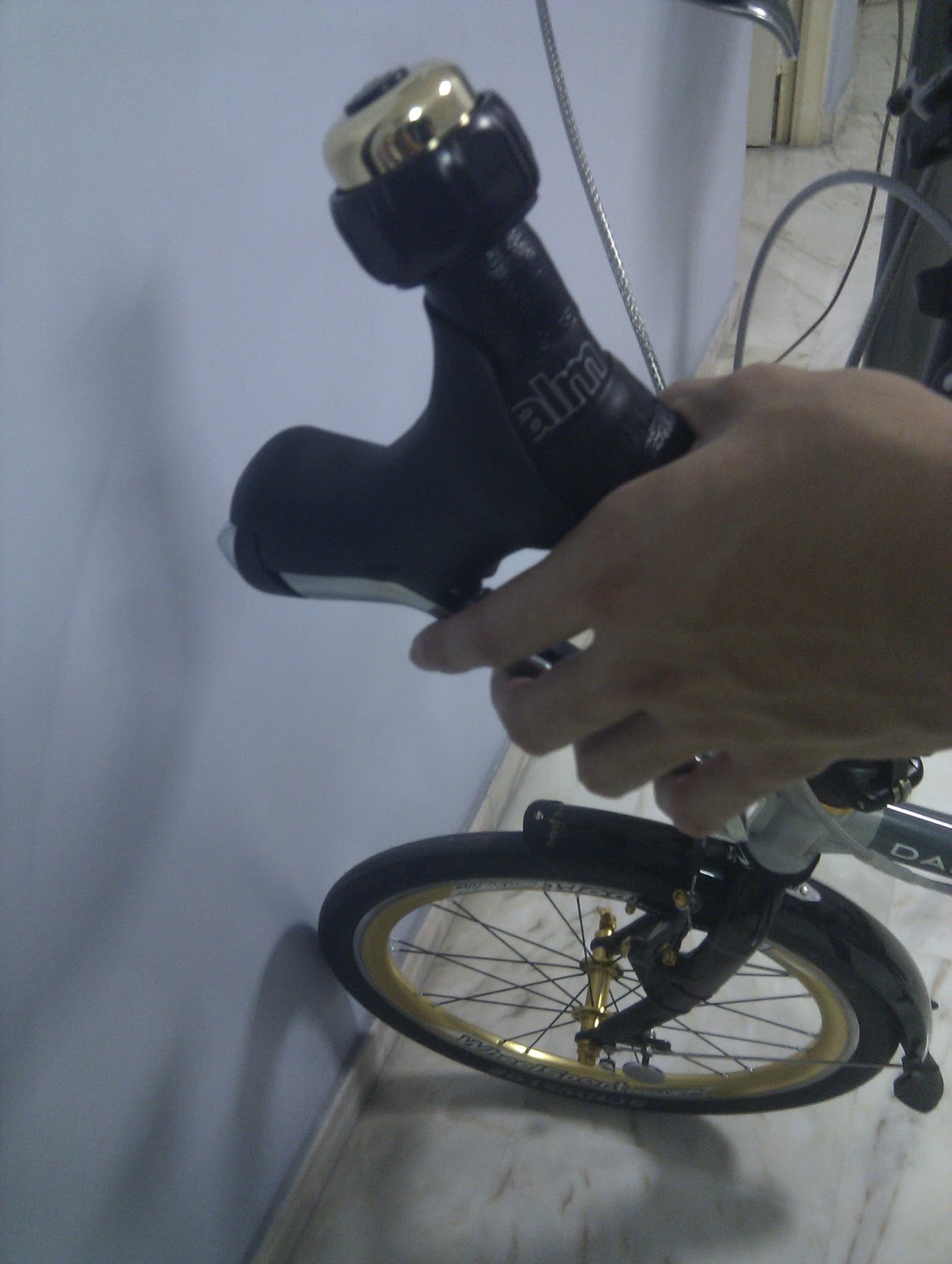
When going downslope, the only position at which you can brake effectively is to hold the bullhorns on the side, as shown below. This is also the primary bullhorn hand position. Holding at the cyclocross brake lever position is too dangerous as it is too narrow for you to control the bike properly at high speeds.

Primary hand position for bullhorns

Hand position during braking. However, the grip on the handlebar is less secure.

When coasting downhill, you will need to brace your hand against the hoods, or grip the handlebar tightly. In the primary hand position for the bullhorn, it is not possible to brace the hands against the hoods. Therefore it is essential to maintain a firm grip on the bullhorns. However, there is a need to open up the fingers of the hand to grip the brake levers when braking for the corners, as shown above. This means that during braking, the hand is kept in that position only by friction between the bar tape and the palm!

I found myself constantly switching between gripping firmly and braking, but it is not possible to maintain a firm grip and also brake at the same time. 

Another one of the major reasons why I got bullhorns is so that I can use the time trial position, where I can rest my elbows on the handlebars, go low and aerodynamic.

TT position, with the hand gripping the "horns" and the forearm resting on the handlebar. However, the elbow is too far back, and it is very tiring to maintain this position.

Alternative TT position, with optimum elbow position for comfort. However, there is nothing to grip, and this makes the ride unstable.

Eventually, I found that there is no suitable TT position for these bullhorns, as the positions are either too tiring for the arms or too unstable to use safely.

Overall, changing to bullhorns has more advantages than disadvantages. I know that there are other Dahon folding bikes which have also been converted to bullhorns. This makes the bike really fun to ride, and can also seem faster!

I will soon be posting the next part of Journey of the Boardwalk, where I will document the conversion of my Dahon Boardwalk TT to a Boardwalk X20-R!

Saturday, December 10, 2011

Part 8: Cheap Bikes vs Premium Bikes: What is the Difference?

This is the final instalment of the bike comparison series! In the previous parts, we have already discussed and compared the other major components on the bicycle. The detailed analysis and comparisons can be found at the links below.

Cheap Bikes vs Premium Bikes: What is the Difference?

Today, we shall compare the rest of the components on the bike. Besides the major ones like the braking system or the drivetrain, we will take a closer look at the folding joints and some other miscellaneous stuff on the bike, which may seem insignificant but are actually rather important.

Folding Joints
For a folding bike that folds into half like the Aleoca Ready2Ride or the Dahon MuP8, there are a few main joints/mechanisms on the bike that enables folding.

1) Frame Joint
2) Handlepost Joint

By folding the frame into half and then folding down the handlepost, it will make the folded package rather compact. The seatpost is also lowered to be the third leg that stabilises the folded bike.

The main frame joint is very important here, as it is crucial to keeping the bike in one piece, and needs to be strong enough to prevent frame flex. Taking into account the rider's weight, and maybe some luggage, the frame joint needs to be large in order to hold the front and rear part of the frame together tightly.

Aleoca R2R Frame Joint: Quick Release Skewer
Dahon MuP8 Frame Joint: Dahon proprietary V-Clamp

Type of quick release skewer clamp found on the Aleoca R2R frame.

Frame clamp on Dahon MuP8. See how tall and big the metal clamp is!

The frame clamp when opened. Ingenious construction with precision machined components to ensure that the two halves fit together snugly.

From the pictures, it can be clearly seen that the huge frame joint of the Dahon MuP8 is much stronger than the frame joint on the Aleoca R2R. It is hard to explain the physics of the frame joint here in words, but to put it simply, the Aleoca R2R's quick release frame joint is definitely not ideal for taking on the heavy loads acting on the joint. This results in a flexible frame that will twist from side to side as you pedal hard.

On the other hand, the large metal clamp on the Dahon MuP8 has a much larger clamping area, and is also taller, which makes the two halves of the frame fit very tightly to each other, and helps to maintain the stiffness of the frame.

In my opinion, this frame joint is one of the main reasons why the MuP8's frame is much better than the Aleoca R2R's frame. Poor components can be upgraded, but you cannot change the frame, else you might as well change a new bike. The excellent frame joint is one of the reasons why the MuP8 is worth much more than the Aleoca R2R.

Aleoca R2R Handlepost Joint: Traditional folding handlepost joint
Dahon MuP8 Handlepost Joint: Radius Handlepost with V-Clamp

Handlepost joint on the Aleoca R2R. Also found on many other folding bikes, even the new Tern bikes. There is a hidden vertical metal rod that pushes the top half of the handlepost onto the bottom half.

Radius handlepost with V-clamp lever seen at the bottom.
Big stainless steel clamp that clamps the top and bottom half of the handlepost together. Similar construction to the frame clamp of the MuP8.

I used to think that the traditional handlepost clamp is inferior to the new V-clamp handlepost hinge used by Dahon, which is why Dahon has been phasing out the traditional handlepost clamp found on the older Dahon Eco 2/3 bikes. However, after Tern bikes began using this construction on their handleposts, I realised that the traditional handlepost clamp can also be very strong! This can be seen in the excellent handleposts made by Tern for their bicycles.

In any case, Tern has already improved greatly on the design of the traditional handlepost clamp. However, the older one found on the Aleoca R2R is not good enough to ensure sufficient stiffness in the handlepost. The main culprit here is the hinge on the handlepost. The hinge that links the two parts of the handlepost must be well engineered to tight tolerances, to prevent any play. This hinge cannot be adjusted, so once it wears out and develops play, there is no way to tighten up the handlepost properly.

Whereas on the Dahon V-clamp handlepost, the whole mechanism is much more robust when compared to the one on the Aleoca R2R. There is minimal play when the handlepost hinge is properly adjusted and tightened. This handlepost hinge can also be considered part of the frame, as it is proprietary to Dahon and cannot be swapped out for a handlepost from other folding bikes. A lot of people have the misconception that folding bikes always come with flexible handleposts. However, a stiff and strong handlepost is possible, just that it will cost more to develop and produce. Which is why the Dahon MuP8 is a premium bike, because it comes with frame technologies that are specially developed for folding bikes.

Miscellaneous Stuff
There are other components on the bike which do not fall into any specific category. Here, I have listed out some components/accessories which I feel are really useful and worth mentioning.

Dahon MuP8 Seatpost: Biologic Postpump Seatpost

Biologic Postpump Seatpost. Use the saddle as the handle for pumping!

This is an ingenious pump that hides inside your seatpost. It does not take up any space on the bike, such as a frame mounted pump, and yet is powerful enough to be used like a standard floor pump. People are always amazed when you draw out your seatpost, and flip out the pump to use! One drawback is that there is no pressure gauge on the pump, but then again how many portable pumps come with a pressure gauge? Best of all, it only weighs 100+ grams more than the stock seatpost without a pump. Definitely a value-adding accessory that comes with the Dahon MuP8.

When folded, the magnet on one half of the frame will stick to the metal plate on the other half, keeping the folded bike together neatly. There is no need to take out a velcro strap to tie the folded bike together. With the magnets, the bike folds quickly and can also be unfolded quickly. You won't know how useful it is until you have used it!

Magnetix system that holds the two halves together

Magnet on springs on one side (to absorb the impact when the two sides come together) and a steel plate on the other side.

There are also other factors that affect the quality of the frame, such as the dimensional precision of the parts the make up the frame, the welding quality, or the quality control that determines if the frame passes the strength test. However, there is insufficient information available to compare these things, so they will not be discussed.

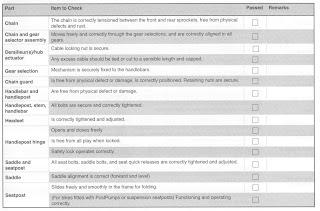
What we do know is that for Dahon bikes, the dealer/bike shop that is selling the bikes need to go through the checklist as shown below, before the bike can be delivered to the customer.

Dealer Pre-Delivery Checklist
For every Dahon bike that the dealer sells, they have to go through this checklist before the bike can be handed over to the customer. This is necessary because when the bikes are delivered around the world, it is almost unavoidable that there will be some rough handling of the boxes containing the bikes. By tuning the bikes and checking them for damage, it ensures that the customer gets a bike that can be ridden out of the shop in good condition, which is especially important for a folding bike that has many more joints and parts than a normal full sized bike.

At MyBikeShop, or any authorised Dahon dealer, whenever a new batch of Dahon bikes arrive, the numerous boxes of bikes are always taken out one by one, and each bike will be taken out and inspected. Basic tuning such as the gear shifting will be done at this time. The bike is then placed back into the box, fully tuned and ready for delivery!

When the customer buys a bike, the bike is then brought out of the box again, unwrapped, and then checked again to ensure that the bike has been tuned properly. The mechanic will run the bike through the checklist either during the initial check, or when the bike has been unwrapped for delivery.

If you buy a Dahon bike from overseas, it is unlikely that these checks will be made. There is no warranty, and therefore no obligation for the bike shop to do this, as you will not fly back to the country if anything goes wrong with the bike. The onus is wholly on the customer to make sure that the bike is properly tuned and adjusted. I have seen instances whereby new Dahon bikes have been brought back to Singapore from overseas, but have been plagued with several problems. These problems include loose pedals, warped bashguards, poorly adjusted hinges and clamps, that may pose serious problems if not remedied quickly. Unless you know your bike well, and have the ability to service your bike completely, it is not advisable to bring in bikes from overseas, bypassing the quality checks that are done by the bike shop.

This checklist can actually be found in the Dahon manual that comes with every new bike. Has anyone actually read that manual? In any case, I have included the checklist here for your reference.

      
Dealer Pre-Delivery Checklist for Dahon bikes

This checklist is not restricted to Dahon folding bikes! In fact, most of the items on the list are applicable to other bikes. You may want to print out the checklist and use it to inspect or service your bikes.

Final Summary
And here we are at the final part of the bike comparison article! I have made every effort to ensure that the facts are correct, and that the comparison is as fair as possible.

To answer the question: Cheap Bikes vs Premium Bikes, What is the Difference? The main components that come to mind when I compare the Aleoca R2R to the Dahon MuP8 would be the wheelset, the frame, the handlepost, and the folding joints. These are the major components that account for most of the difference in price between those two bikes. The detailed facts have been laid out for your comparison, whether the MuP8 is worth the price or not, it is up to you to decide!

Monday, December 5, 2011

Part 7: Cheap Bikes vs Premium Bikes: What is the Difference?

Before I continue with the article, I would like to thank all my readers, some of whom have given me valuable feedback and compliments. Without all your continued support and encouragement, I would not have found the inspiration and drive to write all these articles on my blog. Thank you!

The Drivetrain! It is the heart of the bicycle, without which the bicycle is just a Flintstone-style vehicle. The drivetrain is the system that transmits the power from the rider to the bicycle, powering you forward. A good drivetrain will be very efficient, using almost 100% of the rider's input to drive the bicycle forward. It is not possible to be 100% efficient, because energy losses are unavoidable. However, we can try to minimise the energy loss with good engineering. Let us first take a look at what the drivetrain of the modern bicycle consists of.


Components that make up the drivetrain:
1) Bottom Bracket (BB)
2) Cranks
3) Chainring
4) Chain
5) Cassette sprockets

Useful accessories that help to keep the drivetrain running properly:
1) Chainguard
2) Bashguard

Now for the comparison! I don't have complete information on the Aleoca R2R's drivetrain, so I will give it my best shot at guessing the parts, and give it the benefit of the doubt. Hope it does not affect the credibility of the comparison too much!

Bottom Bracket (BB)
The bottom bracket, also commonly known as the BB, is the core of the drivetrain. For the square taper BB used for both the Aleoca R2R and the Dahon MuP8, the BB has bearings at either end of the BB, together with the square taper axle.

The square taper BB has been around for a long time, and is still very commonly used nowadays. It is also cheap, and nowadays people don't service square taper BB's. When it wears out, it is much easier to just change out the BB.

The BB screws into the bottom bracket shell on the frame of the bike. Point to take note is the direction of the screw thread used. To loosen the BB from the frame, the BB cups have to be turned in the pedalling direction. This helps to prevent the BB cups from tightening further during pedalling, which will make it impossible to remove in the future. The BB cups will have a left-hand thread on the right side, and right-hand thread on the left side. Confusing?

Aleoca R2R Bottom Bracket: Square Taper (Cup & cone bearings with ball retainer)
Dahon MuP8 Bottom Bracket: Square Taper (Cartridge type, sealed bearings)

Cartridge-type BB on top, Loose bearing type at the bottom. Note the difference in the number of parts!

The excellent picture above shows the difference between a cartridge-type BB and a loose bearing BB. The cartridge-type is non-serviceable, you just replace the whole unit when it is broken.

Both the BB's are square taper BB. When mounted on the bike you cannot really tell the difference. The difference is in the construction. The Aleoca R2R uses an older type of square taper BB, with loose bearings (kept together with a ball bearing retainer) that can be serviced. This is the same stock BB used on the Dahon Vitesse D7. The disadvantage is that it is not as well sealed against dirt and water as the sealed bearing type. Since BBs are rarely serviced nowadays, there is hardly any advantage to be able to service the bearings. Just change the BB!

The Dahon MuP8's square taper BB is the newer type, with sealed bearings that come from the factory almost fully assembled. You just need to screw in the cartridge from the right side, and then insert the left side BB cup. Cartridge type refers to the construction, where the BB comes as a cartridge that you can just change out as a single unit. This type of BB is better sealed against the elements, thus it should be more durable.

Comparing these 2 BB's, there is frankly not much difference here. Cost savings are made here since it cannot be seen by the user anyway. Performance wise there isn't much that can go wrong here, even cheap BB's will perform decently.

Cranks
The cranks link the pedal to the chainring, which in turn pulls the chain and drive the rear wheel. To be efficient, the cranks have to be very stiff to endure the high forces that the rider exerts on the drivetrain. The ultimate crank would be super stiff and ultra lightweight. Carbon cranks come close, but at a high price! Nowadays, cranks are mostly made out of aluminium, because it is relatively lightweight and strong.

Aleoca R2R Cranks: Cold-forged aluminium, crank+chainring
Dahon MuP8 Cranks: Kinetix Supra Crank, forged aluminium

Cranks that come attached with chainring. Similar to the type found on Aleoca R2R.

Kinetix Supra crank. Note the 5-bolt chainring mounting and the beautiful surface finish!

Aluminium cranks are always cold-forged for strength, which is especially important for cranks. It would be very "exciting" and dangerous if your crank were to snap while pedalling hard!

The main difference here is the way in which the chainring attaches to the right-side crank. For the Aleoca R2R crank, the chainring is permanently press-fitted onto the crank with a splined interface. Good system, just that you cannot change out your chainring if it wears out or if you want a chainring with different number of teeth.

The Kinetix Supra crank uses the 5-bolt mounting with 130mm bolt circle diameter (BCD). This is a pretty standard mounting for most road bike cranksets nowadays, which means that you are free to change your chainring as you please. What stands out here is the polished surface finish of the Kinetix Supra crank! Really beautiful finish that greatly elevates the aesthetic value of the cranks.

Chainring
The chainring drives the chain, and by varying the number of teeth on the chainring, you can alter your gear ratio. Some strong riders like to change their chainring from the standard 52T chainring to a larger 56T or even 60T chainring to compensate for the smaller wheel size of the 20" bikes. Since there is no front shifting for these two bikes, there is no need to get highly engineered chainrings (with ramps and pins and profiled gear teeth for optimum front shifting) used for bikes with double or triple chainrings.


Aleoca R2R Chainring: Steel chainring
Dahon MuP8 Chainring: Aluminium 6061 chainring

Typical aluminium chainring with 130 BCD mounting.

Main difference here is the material! A steel chainring is very durable, but it is heavy and may be prone to rust after some time. Aluminium chainrings are the norm nowadays, being light and strong. A chainring can always be replaced if it wears out, which is possible only if the standard 5-bolt mounting, such as those found on the Kinetix Supra crank is used.

With the 5-bolt mounting, the mounting points of the chainring onto the crank is much closer to the edge of the chainring. This reduces the likelihood that the chainring will be bent during transportation or usage, as the chainring is better supported by the crank spider. This contrasts with the one-piece crank+chainring set found on the Aleoca R2R, where warping of the chainring is much more common.

Chain
Not much to compare here, pretty standard chains used for the bikes! A nicer chain would usually be nickel or chrome plated for better appearance and corrosion resistance. The most important aspect is not the surface finish of the chain, but how you take care of the chain. As long as you remember to clean and lubricate the chain regularly, even the dull looking cheap chains will run nice and smooth.

Typical bike chain. Dull surface finish.

Dura-Ace 10 speed chain with durable zinc-alloy silver finish for corrosion resistance.

In the previous post of the bike comparision article, which is Part 6: Gear Shifting System, I mentioned that the recommended chain for an 8 speed system should be an 8 speed chain. (6,7,8 speed chains are the same). However, you can also use a 9 speed chain on an 8 speed system with not much of a problem. Being narrower, the 9 speed chain should run quieter, as it is less likely to rub on adjacent sprockets, especially when cross-chaining. The compromise here is the gear shifting, where it might be hesitant to downshift (change to lower gear), as the chain is narrower and will not climb as well onto the larger sprockets. But it is usually not a big issue. Just don't use an 8 speed chain on a 9 speed drivetrain, as the wider 8 speed chain will be too wide to fit properly on the narrower 9 speed sprockets!

Cassette Sprockets
In the previous part, the cassette sprockets were discussed when the gear shifting systems were compared. The sprockets are also part of the drivetrain, as the sprockets drive the freehub, which then turn the rear wheel. This will not be discussed further as it has already been compared in Part 6: Gear Shifting System.

Chainguard and Bashguard
Other little parts that complement the drivetrain would be the chainguard and the bashguard. The chainguard and bashguard are commonly mis-labelled, with the bashguard also being called the chainguard.

Strictly speaking, the chainguard is the little black tab that wraps around the seat tube, which helps to prevent the chain from falling inward off the chainring. The bashguard is the large disc that encircles the chainring, preventing the chain from falling to the outside of the chainring. With these, the chain will stay on the chainring, and not fall off when shifting too quickly or riding over bumpy terrain.

Aleoca R2R: 2-piece plastic bashguard
Dahon MuP8: Chainguard and alloy bashguard

2-Piece plastic bashguard. Sandwiches the chainring to prevent chaindrop.

Black chainguard and edge of bashguard shown. Together, they prevent chaindrop.

The very stylish bashguard that was on my Boardwalk! It has since been removed as I have added a front derailleur (FD), and the FD will prevent chaindrop.

An alloy bashguard would be more durable and resistant to damage compared to plastic bashguards. But performance wise, there is no difference here. It does not contribute to drivetrain efficiency, although it may improve the appearance!

Comparing the drivetrains, the significant differences are the cranks and also the chainring. Other than that, the other components are quite similar. I would have expected the Dahon MuP8 to have a better BB, such as a Shimano Octalink BB (stiffer and more efficient). However, this would mean upgrading the crankset too, which I guess is not possible if they need to keep the production costs down.

One good thing is that the Dahon MuP8 frame is a good frame, thus it is worth upgrading the drivetrain to a Shimano Hollowtech II drivetrain. The Hollowtech II drivetrain is much stiffer and also lighter at the same time, making the drivetrain more efficient as less energy is lost to the flexing of the BB axle and also the cranks.

You can read the other parts of the article at the links below!

Cheap Bikes vs Premium Bikes: What is the Difference?
Part 1: Frame & Fork
Part 2: Frame & Fork (continued)
Part 3: Contact Points and Steering System
Part 4: Wheels and Tires
Part 5: Braking System
Part 6: Gear Shifting System

In the next and last part of this article, other less well-defined aspects of the bikes will be discussed and compared. Examples would be the folding joints that are used on the bike, and the Pre-Delivery Inspection (PDI) conducted by the bike shop before selling the bike to the consumer.

Check out Part 8 here!
Part 8: Folding Joints and Miscellaneous Stuff

fortgesetzt werden!

Thursday, December 1, 2011

Journey of the Boardwalk: Part 17 - Rido LT Saddle + Seatpost End Cap

It has been quite some time since I upgraded my Boardwalk TT. Have been busy writing other articles such as the bike comparison between the Aleoca Ready2Ride & the Dahon MuP8, and also other product reviews.

Nothing too major this time, the major ones were the previous upgrades, with a new front derailleur installed and also the conversion from flat handlebars to bullhorns.

But before that, let me review the front derailleur upgrade! The aim of adding double chainrings is to give me a lower gear when climbing hills, as I find that the 38 gear inch (53Tx28T with 20 inch wheels) that I had is still too high for me. I don't like to stand up and pedal on a folding bike, thus I will need a lower gear to spin while sitting on the saddle. The aim is to make it up Vigilante Drive (Kent Ridge slope) without stopping! For those who don't know the slope, it is one of the steepest slopes in Singapore! Not very long, but it is really steep. A picture speaks a thousand words...

Slope at Vigilante Drive. Just for your reference, the tree in the picture is growing vertically up!

After adding the 39T chainring, my lowest gear is now 28 gear inches. And I am pleased to say that this time, I managed to make it up that slope non-stop! Managed to stay on the seat the whole time to pedal, and I was puffing like mad when I reached the top, but it is now possible!

So I would say that adding a front chainring and front derailleur to my Boardwalk TT was worth the effort!

As for the upgrades this time, let us start with the saddle. My previous saddle, the Biologic Aria saddle, was starting to wear out. The centre meshed portion was starting to tear, so I took the opportunity to source for a new saddle.

As written in the Rido LT Saddle review, this new saddle is quite good. It is actually quite conflicting, because it is excellent when used on fast rides with padded cycling shorts, but it is not so comfortable when not in cycling gear. Still trying it out, maybe give it a few hundred more kilometres before I decide to keep it permanently or not haha.

Some pictures here!

Rido LT Road Saddle. Narrow and long nose, split rear with little cushion.

Installed on the bike with no big problems. Saddle bag also hangs on the saddle rails properly.

 Textured area under sit bones to grip your butt and stop it moving away from the optimum location.

 Rido LT Road Saddle for my Boardwalk TT!

Another small but nice improvement to my bike is to add a rubber seatpost cap on the bottom of the seatpost. For the stock Dahon seatpost, it already comes with a plastic cap. However, if you get lightweight aftermarket seatposts, most of them don't come with the rubber end cap. Thus it is very easy to scratch and damage your seatpost when you fold the bike, because the base of the seatpost will contact the ground.

Rubber end cap for your Dahon seatpost

Without an end cap to protect the seatpost, this is what you get. Scratches and dents. Not nice!

With the rubber end cap, the base of your seatpost is nicely protected!

The rubber end cap is quite soft, so it will not stay there on its own. What I did was to apply a little bit of super glue to the inside of the rubber cap, and then stick it into the seatpost. This makes the connection very tight.

No performance upgrades this time, just some minor improvements here and there. Is there anything else I can upgrade on my bike? Stay tuned...

Wednesday, November 30, 2011

Rido LT Saddle Review!

Are you looking for a comfortable saddle for your bike? The Rido R2 series of saddles is well known for being extremely comfortable and is usually recommended through word of mouth. However, one of the major drawback is that the Rido R2 saddle is not blessed with great looks! Although the 2 large cushions on the saddle is very effective in keeping you comfortable, it is too heavy and wide for more hardcore cyclists who want a lighter and more sleek looking saddle.

Here is a nice review of the Rido R2 saddle written by Matt.

Rido R2 Saddle Review

Recently, the Rido LT saddle was launched! It is designed to be a performance road saddle, with some of the comfort features of the Rido R2 saddles. One thing to note is that the Rido LT is not a replacement for the Rido R2 saddle, but is another type of saddle which is meant for more serious road cyclists.

Rido LT Road Saddle

Rido R2 Saddle

I recently changed my saddle to a Rido LT saddle, and have clocked over 100km on it. Not a lot, but enough to determine if the saddle suits me or not. Let's take a closer look at the Rido R2 Saddle!

Very slim, similar to a road saddle. It is about 138mm wide at its widest point.

Much lower profile height than the Rido R2 saddle. Although the hump at the rear is still visible.

This Rido LT saddle at 230g is much lighter than the Rido R2 saddle, which weighs in at a hefty 480g. Also, the sleek profile makes it look more like a race saddle, which may appeal to some riders.

Of course, the most important question is whether the saddle is comfortable for you or not! No point having a lightweight and flashy saddle if it hurts you while cycling.

Installing the saddle is quite straight forward. One thing to note is that there is not much cushion on this saddle, so getting the angle and fore-aft adjustment correct is very important. The 2 raised lumps on the saddle is actually not cushion, but curved parts that flex slightly to offer a degree of suspension.

Black/black version of the Rido LT saddle

The angle of the saddle needs to be adjusted properly, a difference of just a few degrees makes a big difference.


Close up look at the saddle. It comes in white/black and yellow/black colours too!

Rubber patches under your sit bones help to grip your pants and keep you in the correct position on the saddle.

Comparing the Rido LT saddle to my previous Biologic Aria saddle, you can see that the Rido LT saddle is much smaller and flatter. I had to raise my seatpost by about 2cm in account for the difference in height.

Biologic Aria Saddle. Very comfortable! Weighs 380g.

Side to side comparison. See how much wider and more cushion the Biologic Aria saddle has.

So how does the Rido LT saddle feel? When I tried it at MyBikeShop, I was wearing jeans. It felt very comfortable, which is why I bought it. However, when I tried the saddle at home with just a normal pair of shorts, not padded cycling shorts, it felt hard! This is because there is very little cushion on the saddle itself.

With cycling shorts on, this Rido LT saddle feels really comfortable. Once you get the saddle adjustments spot on, you will know it straight away. No slipping forward on the saddle, no shifting about to find a good position, no numbness or any discomfort. That is how good it is!

Once the saddle adjustment was correct, I tried again with non-padded shorts. Of course, it is still not as comfortable as the well-padded Biologic Aria saddle, but it was much better than the first time. Once again, this shows how important the saddle adjustment is for this particular saddle.

Another factor to take note is your riding style. Referring to the previous post, you can see the different riding styles and positions.

If you ride sitting upright and pedal leisurely, most of your weight will be on the saddle. For this type of riding style, it is best to get a wide comfortable saddle. On the other hand, if you ride in a more aerodynamic position, and pedal reasonably hard, a slimmer and harder saddle is sufficient as there is less weight on the saddle.

This saddle is not for everyone. If you do most of your cycling with padded shorts, with only occasional short trips with non-padded shorts, this saddle would be great. The Rido LT is lightweight, comfortable and sleek looking.

However, if you cycle mostly with non-padded cycling shorts, you would be better off with a more well-cushioned saddle.

The best way to find out of the Rido LT saddle is for you is to try it out! Make an effort to try out the saddle in your usual cycling gear, and don't be afraid to make adjustments to the saddle. This will ensure that your feeling of the saddle is as accurate as possible.

Will continue to try out this saddle, hopefully it gets more and more comfortable as I get used to it!

Boardwalk TT with Rido LT Saddle