Thursday, December 29, 2022

Specialized Aethos: Dura-Ace C36 Wheelset and GP5000 Tires

Building a lightweight bike requires a lightweight wheelset. For the Specialized Aethos, I decided to get a relatively lower profile carbon wheelset to help save some weight.

Previously I got the Dura-Ace C50 wheelset for the Focus Paralane, during the change to 12 speeds. That C50 wheelset with a 50 mm tall rim profile weighs 1493 grams, which is a good weight but not really lightweight.

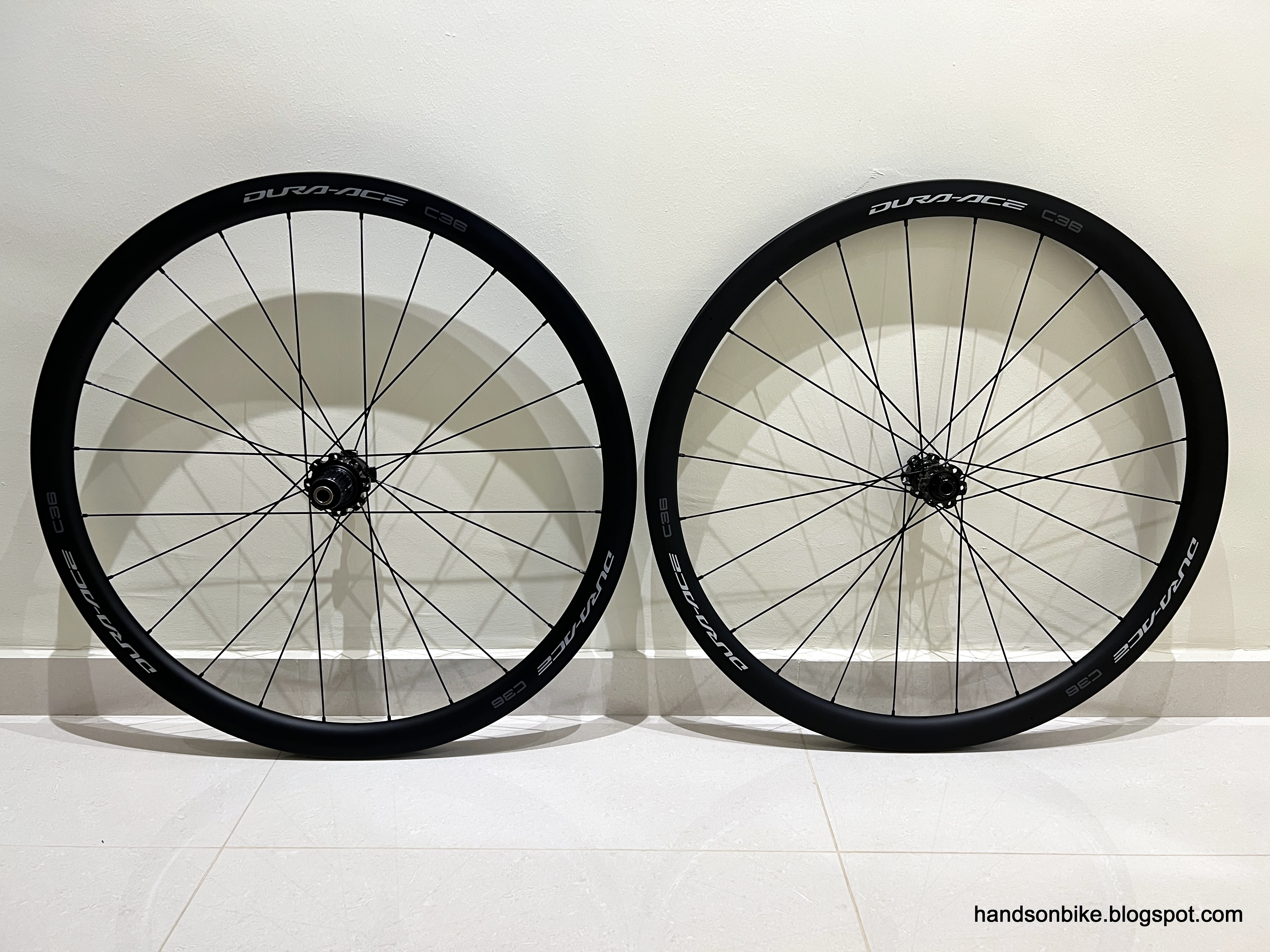
This time, I got the Dura-Ace C36 wheelset, which is exactly the same as the C50 wheelset, except for the lower 36 mm rim profile. Due to the lower profile, the wheelset will be lighter. Check out the details below.

Dura-Ace C36 R9270 wheelset

Dura-Ace wheelsets are available in 36, 50 and 60 mm rim profiles. The C36 is the lightest but also least aerodynamic.

Saturday, December 24, 2022

Specialized Aethos: S-Works SL Stem and PRO Vibe Superlight Handlebar

In the earlier posts about the Specialized Aethos, I have shared some information about the frame, fork and other small parts that come with the frameset.

As the Aethos is designed to use a standard stem and handlebar, with no integrated cable routing at the front, it means that I am free to choose a stem and handlebar to use. I like it this way as I am not a fan of integrated cockpits. Although it looks very neat and clean, it takes a lot of effort to assemble this kind of integrated cockpits. If you leave this job to the experienced bike mechanics at the shop, it is not an issue for you. However, if you prefer to work on your own bikes, I would definitely prefer to have a non-integrated front end that I can work on easily.

For a lightweight build, the weight of every part needs to be considered carefully, as every gram counts. I have considered using super lightweight parts from Darimo, but the price is just too high for me to accept, at $750 for a handlebar and $650 for a stem. An alternative is to use Specialized own stem, which is pretty lightweight. It also matches the S-Works frameset which is a nice touch as well.

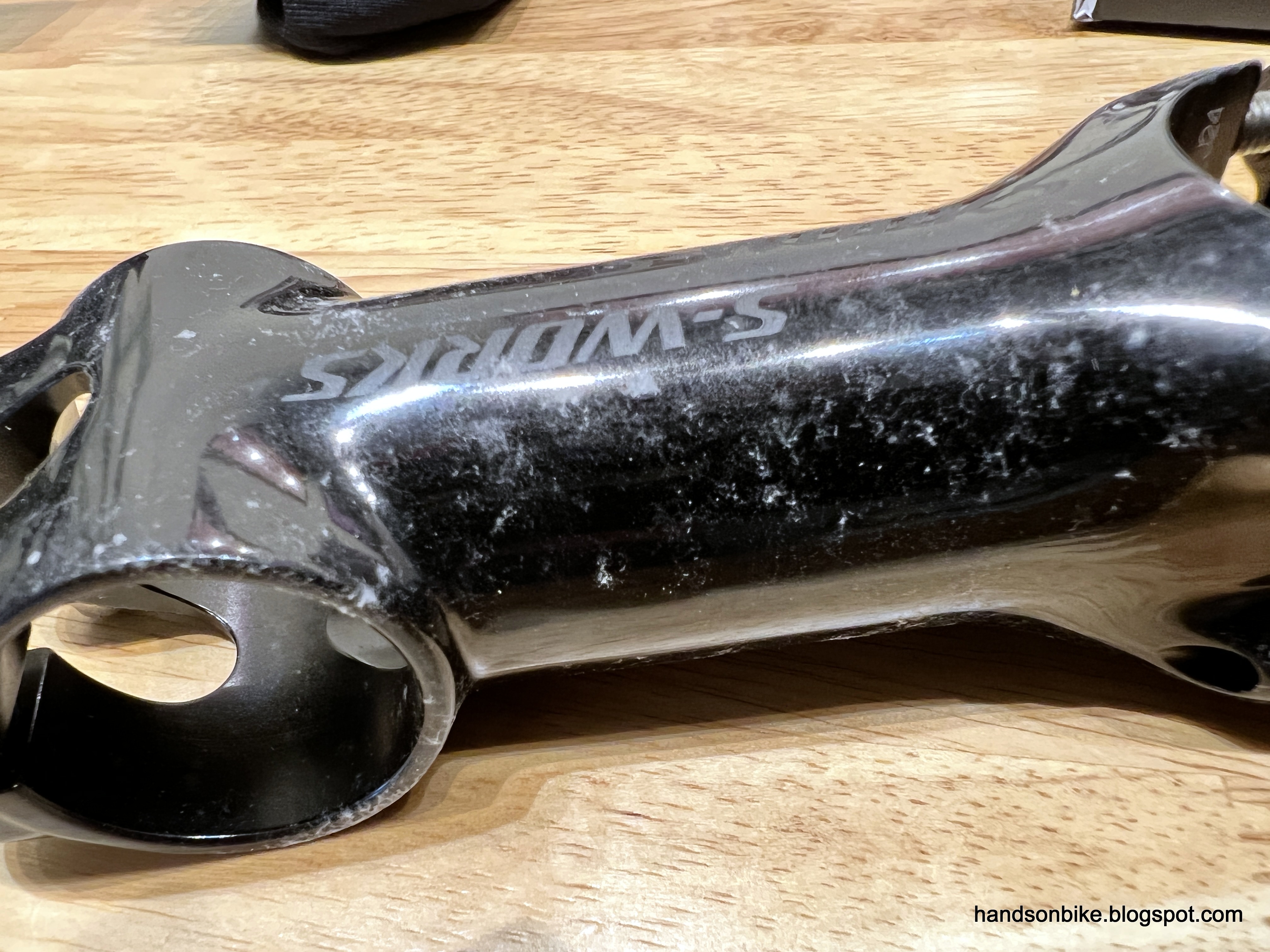
Specialized S-Works SL Stem, ordered online from the Singapore Specialized store.

I was surprised to see how moldy it is straight out of the box!

Thursday, December 15, 2022

Specialized Aethos: Front Brake Caliper Adapter and Disc Rotors

The Specialized Aethos uses mostly standard components and specifications. For example, it uses a standard threaded bottom bracket and round seat post on the frame. There is no internal routing around the head tube and steerer tube of the fork as well.

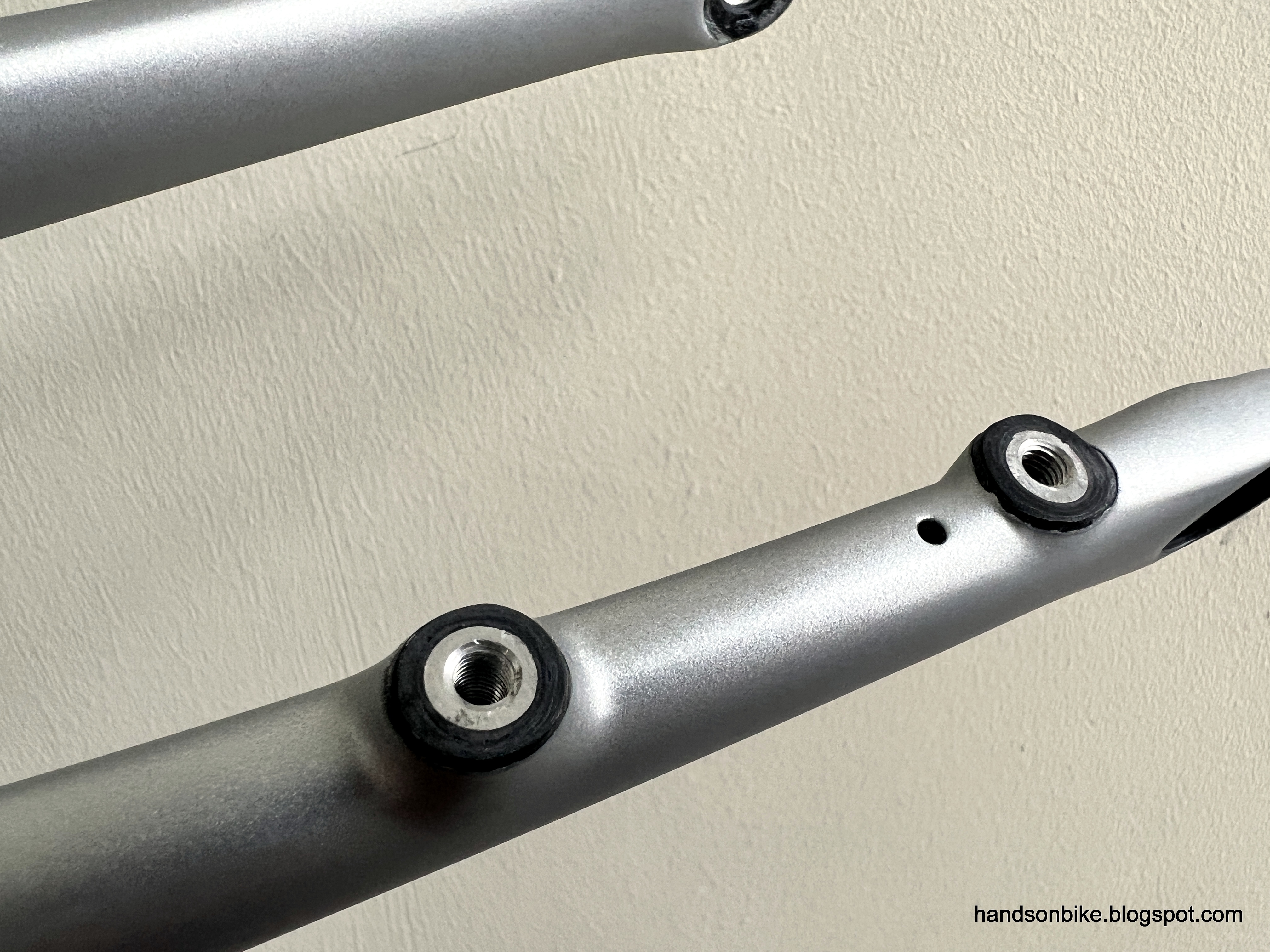
However, there is one non-standard design on the fork, which is the disc brake mounting area. Although it uses a flat mount brake design, the distance between the holes are not the flat mount standard.

According to Specialized, the holes are closer than the usual flat mount standard, so that they can make the end section of the fork leg hollow, in order to save some weight. Not sure if it is worth it to make this non-standard design, when most other areas are standard.

Flat mount holes on the front fork, where the hole to hole distance is closer than usual.

Special flat mount adapter (top) supplied with the Aethos frameset, and it means only a 160 mm front rotor can be used.

Specialized Aethos: Thru Axles, Roval Seatpost and Di2 Battery

On the Specialized Aethos, there are many high end components used, with the main objective being to make the bike as lightweight as possible.

Starting with the super lightweight sub-600 gram frame and sub-300 gram fork, even the fork expander plug is designed to shave off every gram possible. To continue with this lightweight theme, the other parts on the bike are also designed or chosen to be lightweight.

In the previous posts on the frame and fork, I shared that the thru axles are designed to rest inside a countersunk, giving a seamless look on the outside of the frame. To do so, the thru axles need to have a chamfered head to match, as shown below.

Aethos 142x12 mm rear thru axle, only 29 grams.

Aethos 100x12 mm front thru axle, only 22 grams.

Saturday, December 3, 2022

Specialized Aethos: Headset, Spacers and Expander Plug

Joining the Aethos frame to the Aethos fork is the headset and other small parts around the headset. As mentioned earlier in the posts, the Specialized S-Works Aethos uses an integrated headset design, with the bearing races already molded directly into the head tube of the frame, and steerer tube of the fork. This eliminates any extra headset bearing races that needs to be pressed into the frame, such as on the Fnhon Gust or Fnhon Tornado frames.

Headset bearing races already molded into the head tube, at the top and bottom.

The frameset includes the headset bearings, and here are some pictures of it. Good reference for the future when a new replacement bearing needs to be sourced.

Headset top bearing, with 1 1/8" inner diameter and a 45 degree chamfer.

Thursday, December 1, 2022

Specialized Aethos: S-Works Fork

Previously, I showed the Aethos frame, which is part of the Specialized S-Works Aethos frameset. Now, let's look at the S-Works Aethos front fork. This fork is included in the frameset, along with the frame and seat post.

Being an S-Works fork, I expect it to be lightweight as well. At this price range, it is a given that the fork has a full carbon steerer tube for minimum weight. 

S-Works Aethos front fork, with a long carbon steerer tube.

Tuesday, November 29, 2022

Specialized Aethos: S-Works Frame

Time to build a new bike! I have been reading about the Specialized Aethos, and it seems to be an awesome bike that is different from others. Some of the features that attracted me:

1) Rides very well without being overly stiff nor flexible.
2) Extremely lightweight frameset, especially for a mass produced carbon frame.
3) Non-integrated cable routing at the stem and headset area, for easy maintenance.
4) Threaded bottom bracket for easy servicing.
5) Conventional round seat post, with external seat post clamp.

After doing lots of research, I decided to buy the frameset from the local Specialized dealer. I was able to find the colour that I wanted (Satin Flake Silver/Red Gold Chameleon Tint/Brushed Chrome), or Champagne colour in short.

With this bike, I can go full weight weenie, and source for components that are of high quality and also lightweight. Starting with the frame, follow me on this bike build process!

Specialized S-Works Aethos frame! No large S-Works logo splashed across the down tube.

The colour looks like pinkish champagne, which is very unique as I have not seen it on other bikes before.

Saturday, November 26, 2022

Cervelo Aspero: PRO PLT Carbon Road Handlebar

On the Cervelo Aspero gravel bike, I have been using the PRO Vibe Aero Superlight handlebar since the beginning. At that time, the plan was for the Aspero to serve as a dual purpose road and gravel bike, as seen from the two wheelsets that I had.

Later on, after I got the Focus Paralane as a road bike, the Cervelo Aspero was converted to be a dedicated gravel bike with a front single drivetrain. One of the more recent change was to GRX Di2 shifters which work really well for gravel riding.

All the while, the handlebar used was the PRO Vibe Aero Superlight handlebar, which is OK for road riding but not really ideal for gravel. I have some issues with the design of the PRO Vibe handlebar, such as the teardrop bar shape in the drops, and the non-compatibility with standard Garmin computer mounts.

Therefore, after much consideration, I decided to change the handlebar to a more conventional round type, to improve the ergonomics and avoid all the downsides of the PRO Vibe Aero handlebar.

At the same time, I wanted to avoid or minimize the internal routing needed, as it takes more work to route hydraulic hoses and Di2 cables through the handlebar.

Finally I chose the PRO PLT Carbon Handlebar, which is relatively lightweight, with less internal routing and a normal round clamp section on top.

New PRO PLT Carbon Handlebar

Wednesday, November 23, 2022

Shimano Hydraulic Disc Brake Pads: Resin vs Metal, With and Without Cooling Fins

Here is a detailed blog post comparing the different brake pads made by Shimano, for their hydraulic disc brakes. With many model numbers used for the different brake pads, it is confusing for almost everyone.

However, after studying and comparing many different brake pads, I think I have got it figured out. Each brake pad has a specific model number, such as L03A, or K05Ti, etc.

Breaking down this model number into the different parts, using L03A Resin as an example.

L: Shape of brake pad, to match different brake calipers.
03: Version of brake pad. Different revisions are cross-compatible if the other parameters are the same.
A: Aluminium backing material.
Resin: Resin material used for the pad, to reduce noise.

First letter denotes the shape of brake pad. L is the finned brake pad used for road brake calipers.
Other letters that I have seen are K (similar shape and compatibility as L, but without fins) and H (4 piston brake pads). There is also the J and G type for other brake pads, just to name a few.

This is followed by a number, usually 02, 03, 04, 05 and so on. It is just the revision number of this brake pad design. For example, L02A was recently replaced by L03A, which has a more durable resin pad material. Different revisions are compatible as the pad shape is unchanged.

After the number, the letter refers to the backing material. The backing is the plate that the brake pad is attached to. This can be made with aluminium, steel or titanium.
A: Aluminium
S: Steel
Ti: Titanium
C: Combined

Final part of the model number refers to the pad material, whether it is made of resin or metal.

With different backing materials, different pad materials, and different shapes, it gives rise to many different combinations and thus many different options. In fact, I think there are too many variations which makes it very confusing.

Here are 5 different brake pads that I have, to match different brake calipers.
Sunday, November 20, 2022

Dura-Ace Crankset Comparison: R9100 vs R9200 plus others

When Dura-Ace was refreshed from 11 speed to 12 speed, the crankset was changed as well. However, what I noticed was that the new R9200 crankset is actually heavier than the old R9100 crankset, and not by a small margin.

By comparing the individual parts of the crankset, we can see what are the parts that contributed more to this weight increase. Both of the cranksets have 50/34T chainrings, and are of 165 mm crank arm length.

At the end of this post, a brief comparison with even older Dura-Ace cranksets will be made. I kept some of these old parts of Dura-Ace crankset, just for collection's sake. For other comparisons, such as 9000 vs R9100, check this out.

Dura-Ace R9100 right crank arm, 303 grams.

R9200 right crankarm is 38 grams more, at 341 grams. Quite a substantial increase.