Saturday, February 16, 2019

Strider 12 Sport Balance Bike

One of the most popular push bike for kids is the Strider, which is famous for their well designed kids bikes. On a recent trip to Japan, I came across the Strider at BIC Camera, with a wide range of colours and types. Since there was a sale, the final price was substantially lower than if I bought it in Singapore. Therefore, I brought it back from Japan for my kid!

I believe that push bikes are better for kids who are learning cycling, as the emphasis is on learning to balance on two wheels, instead of relying on the extra two training wheels. When I see kids on bikes with training wheels, they are often leaning on one side, using the training wheel as support while cycling. Although this allows them to cycle easily, it does not provide the opportunity for learning how to balance on a bike.

The Strider came in a small box, with the bike disassembled. As you can see below, some assembly is necessary. If you are mildly technically inclined, it should not be an issue at all. Let's take a look at some of the features!

Fresh out of the box! Just need to put in the front fork, handlebar and seat post. The extra seat post on the bottom right is for taller kids.

It is very easy to assemble, just put in the parts and use the quick release levers to tighten them.

Solid tires with 5 spoke resin wheels. These are 12" wheels.

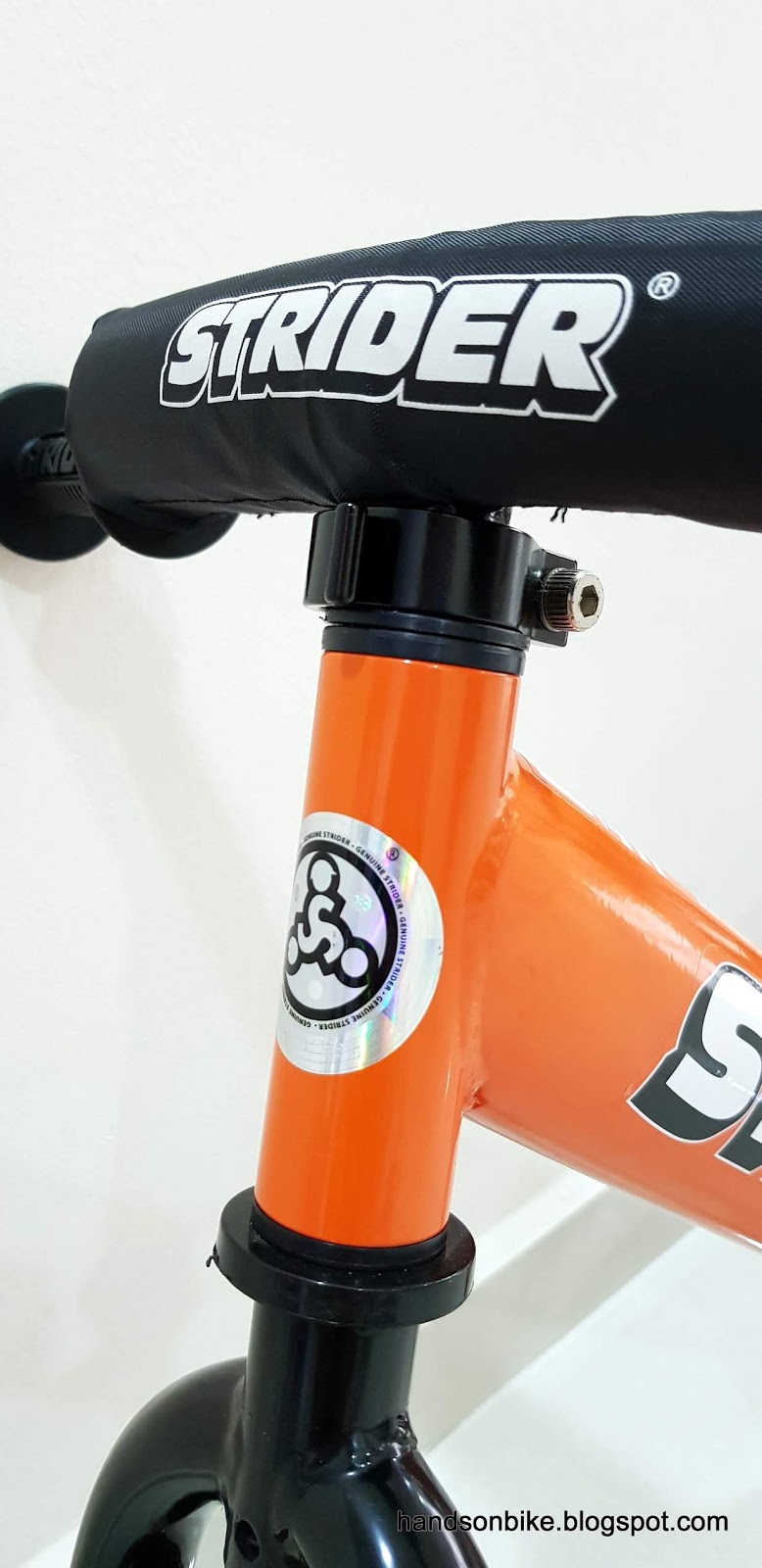
Instead of using bearings, the headset is just a bush type, as the load is not high. This saves some weight too. I lowered the handlebar all the way down.

The grip diameter is extra small, for the small hands. This is one of the unique features that not many kids bikes have.

A cushioned wrap across the handlebar prevents the head or face from hitting the handlebar hard.

Japanese wording on the top tube. This is a Sport model, which has some newer features that the Classic does not have.

Saddle can be set really low if needed, which is useful if you want to start your kid early. A quick release seat post clamp makes it really easy to adjust the saddle height.

Saddle shape is shaped and sized for kids

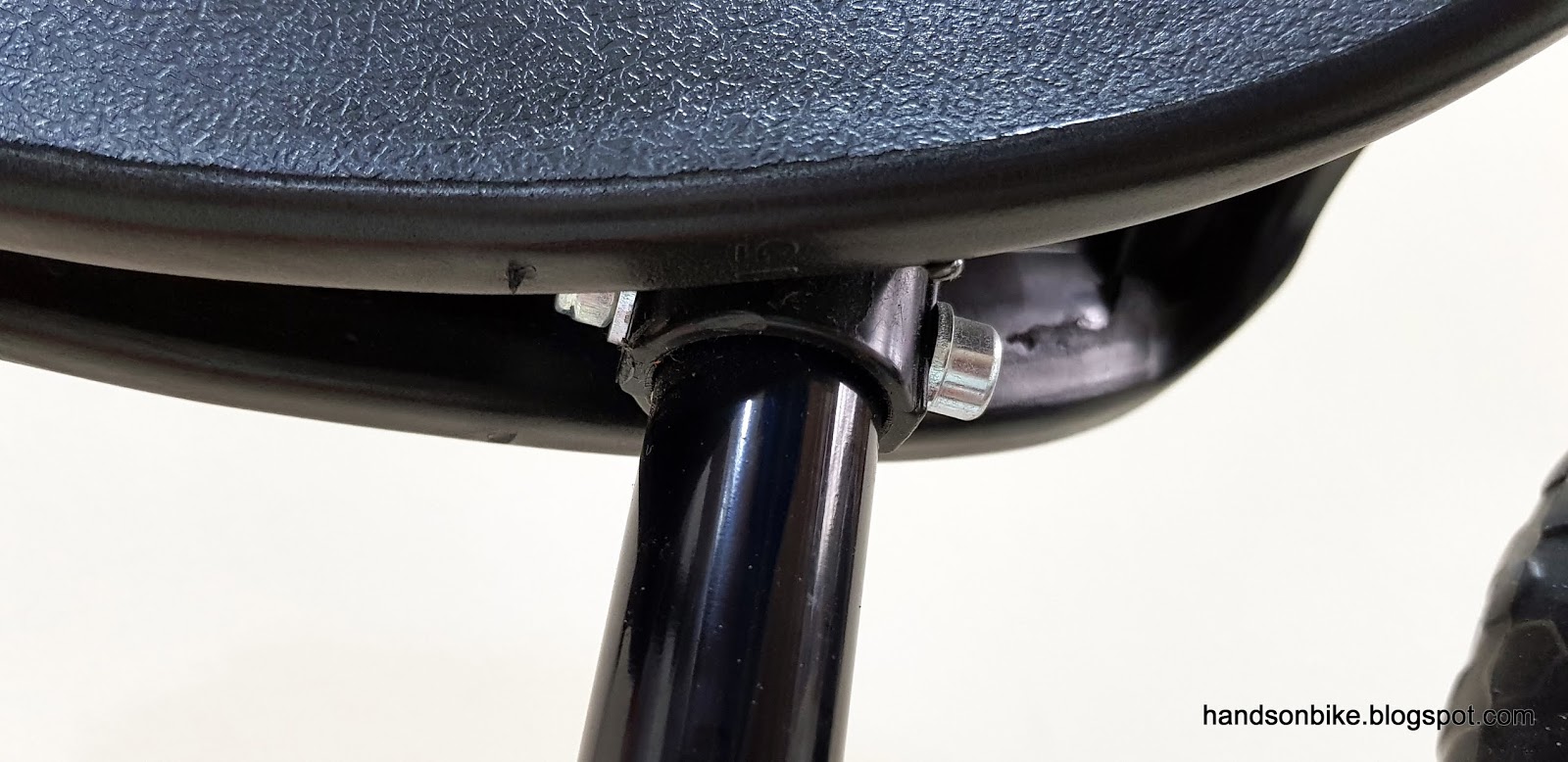
No angle or fore/aft adjustment possible, as the saddle simply clamps to the top of the seat tube.

Chain stays with black grip tape, this area is for the kid to rest the feet on when they are cruising.

Pretty well designed kids bike, with some nice features such as a small diameter handlebar and a seat height that can be adjusted easily.

The whole bike is only 2.9 kg, so it can be easily lifted or put down by a kid. So far, the training progress is slow as the kid still does not know how to push off with both legs simultaneously. Now, it is more of running while seated on the bike, which is also fine as they are learning how to balance on two wheels.

The Strider can be a bit pricey, even with a discounted price. There are cheaper ones such as those from Decathlon, but the adjustment range is not so big while it is also heavier.

Sunday, February 10, 2019

S-Ride vs SRAM: 12 Speed MTB Groupset

In the recent few months, 1x12 speed MTB groupsets have become more popular and commonplace. It all started with the SRAM Eagle groupset a couple of years ago, followed by a few other upgrade kits by smaller manufacturers. Late last year, Shimano finally followed with a 12 speed XTR groupset.

On my Polygon Cozmic CX3.0 MTB, I have tried the S-Ride 12 speed upgrade kit, and also the SRAM NX Eagle 12 speed upgrade kit. The links showing the bike build can be found here.

Polygon Cozmic CX3.0 with S-Ride 1x12 Speed
Polygon Cozmic CX3.0 with SRAM NX Eagle 1x12 Speed

These two groupsets are actually very similar in terms of specifications, but the SRAM NX Eagle upgrade kit is slightly more expensive. Let's do a quick comparison of the 12 speed components!

For a 1x12 speed setup, there are only a few components to take note. The main component is definitely the 12 speed cassette, with super wide range cassettes the main selling point. The rear derailleur design is also important, as it has a really tough job to ensure good shifting across the wide gear range. A narrower 12 speed chain is needed to fit between the more closely-spaced sprockets. Finally, the shifter needs to shift across 12 gears accurately and efficiently.

S-Ride Cassette
S-Ride 12 speed cassette, with a 11-50T range. Only the top 2 sprockets (11T and 13T) are loose, the remaining 10 sprockets are riveted together.

Standard Shimano 9 spline design enables this cassette to be retrofitted onto almost all older 8/9/10 speed MTB rear hubs.

Red aluminium spider makes this cassette stand out. This spider reduces weight and improves the stiffness of the larger sprockets.

4 sprockets are riveted to the aluminium spider. Last 2 sprockets are offset towards the non-drive side, overhanging the drive side flange of the rear hub.

S-Ride 11-50T 12 speed cassette weighs 596 grams, which is heavy compared to higher priced cassettes that weigh less than 400 grams.


SRAM NX Eagle Cassette
SRAM NX Eagle 11-50T cassette looks to be more lightweight, with the large cutouts on the sprockets. 

The 4 largest sprockets are riveted to the stamped/forged aluminium spider.

The remaining 8 sprockets are loose, which makes it easier to remove and clean thoroughly. I like the design of the cutouts which look like sport rims of cars.

Unfortunately, the SRAM NX Eagle 11-50T 12 speed cassette actually weighs more, at 613 grams.


S-Ride Rear Derailleur
S-Ride 12 speed rear derailleur with clutch weighs 265 grams, which is quite good.

Top and Low limit screws are located on the Outer Link. It is not of a low profile design unlike the Shadow construction of Shimano MTB rear derailleurs.

Resin cable guide to route the inner cable, similar to the design of SRAM MTB rear derailleurs.

Long cage rear derailleur with a small offset for the guide pulley. Both pulleys are 11T.


SRAM NX Eagle Rear Derailleur
SRAM NX Eagle rear derailleur weighs much more at 339 grams. 

Includes a Type 3 (version 3) clutch in the rear derailleur. Only Shimano Shadow+ rear derailleurs have an adjustable clutch resistance.

Cable roller and cable guide to route the inner cable to the cable fixing bolt.


Cage length seems to be shorter than the S-Ride. 12T guide pulley and 14T tension pulley. Large guide pulley offset to reach the larger sprockets.


S-Ride Shifter
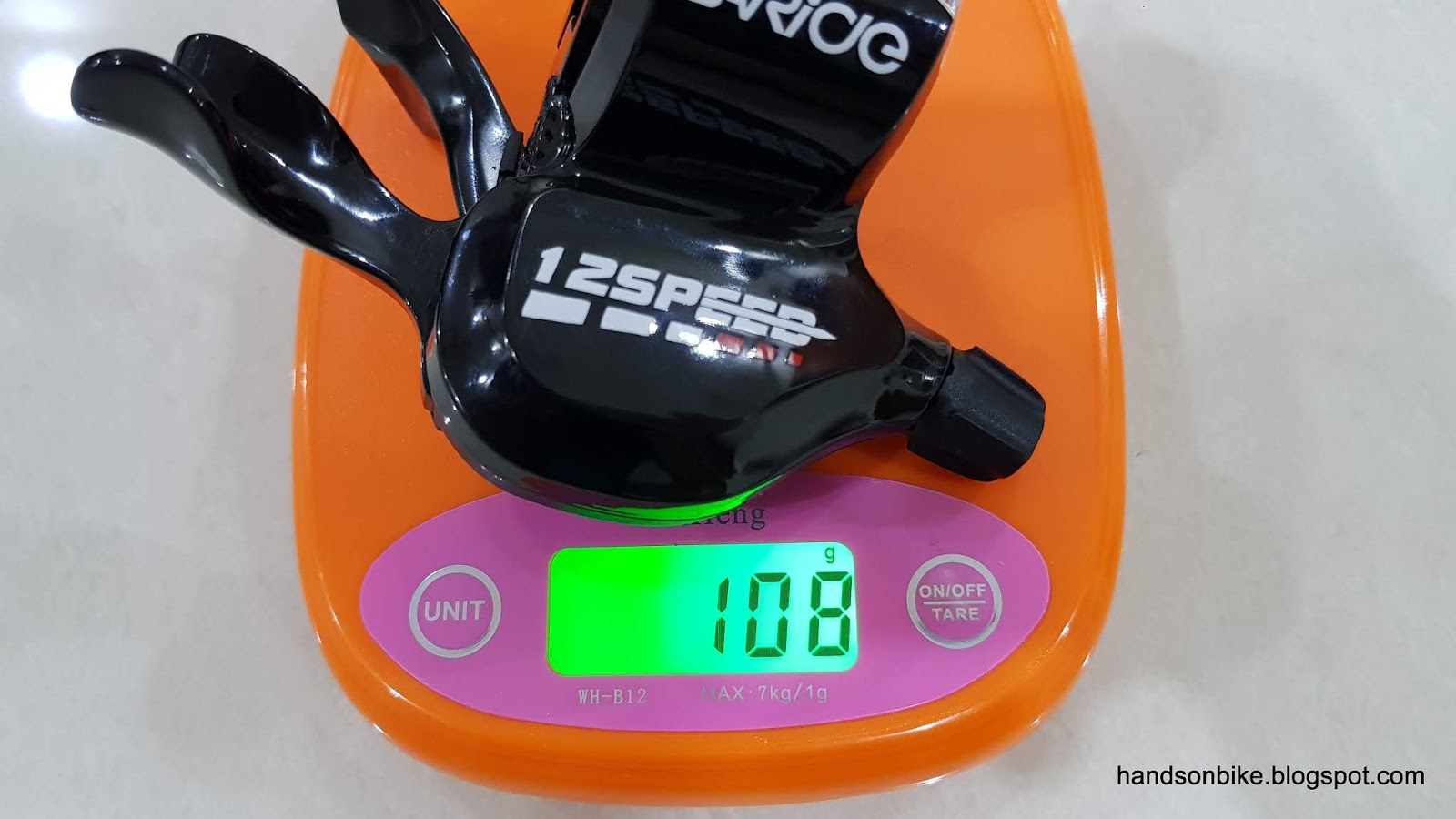
S-Ride 12 speed shifter, with 2 way release lever. Just 108 grams!

Even though it is lightweight, the gear display is already included! Useful if you tend to get lost in the large number of gears like me.

Bottom view of the S-Ride shifter looks so much like a SRAM shifter.


SRAM NX Eagle Shifter
SRAM NX Eagle 12 speed shifter has a detachable clamp band.

With the clamp band installed. Clamp band looks very lightweight! No gear display on SRAM MTB shifters.

Resin levers makes this SRAM NX Eagle shifter even lighter than high end SRAM shifters which have aluminium main levers.

Weighs exactly the same as the S-Ride shifter, even though there is no gear display.

Based on this comparison, the S-Ride upgrade kit is more lightweight than the SRAM NX Eagle upgrade kit! The shifters weigh the same, while both the cassette and the rear derailleur of the S-Ride groupset weigh less than that of the SRAM NX Eagle groupset. I assume that the chain weight is the same.

S-Ride Rear Derailleur, Cassette, Shifter: 969 grams
SRAM NX Eagle Rear Derailleur, Cassette, Shifter: 1060 grams

The SRAM NX Eagle does have a more low profile rear derailleur, and a shifter that feels slightly better than the S-Ride shifter. Which groupset is better depends on your priority.

If your priority is on a very affordable 12 speed upgrade kit, the S-Ride is the better choice. Not only is it cheaper, as a bonus, it is also more lightweight! However, the SRAM NX Eagle components does look and feel better engineered than the S-Ride components, although it comes at a higher price.

Sunday, February 3, 2019

Polygon Cozmic CX3.0: SRAM NX Eagle 1x12 Speed

Not too long ago, I installed the 1x12 speed S-Ride groupset onto the Polygon MTB to test it out. It was always intended to be a temporary installation, until the next interesting groupset comes along. As you may have realized, my Polygon MTB is being used as a test bike, where I will install new setups on it for test riding, before swapping it for other components later on.

It came stock as a 3x10 speed setup, which I changed to 2x10 speed. After that, I tried 1x11 speed, followed by 1x10 speed and then the S-Ride 1x12 speed. Now, I shall try the SRAM NX Eagle 1x12 speed upgrade kit!

Installation is straightforward, very similar to the S-Ride 1x12 speed upgrade kit. The 11-50T 12 speed cassette also uses the standard Shimano spline design, which means it goes straight onto the stock rear hub without any issues. That is the benefit of using the original spline design, which makes it really easy to upgrade older bikes such as mine.

SRAM NX Eagle rear derailleur, with a clutch. The clutch mechanism is not very strong though.

SRAM NX Eagle 12 speed cassette, 11-50T. Plenty of range and gears!

Drivetrain setup, still using the front single Shimano SLX M7000 34T crankset.

SRAM NX Eagle 12 speed shifter, paired with the Shimano Deore M615 hydraulic brake levers.

Shifter clamp band position is adjustable, and I had to set it up this way as there will be interference between the shifter and brake lever clamp bands.

The upgrade kit consists of the rear derailleur, cassette, chain and shifters. All other components such as the crankset or the brakes are unchanged as they are still compatible.

At the same time, I decided to swap the brake rotors, from the previous RT81 rotors to the nicer looking RT99 brake rotors. These RT99 brake rotors were taken from the Avanti Inc 3 when I changed to the Fabike C3. Before the Avanti Inc 3, these RT99 brake rotors came stock with the Canyon Endurace road bike. As you can see, it is nice to have cross compatibility across different bikes as it is easy to swap components without fuss.

160mm RT99 brake rotor on the front wheel

Similar 160mm size brake rotor on the rear wheel.

View of the full bike with SRAM NX Eagle 1x12 speed components!

Once again, with a different 1x12 speed setup, I can test out the components and compare it with the S-Ride 12 speed groupset.

On the first ride off road, something strange happened to the SRAM NX Eagle shifter. The first click of the shifter could not engage, meaning that to perform a shift, I had to push the main lever a long way until the second click, before it could shift.

After dismantling the shifter, I could not find anything wrong with it. Upon reassembling, it worked normally again. Seems that something inside was misaligned or jolted out of place when I went off road, and the reassembly aligned everything properly again. Not ideal as a MTB shifter needs to withstand off road riding without malfunctioning.

Other than that, everything else worked fine. The new and slightly wider Maxxis tires work well, while the new ODI Rogue grips also feel comfortable. Overall, the shifting feeling and performance of the SRAM NX Eagle groupset feels better than the S-Ride groupset.

Saturday, January 26, 2019

Java Neo 2 vs Dahon MuEX

How does the Java Neo 2 folding bike compare to other folding bikes? After introducing the main features and specifications of the bike in Part 1 and Part 2, let us now compare it with another bike. In this case, it is fair to compare it with a Dahon folding bike as both bikes are using 20" 406 wheelsets.

For comparison, I used the Dahon MuEX as that is the only 20" folding bike that I have currently. For those who know, the Dahon MuEX is a high end Dahon folding bike, with many top level and lightweight components. However, for this comparison, I will not be comparing the bike weight or components specifications, as components can be changed easily. Furthermore, it is not fair to compare the stock components of the Java Neo 2 to the upgraded components of the Dahon MuEX.

What I will compare is generally the bike geometry and size, plus other features such as ease of folding. The Dahon MuEX geometry will be representative of most other 20" Dahon folding bikes. First, let's look at the wheelbase and overall length of these two bikes.

Same as for other bike geometry comparisons, I used the centre of the bottom bracket as the datum for aligning the bikes.

Chain stay length of the Dahon MuEX is slightly longer than the Java Neo 2, by about 10mm.

Distance from front hub to bottom bracket is also longer on the Dahon MuEX, by about 25mm.

Bottom bracket on the Java Neo 2 is higher than the Dahon MuEX, which is quite unusual. This might be due to the folding rear triangle design which requires this.

What this means is that the wheelbase of the Java Neo 2 is shorter than the Dahon MuEX, while the bottom bracket is higher. This means less stability on the Java Neo 2 as the wheelbase is shorter, while the centre of gravity is higher due to the higher bottom bracket.

Java Neo 2
Chainstay length: 390mm
Wheelbase: 985mm
BB height: 310mm

Dahon MuEX
Chainstay length: 400mm
Wheelbase: 1020mm
BB height: 284mm

Height of top tube (or main frame) is about the same at the head tube area. However, the Dahon MuEX frame curves downwards near the seat tube. This means that step over height is about the same.

How about the folded size? This is a very important factor as a folding bike needs to fold easily and compactly, in order to justify the higher weight and cost compared to a non-folding bike of the same specifications.

When folded, the Java Neo 2 is about the same length, but is quite a bit taller, due to the long seat post and the high seat tube. This is a big issue for me as I cannot fit the Java Neo 2 upright into the back of the car, unlike the Dahon MuEX.

For folded width, both bikes are about the same, even though the Dahon MuEX handlepost folds inwards while the Java Neo 2 handlepost folds outwards.

Up till now, we can see that the Java Neo 2's folded size is taller than the Dahon MuEX, even though it has an innovative new folding design. In my opinion, if a new folding design does not result in a more compact fold or easier fold, what is the point? It may be cool or interesting to have a new folding method, but it has to be at least equal in size to the market standard, which is the Dahon fold.

If a new folding method results in a smaller folded size, it may be acceptable to have a more complicated fold. Or, if the folded size is larger, but is easier to fold, it may also be acceptable. Some other folding bikes also have a larger folded size plus a more complicated fold, but they have other features. For example, the Birdy fold is larger and more complicated than a Dahon, but it has full suspension. A Tyrell FX also folds larger and is more complicated than a Dahon, but it rides very well due to the rigid frame.

However, in this case, the Java Neo 2 has a larger folded size, plus a more difficult fold (refer to Part 2), with no other feature that makes it better than a Dahon.

Let's check out the weight of some stock components. From what I see, the handlepost can be easily upgraded to a more lightweight type (non-adjustable), while the handlebar components (shifters, brake levers, grips) are more or less standard with similar weight no matter what you upgrade to.

The stock crankset is a square taper type, which is quite heavy. Upgrading to a Hollowtech II type of crankset and bottom bracket will save quite a bit of weight. The exact weight is not known as I will not be disassembling those parts.

However, other components that are easily removed will be weighed, such as those shown below.

Weight of super long seat post (650mm) plus stock saddle is 761 grams. In comparison, a Litepro seatpost (320g) plus a mid range saddle (230g) will weigh just 550 grams.

Weight of high profile front wheel (wheel + tire + tube + rotor + QR axle) is 1639 grams. In comparison, a Wheelsport Smart front wheel (584g) + Kojak (230g) + tube (100g) + rotor (125g) + QR axle (50g) will be just 1089 grams. Much room to save weight here.

Weight of high profile rear wheel (wheel + tire + tube + rotor + QR axle + cassette) is 2083 grams. In comparison, a Wheelsport Smart rear wheel (793g) + Kojak (230g) + tube (100g) + rotor (125g) + QR axle (65g) + cassette (300g) will be just 1613 grams.


From this, we can see that the stock high profile wheelset is quite heavy. Changing to a mid range Wheelsport Smart 1.0 wheelset plus better Kojak tires would save you 1 kg, while keeping the other parts the same. If you spend more for high end parts (lightweight wheelset and tires, titanium QR axles, etc), you can save another 300 grams or so from just the wheelset.

With these weight estimates of the various bike components, plus the weight of the overall bike, I was able to make a rough estimate of the frame weight (main frame + rear triangle only). This is just an estimate as I do not have the exact weight of many other components, but it should be around this range.

Full bike weight is 12.3 kg without pedals in stock condition. After deducting the weight of all the components, the estimated frame weight is 3.6 kg. This does not include the front fork. For comparison, the other bike frame weights are shown below. Some of these weights include the rear derailleur hanger or seat post clamp, or the headset weight, so the comparison is not exactly accurate, but the general trend is there.

Frame only weight estimates (excluding fork)
Java Neo 2: 3600 grams
Dahon MuEX/MuSP: 2400 grams
Crius AEV20: 2440 grams
Java Freccia: 1060 grams
Canyon Endurace: 807 grams
Fabike C3: 1296 grams


Note that the Java Freccia, Merida Scultura 5000, Canyon Endurace, and Fabike C3 are carbon frames, while the others are aluminium frames.

From this frame weight comparison, we can see that the weight of the Java Neo 2 is not competitive at all, being much heavier than the aluminium Dahon frame. The carbon frame version of the Java Neo will weigh less, but it will also cost a lot more.

Disadvantages of Java Neo 2 compared to Dahon
1) Taller folded size.
2) Long seat post is necessary for folding, cannot change to shorter and lighter seatpost.
3) Frame is heavier than Dahon.
4) Folding and unfolding steps is awkward.
5) Some lateral flex (between seat tube and rear triangle) at rubber stopper area.
6) Not possible to change to 451 wheels as it will affect the folding.

Advantages of Java Neo 2 compared to Dahon
1) Drivetrain is tucked inside when folded.
2) Can lay the frame down on the side easily, ideal for putting into car boot lying down.
3) Frame folding lever is nicely integrated into the frame.

My initial intention of getting the Java Neo 2 folding bike was to see if it is good enough to replace the Dahon MuEX. If it was, I planned to transfer all the compatible components from the Dahon MuEX to the Java Neo 2. However, after comparison, the Java Neo 2 loses out to the Dahon MuEX in almost every aspect. Note that I did not compare the components specifications, just mainly the frame weight, the folded size, and ease of folding.

The conclusion for me is that the Java Neo 2 is not good enough to replace the Dahon MuEX. On its own, the Java Neo 2 is a decent folding bike. With its unique folding design and sharp appearance, it looks quite good. However, in my case, it is not better than a Dahon in terms of weight, folded size or ease of folding.